Yoga Pose Library
Browse by concern, family & difficulty
Yoga & Science
Why yoga works — stress, sleep, posture & recovery
Browse by concern
 For shallow-sleep nights, easing body & mind
Guided Meditation Videos
5–10 minutes · Watch anytime
Wellness Articles
Browse by concern
 Premium Restless nights
Sleep Arrives on the Exhale: 4-7-8 Breathing for Rainy Nights
The rain has been falling since evening, and now you are in bed, wide awake. Your body feels heavy, your eyes are tired, and yet your mind keeps circling the day. If the rainy season fills your nights with this restless, foggy wakefulness, you are far from alone. Tonight, instead of trying harder to fall asleep, try giving your mind one simple job: counting your breath. The 4-7-8 method is a quiet practice rooted in pranayama, the yogic art of breath regulation — and you can do the whole thing without leaving your bed. Why Rainy Nights Feel Different Many people notice that on low-pressure days the body wants to rest but the mind will not switch off. You lie down exhausted, and somehow become more alert the moment the lights go out. The harder you chase sleep, the shallower and faster your breathing tends to become — which is precisely the breathing pattern of staying awake. Add the white-noise hum of rain and a duvet that feels a touch too humid, and it is no wonder June nights can seem longer than they should. Here is the small insight at the heart of the 4-7-8 breath: the exhale is twice as long as the inhale. A long, slow out-breath is something many practitioners find supportive for easing toward rest mode. And the rain outside does not have to be the enemy. Its rhythm is steady and patient — let it become the backing track for your counting. The 4-7-8 Breath, Step by Step Start with the detail most people skip: the tongue. Place the tip of your tongue gently against the ridge of gum just behind your upper front teeth, and keep it there for the entire practice. This anchors the mouth and gives the exhale its soft, whooshing sound. First, exhale once completely through your mouth, making an audible whoosh and emptying your lungs. Close your mouth and inhale quietly through your nose for a count of four. Hold your breath for a count of seven. Exhale through your mouth, whooshing softly, for a count of eight. That is one cycle. Do four cycles, then stop. Even once the practice feels familiar, cap a single session at eight cycles. This is not a "more is better" technique — what matters is the ratio, not the volume. About that ratio: the counts do not need to be seconds. Keep the 4:7:8 proportion at whatever tempo feels comfortable. If holding for seven is a strain, halve everything — two, three and a half, four — and grow from there. And if you feel light-headed at any point, simply return to normal breathing and rest. Dizziness is your body asking you to slow down, not a wall to push through. One practical note before you begin: put your phone out of reach and dim the lights. Counting holds your attention far better in a dark, quiet room. Positions You Can Take Without Getting Up You do not need to sit up cross-legged for this practice. In fact, staying in your sleeping position is the point. Lie on your back with your knees bent, or slide a pillow under your knees to soften the lower back. Rest one hand on your belly and one on your chest. As you inhale, feel the belly hand rise first. If lying on your back is uncomfortable, turn onto your side and hug a pillow; it gives the chest room to soften. Pull the duvet up to your chest rather than over your shoulders, so the breath has somewhere to go. Check your shoulders and jaw before you start. If they are holding tension, squeeze your shoulders up toward your ears once, then let them drop completely. And when the four cycles are done — do nothing. Resist the urge to check whether it "worked." Keep your eyes closed, let the rain keep its rhythm, and allow your breath to drift back to its own pace. Sleep is not something you chase; it is something you make room for. Into Today's 45 Minutes Counting your own breath while also letting go of effort is surprisingly hard to do alone — in our live classes, the teacher watches your breathing and carries the count for you, so all you have to do is follow. On a rainy night, those 45 quiet minutes might be exactly the room your sleep has been waiting for. This article is general wellness information, not medical advice. If you have pain or a medical condition, consult your doctor before practising.
Reset Yoga Editorial Team →
 Premium
 Stress relief Restless nights
3 Minutes of Breath to Switch the Body Into Sleep Mode
If you want a simple bedtime breathing method, this is enough: Inhale through the nose for 4 counts, exhale through the nose for 6 counts, for 3 minutes. Three essentials: At night, the exhale matters more than taking a huge inhale A longer exhale helps shift the body toward “sleep mode” Do not judge whether it “worked” immediately — let it become a signal, not a task In short: You do not need a long sleep ritual. You need a short breathing pattern that tells the body it is safe to let go. 3 Minutes of Breath to Switch the Body Into Sleep Mode A simple bedtime breathing pattern that works without being long — even for complete beginners There is a particular cruelty to the sleepless night. You are tired enough to know you need rest. But the moment you lie down, the mind becomes brighter than it was an hour before. The room is dark. The body is horizontal. Yet thought continues — unfinished conversations, tomorrow’s tasks, small future worries enlarging in the silence. At that hour, many people believe the answer must be something complicated. A longer routine. A more advanced sleep practice. A better ritual. A more disciplined evening. But often the body does not need something elaborate. It needs something legible. What the sleepless body often needs is not a heroic effort, but a short, repeatable signal that it is finally safe to power down. Breath is one of the clearest ways to send that signal. And it does not need to take long. Three minutes can be enough to begin. Sleep is not something the body can be ordered into. The more a person tries to force it, the more the nervous system often interprets the effort as evidence that something important is still happening. Stay alert. Get this right. Do not fail at sleeping. That inner tone is incompatible with ease. So a useful bedtime breath should not feel like work. It should feel like downshifting. This is why the most beginner-friendly breathing pattern for sleep is so simple: Inhale through the nose for 4 counts. Exhale through the nose for 6 counts. Repeat for 3 minutes. That is all. Not because it is magical. But because it respects something essential about the nervous system. A slightly longer exhale tends to signal reduced urgency. It tells the body: you do not need to prepare for the next thing right now. The inhale receives. The exhale releases. And at night, release is what matters most. Many beginners assume that good breathing means very deep breathing. So when they try to relax, they over-inhale. The chest lifts too much. The neck tightens. The shoulders become involved. What was meant to calm the body begins to activate it instead. This is why sleep breathing should remain modest. The goal is not to fill yourself with air. The goal is to soften the tempo. A 4-count inhale is usually enough. A 6-count exhale is long enough to nudge the system downward without becoming stressful. If six feels too long, five is fine. The exact mathematics matter less than the direction: let the exhale be a little longer than the inhale. That is the key. There are a few gentle rules that make this work better. First, the body position does not have to be perfect. You can lie on your back, lie on your side, or sit propped up in bed. What matters most is that the throat and chest are not compressed. Second, do not force the breath into a single area. Let it move softly through the torso — front, sides, perhaps even a little into the back body if that is accessible. Third, and this may be the most important part: do not turn the breath into a test. The purpose of the 3-minute pattern is not to guarantee immediate unconsciousness. It is to help the body shift toward the physiology of sleep. If, after three minutes, you start evaluating whether it worked, the nervous system may become tasked again. The better response is simpler. Finish the breath. Then remain there. Let the body continue the conversation the breath has started. This shortness matters, especially for busy adults. People with full lives often imagine that real recovery must be elaborate to be effective. A perfect nighttime protocol. An hour of dim lights and ideal habits. A carefully managed sequence. In reality, the most effective practice is often the one a tired person can actually do. Three minutes is small enough not to become another burden. Short enough for late nights. Portable enough for travel. Simple enough not to provoke resistance. And small does not mean weak. The nervous system can respond strongly to repetition, especially when the signal is clear. A short pattern practiced consistently may be more useful than a longer one practiced rarely. Because healing is often less about intensity than direction. Three minutes may not solve everything. But it can point the body toward rest. And at night, direction matters. There is also a larger lesson hidden here. Modern people often think restoration must be earned through scale. Longer sleep. More time off. A bigger intervention. But some of the most meaningful changes begin with smaller acts that the body can trust. A slower exhale. A softer jaw. A rhythm that no longer feels like daytime. What the sleepless body needs is not more command. It needs a reason to stop guarding. The breath can become that reason. Not because it controls sleep directly, but because it changes the conditions in which sleep becomes more possible. That distinction is everything. Sleep cannot be seized. It can only be invited. And invitation is made not through force, but through safety. If tonight feels restless already, begin there. No advanced techniques. No pressure. No attempt to perform calm. Just this: Inhale through the nose for 4. Exhale through the nose for 6. Three minutes. Quietly. Without rushing. Without grading. Let the breath become slower than the day. Let the body notice. Let the nervous system update its assumptions. Perhaps not everything in life is safe and settled. But for these few minutes, maybe the body can stop behaving as if it must remain on duty. That is what makes this pattern powerful. It does not promise perfection. It offers a way back. A way from alertness toward surrender. From defended wakefulness toward possible sleep. And sometimes that is all the body has been waiting for: not a better argument, not a stronger will, but one small, repeated rhythm that says — you may let go now.
Reset Yoga Editorial Team →
 Premium
 Recovery Restless nights
Why Sleeping In on the Weekend Still Doesn’t Restore You
Weekend catch-up sleep often fails because your fatigue is not only a sleep debt . What accumulates during the week is also shallow breathing, unresolved muscle tension, nervous-system activation, and nonstop mental input . Three essentials: Sleeping longer on weekends cannot fully undo a weekday body that never really downshifts Recovery works better when it is distributed in small daily resets, not postponed into one big rescue Tiny habits — breathing, micro-movement, screen breaks, and evening downshifts — matter more than they seem In short: Real recovery is less about catching up on weekends and more about building small exits from stress into each day. On Saturday morning, many people wake up with a quiet disappointment. They slept longer. The alarm was off. There was no commute waiting. No meetings. No rush. And yet the body does not feel restored. The heaviness is still there. The mind is less pressured, perhaps, but not clear. The shoulders still seem to remember the week. This is the moment when a familiar assumption begins to crack. If more sleep was supposed to fix the exhaustion, why does the exhaustion still feel so present? The answer is not that sleep does not matter. It matters profoundly. But the reason weekend catch-up sleep often fails is that the fatigue carried through modern life is not only a shortage of sleep. It is also a build-up of things that sleep alone cannot fully erase in one or two mornings: shallow breathing, persistent muscular tension, a nervous system that never really comes down, and a mind that remains flooded with unfinished input. In other words, many people are not just sleep-deprived. They are under-recovered. Modern adults tend to think of fatigue in terms of hours. How much sleep did I get? How many hours did I work? How many hours can I rest this weekend? These are sensible questions. But they can obscure something more important: the state in which the body spends those hours. A person may be technically resting while still physiologically braced. They may be lying down while the nervous system remains at work. They may be sleeping longer while carrying a body that has forgotten how to release. That is why two nights of extra sleep can help, but still not feel like enough. The body is not simply short on time in bed. It is carrying accumulated activation. Work stress. Emotional labor. The posture of screens. The shallow breath of constant response. The subtle muscular gripping of living in a state of permanent readiness. This kind of fatigue is more structural than people realize. It is not just tiredness. It is “not yet off.” This is why the distinction between stopping and recovering matters so much. Stopping means the activity ends. Recovering means the body understands that the activity has ended. Those are not the same thing. A person can finish work and still internally continue it. They can leave the office while their jaw remains tight, their shoulders lifted, their breath abbreviated, their thoughts still rehearsing tomorrow. In that condition, sleep becomes less potent than people expect. Because recovery depends not only on duration, but on whether the system actually entered a state where repair could happen. This is also why people often say, “I slept, but I still feel tired.” The sentence sounds contradictory. In reality, it is precise. They rested in time. They may not have fully rested in state. What changes this is not usually a heroic intervention. It is the introduction of small daily recovery habits. This is where many busy professionals get discouraged. They imagine recovery must mean a long routine, a wellness retreat, an hour of yoga, a perfect evening. But the nervous system does not only respond to grand gestures. It responds to repeated signals. A slower exhale in the morning before opening the phone. A minute of spinal movement between meetings. A moment of looking away from the screen and letting the eyes stop working. A quiet forward fold in the evening. Legs up the wall before bed. Five minutes without input. These acts do not look like much. But they matter because they interrupt accumulation. They stop fatigue from hardening into the body quite so deeply. This is the great hidden power of small recovery. It works not by dramatic rescue, but by reducing how much damage has to be rescued from. The logic is simple. If the week is built from daily deposits of tension, then the body benefits from daily withdrawals of tension as well. Breath is one of the fastest routes in. When the exhale lengthens, the nervous system receives a message of reduced threat. When the ribs begin to move again, the body stops living entirely in the upper chest. When the shoulders lower, not by force but by release, the muscles stop holding the entire week alone. Movement helps too, but not necessarily intense movement. Gentle spinal motion. A neck release. Walking without a screen. A child’s pose. Small, repeatable forms of returning. And then there is perhaps the most difficult practice of all: reducing input. Many people attempt to recover while still consuming. Scrolling. Streaming. Checking. Replying. Thinking. The body is no longer active, but the mind remains fed a constant diet of stimulation. True recovery requires moments in which nothing more is being asked of the system. Not because productivity is bad. But because a human being cannot remain in intake mode indefinitely and expect restoration to happen automatically. This reframes the weekend. The weekend is not useless. Longer sleep can help. A slower morning matters. More time in bed can reduce a true sleep deficit. But if the body has spent five straight days never fully returning from activation, the weekend may feel less like renewal and more like damage control. This is why people who rely entirely on weekend recovery often remain chronically tired. They are postponing repair too long. It is not that they are weak. It is that their recovery rhythm is poorly distributed. And that is an important difference. Because a distributed problem often needs a distributed solution. Not one heroic act of rest. But many small permissions to stop guarding. There is, perhaps, a broader lesson here about how modern adults live. Many people still imagine that life can be run on depletion during the week and repair on the weekend. Work hard now. Recover later. Push now. Repair later. Function first. Feel later. But the body is not a machine that tolerates permanent overdraft without consequence. It carries history. It stores unfinished states. It learns patterns. If the pattern becomes “stay on until collapse,” then collapse will come more often, and recovery will feel more elusive. A wiser model is not endless endurance with occasional rescue. It is rhythm. Work, then release. Effort, then breath. Input, then pause. Structure, then softness. This does not require abandoning ambition. It requires redesigning how ambition is supported. If sleeping late on the weekend is no longer enough, do not assume you are failing at rest. You may simply be asking too much of one solution. The real question may not be: How do I recover everything on Saturday? It may be: How do I stop carrying so much unreleased tension into Friday? That question is quieter. It is also more powerful. Because the answer lives in daily life. A breath before the first meeting. A stretch between tasks. A little less input at night. A little more deliberate downshifting before bed. Fatigue accumulates in small layers. Recovery, perhaps, must be built the same way. Not all at once. But often enough that the body begins to remember how to return. And that may be the real art of modern restoration: not waiting for the weekend to save you, but creating enough moments during the week when you stop being only a worker, a responder, a manager of demands — and briefly become a human being again.
Reset Yoga Editorial Team →
 Premium Restless nights Stress relief
The Answer to Sleepless Nights Is to Stop Trying So Hard to Sleep
If you cannot sleep, trying harder usually makes it worse. Why? Because sleep is not something you can force. It arrives only when the nervous system feels safe enough to stop guarding. Key points: The more you try to control sleep, the more alert your brain becomes Nighttime yoga should not energize or “improve” you — it should help you land The goal is not to “make yourself sleep,” but to create the conditions in which sleep can return In short: Stop trying to win against sleeplessness. Start helping your body feel safe enough to let go. English Title The Answer to Sleepless Nights Is to Stop Trying So Hard to Sleep English Subtitle Why sleep worsens when you try to control it — and how yoga can help calm the nervous system instead English Column The Answer to Sleepless Nights Is to Stop Trying So Hard to Sleep — Why sleep gets worse when you try to control it, and how yoga can help the nervous system settle Sometimes the night becomes louder because of how quiet it is. You wake, perhaps without knowing why. The room is dark. The house is still. For one suspended moment, there is only the fact of being awake. Then comes the clock. 2:17 a.m. And with that number, something shifts. The mind moves faster than the body. There are calculations now. How many hours remain. What tomorrow will feel like. Whether this will happen again. Whether something is wrong. At that point, sleeplessness is no longer the only problem. The effort to fix sleeplessness has begun. This is the hidden escalation of many difficult nights: a person is not only awake, but also trying urgently not to be. And that urgency is often what keeps the system alert. Sleep does not arrive because it has been forced. It arrives when the body no longer feels the need to remain on guard. This is why the answer to a sleepless night is so unintuitive. It is not to try harder. It is to stop trying so hard to sleep. Modern life trains people to manage almost everything. Time. Productivity. Health. Food. Money. Responses. Schedules. So naturally, people try to manage sleep as well. How quickly can I fall asleep? What is the most effective routine? What should I take? What should I avoid? How do I make this work tonight? Some of these questions are useful. Routine matters. Environment matters. Light and caffeine and screens matter. But sleep has a quality that resists the logic of control. Sleep is not a task completed by willpower. It is not a performance metric. It is not an achievement unlocked by sufficient discipline. Sleep is closer to surrender than success. And the nervous system does not interpret pressure as safety. So when a person lies in bed thinking, I must sleep now, the body often hears something else: Stay alert. Something important is at stake. This is why the harder people try, the more awake they can become. It is not failure. It is physiology. For many adults, especially busy professionals, parents, and people living under chronic responsibility, the real issue on sleepless nights is not lack of fatigue. It is unfinished activation. The workday ends, but the body does not fully clock out. Messages stop, but the mind continues drafting responses. The meeting is over, but the nervous system is still holding its posture. A person can be deeply tired and still not be ready for sleep. This is one of the great confusions of modern exhaustion. People assume that being tired should automatically lead to sleeping. But fatigue and safety are not identical. Sleep requires more than depletion. It requires permission. That permission comes when the system no longer believes it must keep watch. This is why simply collapsing into bed often does not work. The body may be horizontal. The nervous system is still vertical. This is where yoga becomes useful — but only if it is understood correctly. Night yoga is not about improving flexibility. It is not about burning off energy through intensity. It is not about accomplishing something healthy before bed. Its purpose is gentler and more profound. Night yoga can help create a sequence through which the nervous system gradually stops bracing. That sequence matters. Many people try to go directly from high alert to complete stillness. But a body that has been “on” all day rarely shifts that quickly. It needs a descent. This is why the most effective nighttime yoga often begins not with deep stretching, but with soft unwinding. A gentle neck release. Slow shoulder rolls. A rounded spine that carefully opens again. A few quiet waves through the back. The goal is not fitness. The goal is to tell the body: the shape of the day is over now. From there, lower and more supported postures tend to help. Child’s pose. Knees-to-chest on the back. Legs up the wall. Simple, grounded shapes that reduce effort and invite the body downward. These positions do something psychologically important as well. They reduce the sense of having to hold oneself together. Then comes the breath. At night, the most helpful breath is usually not the deepest inhale. It is the longest, easiest exhale. Inhale for four. Exhale for six. Or simply let the exhale become slower than the inhale. The message of the long exhale is ancient and clear: you do not need to prepare for the next thing right now. It is not a command to sleep. It is an invitation to stop defending. There is a larger truth inside this. Many people do not only try too hard to sleep. They try too hard to recover in general. They bring the same mentality to rest that they bring to work. Optimize. Improve. Solve. Perform. Get results. Even rest becomes another arena of achievement. But the deepest forms of restoration do not respond well to aggression. They emerge under conditions of trust. Sleep belongs to that category. It asks for less force, not more. Less command, not more. Less negotiation with the clock, not more. This does not mean helplessness. It does not mean giving up on sleep hygiene or healthy habits. It means understanding the nature of what sleep actually is. Sleep is not conquered. It is received. And on the nights when it does not come easily, the most intelligent response is not self-criticism. It is softer cooperation with the body. Dim the lights. Step away from input. Let the shoulders drop. Use the breath to lengthen time from the inside. Let the body lie in shapes that feel held rather than productive. And perhaps most importantly, loosen the demand. The moment a person stops treating wakefulness as an emergency, the nervous system often begins to soften. Not always instantly. Not magically. But honestly. A sleepless night is not necessarily a sign of failure. Sometimes it is just evidence that the system has not yet felt safe enough to release the day. Seen this way, the problem changes shape. It is no longer: Why can’t I sleep? It becomes: What in me is still on duty? That question invites compassion instead of panic. And compassion, unlike panic, is compatible with rest. The next time you find yourself awake in the dark, do not immediately turn the moment into a contest. Do not grade yourself. Do not weaponize the clock. Instead, remember this: Your body may still be working. Your nervous system may still be guarding. And what it needs is not more pressure, but a pathway downward. That is what gentle yoga can offer. Not sleep on command. Something wiser. A way of helping the body remember that the day is finished. In the end, the answer to sleepless nights is not heroic effort. It is the quiet releasing of the hand that keeps trying to control what only safety can invite.
Reset Yoga Editorial Team →
 Premium Stress relief Restless nights
 Focus & clarity
Three Breathing Pathways for Restless Days
When your mind feels unsettled, “just take a deep breath” is often too vague. What works is choosing the right breathing route for your actual state . If your mind is racing with anxiety → Use a long exhale to slow the nervous system. If you feel irritated or overheated → Use a cooling breath to lower emotional intensity. If you are exhausted but cannot switch off → Use back-body breathing to help the system land. Breathwork is not about erasing emotion. It is about creating a body state in which emotion no longer controls you. English Column Three Breathing Pathways for Restless Days — How to calm emotional waves by choosing the right breath for the state you are actually in Some days feel unsettled before anything has even happened. The inbox is not yet overwhelming. The meeting has not yet gone badly. No crisis has formally announced itself. And still, something inside feels unquiet. The chest is a little tight. The mind is slightly ahead of the moment. A minor comment lingers too long. A future scenario begins playing before the present one has even finished. Busy professionals know this feeling well. It is not dramatic enough to be called collapse. It is not simple enough to be dismissed as mood. It is a kind of inner weather — a low, persistent agitation that moves through the day while you continue functioning. In those moments, many people give themselves familiar advice. Calm down. Don’t overthink. Take a deep breath. Well meant, certainly. But often too general to help. Because not all emotional unrest is the same . And not every breath meets every state. There is the restlessness of anxiety. The restlessness of irritation. The restlessness of exhaustion that still cannot downshift. These may all look like “stress” from the outside. Inside, they are different climates. And different climates require different routes home. That is the real usefulness of breathwork. Not that it removes emotion. But that it gives the nervous system a more intelligent response than force of will. 1. When anxiety makes the mind run ahead Take the long-exhale route This is the kind of unrest that thinks in loops. You replay a message you sent. You anticipate the next meeting. You imagine consequences before there are facts. Your body is seated, but your mind is already in tomorrow. The defining feature here is speed. Thought moves quickly. Breath becomes short and high. The body remains subtly prepared for something it cannot yet name. What helps is not a pep talk. What helps is deceleration. A simple and effective practice is this: inhale through the nose for four counts, then exhale for six to eight. That longer exhale matters. The body reads a full exhale as a signal of reduced threat. It interrupts momentum. It tells the nervous system that urgency may loosen its grip. On anxious days, inhaling is often not the problem. Exhaling completely is. Which is precisely why this route works. It does not argue with the anxious mind. It changes the speed at which the body is living. 2. When irritation or emotional heat is rising Take the cooling route There are days when the problem is not fear, but heat. You are quicker to react. A colleague’s tone feels sharper than it probably is. A minor delay feels like an insult. The jaw tightens. The shoulders lift. The chest carries a small internal fire. This state does not need more reasoning at first. It needs cooling. One useful approach is to purse the lips and exhale slowly and steadily, as if releasing heat from the chest. Another is a gentle cooling-style breath: a light inhale through the mouth and a slow exhale through the nose. The point is not technical perfection. The point is to lower the temperature of the system. Irritation is often tied to a sense of rightness. That is why thinking your way out of it can be difficult. The body is already energized around its position. Breath offers a quieter solution. It does not invalidate the feeling. It simply stops feeding the heat. And very often, once the heat lowers, clarity returns without force. 3. When you are tired but still cannot switch off Take the back-body route This may be the most contemporary form of restlessness. The body is fatigued. The day has already taken too much. And yet, when evening comes, the system does not know how to land. You are not energized. You are merely still activated. This state benefits from a different kind of breath — one that expands not only the front of the chest, but the sides and back of the ribs. Sit deeply in a chair or lie down. Place one hand on the chest and the other on the side ribs or back body. As you inhale, feel for expansion not only forward but outward and behind. As you exhale, let the throat and shoulders soften. This works because many exhausted people try to “relax” by taking effortful deep breaths into the upper chest, which only creates more work. Back-body breathing feels different. It is less performative. More supportive. It gives the nervous system somewhere to settle. On tired nights, what the body often needs is not stimulation, not distraction, not even motivation. It needs a broader internal surface of safety. The deeper lesson is not that one breathing method is superior. It is that discernment matters. What exactly are you feeling? Anxiety? Heat? Wired exhaustion? That question alone changes the relationship. Many adults treat all internal discomfort as one category: stress. But stress has textures. Temperatures. Directions. When you begin to distinguish them, you stop treating yourself so bluntly. That is no small thing. In modern professional life, people are often harsh with themselves by habit. I should be calmer. I should be stronger. I should not be affected by this. But the nervous system does not respond well to criticism. It responds to signal. Breath is one of the clearest signals we have. It reaches the body before language does. It adjusts state before thought catches up. It gives a person a way to intervene not only psychologically, but physiologically. That is why breathwork belongs not only in yoga studios, but in boardrooms, between meetings, in parked cars, outside homes, before difficult conversations, and at the edge of sleep. The next time your mind feels noisy and your body feels slightly displaced from itself, do not rush to fix the feeling with philosophy. Pause. Ask a more practical question: What kind of wave is this? The wave of anxiety? The wave of heat? The wave of depletion that no longer knows how to rest? Then choose accordingly. Lengthen the exhale. Cool the system. Breathe into the back body. This is not about becoming emotionless. It is about becoming less capturable by emotional weather. And that may be one of the most useful leadership skills in modern life — not the ability to never feel turbulence, but the ability to return from it without losing yourself. Calm is not the absence of challenge. It is the capacity to come back to center while challenge is still present. Breath knows that route. Often more quickly than thought. Often more honestly than self-talk. And the remarkable thing is how near that route usually is. Sometimes it begins with a long exhale at your desk. Sometimes with a cooling breath before a hard conversation. Sometimes with one quiet expansion into the back ribs before bed. The path back is rarely dramatic. But it is real. And very often, it is only one conscious breath away.
Reset Yoga Editorial Team →
 Premium Stress relief Restless nights Focus & clarity
Change the Breath, and the Tempo of Life Changes
Busy people rarely forget to breathe. They simply forget that breathing has a quality. The day begins before the body has truly arrived. A phone glows. A schedule reappears. Messages wait. Children need breakfast. A meeting is already forming in the mind before the first cup of coffee has finished. Air moves in and out, certainly. But for many people, breathing is no longer something they do with awareness. It is something that happens while they hurry. Shallowly. Quickly. Incompletely. As if the body has accepted urgency as its native rhythm. Over time, this begins to feel normal. That is one of the great quiet distortions of modern life: a dysregulated pace can become so familiar that people stop recognizing it as a pace at all. It simply becomes “how life is.” And yet, hidden inside that ordinary habit is a profound possibility. When breath changes, what changes is not merely stress level. What changes is the tempo through which a person experiences life. This is why breathwork deserves to be understood as more than a relaxation trick. It is a method for changing the quality of daily existence from the inside out. Most people try to improve life externally. They optimize schedules. They adjust diets. They seek better productivity systems, better sleep, better routines, better boundaries. These things matter. But beneath all of them lies an internal pace — a bodily speed at which life is processed. And that pace is often overlooked. The same conversation feels different depending on the breath. The same problem lands differently depending on the breath. The same family dinner, work meeting, or commute can feel manageable or overwhelming not only because of what is happening, but because of the speed at which the nervous system is receiving it. In this sense, many people are not simply tired because life is demanding. They are tired because their internal tempo is too fast for sustained aliveness. Breathwork addresses that tempo directly. It does not merely calm a person after the damage is done. It helps determine the state in which life is lived. Breathwork is often reduced to a wellness accessory. Something to do at the end of yoga. Something to try when anxious. Something soft, optional, secondary. But this understates its importance. Breath is one of the few physiological processes that is both automatic and influenceable. It stands at the border between body and will. That is why it is so powerful. By changing the breath, a person can send a message to the nervous system that thought alone often cannot deliver. Slow down. You are not under immediate threat. You do not need to react this quickly. You may remain here without bracing. This has consequences far beyond feeling calm for five minutes. When the breath is rushed, life is interpreted through haste. Words become sharper. Attention narrows. Decisions become more reactive. Patience thins. The world begins to feel more hostile than it may actually be. When the breath lengthens, even slightly, another possibility emerges. There is a pause before reaction. A little more room in a conversation. A little less urgency in the body. A little more choice in how to meet what is difficult. These shifts seem small. But life is made of small shifts repeated. And repeated enough times, they become character, climate, and destiny. The yogic traditions understood something here that modern life often forgets. Breath is not merely support for life. It is one of the primary ways life is shaped. That idea may sound poetic, but it is also practical. A person who lives in a hurried breath often lives in a hurried nervous system. A person who never fully exhales often never fully arrives in rest. A person whose breathing remains high in the chest through most of the day may begin to experience even ordinary responsibilities as low-level threat. Seen this way, breathwork is not about escaping reality. It is about changing the physiological lens through which reality is met. The same workload may remain. The same children. The same inbox. The same unfinished tasks. But with a different inner rhythm, the day stops feeling like a series of collisions. It becomes something more inhabitable. What makes breathwork transformative is not complexity. It is portability. You do not need a studio. You do not need perfect silence. You do not need a long spiritual ritual. You need moments. Before opening the laptop: exhale longer. Before walking into a meeting: take three conscious breaths. Before answering a child impatiently: soften the shoulders and let the breath finish. Before sleep: inhale gently, exhale a little longer than the inhale. This is where breathwork stops being an isolated practice and becomes a life technology. A simple pattern such as inhaling for four counts and exhaling for six can be enough. Not because the numbers are magical, but because the longer exhale interrupts the body’s momentum toward speed and defense. The point is not to achieve an altered state. The point is to recover a usable one. To remind the body, again and again, that life does not need to be lived at the pace of panic in order to be effective. Modern adults are extraordinarily trained in acceleration. Reply faster. Decide faster. Travel faster. Produce faster. Move on faster. This has made many outer systems more efficient. But it has also made many inner systems more brittle. Recovery becomes harder. Attention becomes more fragmented. Stillness begins to feel unfamiliar, even threatening. Breathwork is a quiet refusal of that pattern. It says that speed is not the only measure of usefulness. It says that efficiency purchased with chronic internal strain is too expensive. It says that a good life is not only one that gets many things done, but one in which the self is not continually abandoned in the process. This may be especially important for those in the middle years of adult life — professionals, parents, caregivers, managers, builders of families and futures. These are often the years when outer responsibility expands while inner rhythm quietly deteriorates. And because the deterioration is gradual, it can go unnoticed. Until irritability increases. Until fatigue lingers. Until joy begins to feel delayed. Until even success feels strangely breathless. This is where breathwork becomes more than wellness. It becomes reclamation. To change the breath is, in a real sense, to reclaim authorship over tempo. Not the tempo of the calendar. Not the tempo of notifications. Not the tempo of other people’s demands. But the tempo of your own organism. And when that tempo shifts, the day changes with it. Problems may still exist. Pressure may still exist. Grief, deadlines, parenting, uncertainty — none of these disappear. But they are no longer met by a body that is constantly one beat away from alarm. That alone can change the quality of a life. If your days have begun to feel as though they are passing in fast-forward, do not assume the only solution is to redesign your entire life immediately. Perhaps begin somewhere smaller. Perhaps begin where you still have access. With the next exhale. Lengthen it. Let it finish. Allow the body to feel one moment of not rushing. Life’s tempo does not always change through dramatic decisions. Sometimes it changes through the quiet repetition of a new internal rhythm. And sometimes that rhythm begins with something as ordinary, and as powerful, as the way you breathe.
Reset Yoga Editorial Team →
 Premium Restless nights Stress relief Recovery
If Fatigue Never Really Leaves, Your Recovery Switch May Not Be Turning On
You rested. At least, technically, you did. You slept a little longer over the weekend. You spent time on the sofa. You stepped away from work, or tried to. And yet by Monday morning, something still feels unfinished. The shoulders remain slightly raised. The mind is dull but not calm. The body feels heavy in a way that sleep alone did not touch. This is one of the quiet confusions of modern adulthood: many people confuse stopping with recovering. They cancel plans. They sit down. They lie in bed. They do less. But less activity is not always the same as restoration. Because recovery is not merely the absence of movement. Recovery begins when the body understands that it no longer needs to remain on guard. Without that shift, a person can spend hours “resting” while the system remains subtly at work. The body may be still. The nervous system is not. Most people think about fatigue in terms of quantity. How much did I do? How many hours did I sleep? How busy was the week? These questions matter. But fatigue also has another dimension: state. Two people can work the same number of hours and end the day in very different conditions. One feels used but intact. The other feels scraped thin, as though even stillness cannot quite restore them. Part of that difference lies in the nervous system. Human beings are designed to shift between activation and recovery. Sympathetic arousal helps us respond, perform, protect, decide. Parasympathetic activity supports digestion, repair, rest, and restoration. In theory, this rhythm is natural. In modern life, it often becomes impaired. The email is done, but the body is still waiting. The conversation is over, but the chest is still braced. The workday has ended, but some part of the self remains internally on call. This is what many exhausted people are really experiencing. Not too little rest. But too little successful downshifting. Breath is often the clearest place to see this. A body that is entering recovery tends to breathe differently. The exhale lengthens. The ribs move more freely. The breath spreads beyond the upper chest into the sides and back body. There is less urgency in the respiratory rhythm. But in people whose fatigue never seems to clear, breathing is often remarkably shallow. Not dramatic. Just persistently incomplete. The breath stays high. The exhale never fully finishes. The body inhales again before it has truly let go. This matters because shallow breathing is not just a symptom of stress. It is one of the ways stress stays physically organized. When the breath remains small, the diaphragm moves less. The rib cage stiffens. The deep structures that normally help support posture and internal regulation become less available. And then the body compensates. The neck helps. The shoulders help. The jaw helps. The lower back helps. Which brings us to muscle tension. Many tired people are carrying muscles that never really clock out. The shoulders hover slightly upward. The jaw stays faintly clenched. The belly is held, not strongly, but constantly. The thighs and hips remain subtly prepared. This is not the dramatic tension of lifting something heavy. It is quieter than that. More continuous. Harder to notice. But for the nervous system, it is meaningful. A body with ongoing low-grade muscular tension keeps receiving the same message: Stay ready. Hold yourself together. Do not fully release. And if the body does not feel safe enough to release, the recovery switch does not fully engage. This is why many people feel confused by their own exhaustion. They think, “I am resting, so why am I not restoring?” Because restoration requires a specific internal environment. The nervous system must shift. The breath must deepen. The muscular system must stop signaling background alarm. These are not separate problems. They reinforce one another. When the system stays guarded, the breath becomes shallow. When the breath is shallow, the body relies on surface muscles. When those muscles stay tense, the system continues to read the world as requiring vigilance. Fatigue then accumulates not only from effort, but from interrupted recovery . So what helps turn the switch? Not force. Not optimization in the aggressive sense. What helps is creating conditions the body recognizes as safe enough for repair. A useful beginning is the exhale. Inhale softly for four counts. Exhale for six. Repeat this five or ten times. It sounds almost too simple. But a longer exhale is one of the clearest physiological cues of reduced threat. It gently shifts the body away from readiness and toward release. Then come small unwinding movements. Not an intense workout. Not a performance of self-care. Just enough motion to interrupt holding patterns. A soft shoulder roll. A gentle neck release. A rounded spine that slowly opens again. A child’s pose. A forward fold with no ambition attached. These movements matter because they do something larger than stretching muscles. They help the body verify that it can stop bracing. And then there is perhaps the hardest intervention of all in modern life: less input. Many people believe they are resting while continuing to feed the brain a constant stream of stimulation — news, messages, videos, updates, scrolling. The body is motionless, but the mind is still consuming. The visual system is still processing. The nervous system remains partially engaged. Recovery needs a little emptiness. A little boredom. A little quiet. A little time in which nothing new is being asked of the system. This is not wasted time. It is where the return begins. The deeper truth in all of this is that rest is not merely a scheduling issue. It is a relational one. How does the body relate to stillness? Can it trust it? Can it enter it without continuing to defend, brace, or anticipate? For many adults — especially those in the crowded middle years of life, when work and family often overlap in relentless ways — chronic fatigue is not always about weakness or age or poor discipline. Sometimes it is the body saying: I do not need more collapse. I need a successful shift. That shift is subtle, but it changes everything. When the nervous system softens, breath changes. When breath changes, muscles stop volunteering for permanent duty. When muscles release, the body begins to believe that repair is possible. Only then does rest become recovery. If fatigue has been lingering in your life longer than it should, perhaps the question is not simply whether you are taking enough breaks. Perhaps the more revealing question is this: Am I truly resting, or am I merely stopping while my body remains prepared for the next demand? Recovery is not just time away from effort. It is a state. And that state sometimes begins not with a weekend, but with a single deeper exhale — the kind that tells the body, at last, that it no longer has to keep watch. What the chronically tired often need is not just permission to rest. They need the inner conditions under which rest can finally become repair.
Reset Yoga Editorial Team →
 Premium Stress relief Restless nights
For Those Who Do Yoga Before Bed and Still Cannot Sleep
Night is supposed to be the softest part of the day. The lights dim. The noise thins out. The obligations, at least in theory, begin to loosen their grip. And yet for many people, this is precisely when sleep becomes elusive. They try to do everything right. A little yoga before bed. Some stretching. A few mindful breaths. A sincere effort to “wind down.” But once they get into bed, something feels strangely awake. The mind is clearer than it should be. The heart feels slightly elevated. The body is tired, but not surrendered. This is one of the subtle paradoxes of modern wellness: something can be healthy in general and still be unhelpful at a particular hour. Yoga is a good example. It is widely, and correctly, associated with relaxation. But not all yoga leads the body toward sleep. At night, the question is not whether you moved. The question is whether your practice guided the nervous system in the direction of rest. That direction matters more than people think. Sleep is not something the body does on command. The harder we try to force it, the more it recedes. The same principle applies to evening movement. During the day, the nervous system is oriented toward action. Attention is sharper. The body is prepared to respond, decide, produce, and protect. To fall asleep, that state must gradually shift. The system has to move from alertness toward safety, from effort toward release. The mistake many people make is assuming that any kind of yoga counts as winding down. But some forms of practice do the opposite. They stimulate. They sharpen. They heat the body. They raise heart rate. They quietly tell the nervous system: stay online. A strong flow at 10 p.m. may feel satisfying in the moment. A deep backbend may create a temporary emotional lift. A determined stretching session may produce the pleasing sense of having “done something good.” But satisfaction is not the same as sedation. And exertion is not the same as recovery. For many people who struggle with sleep, the issue is not lack of fatigue. It is that they are tired while still internally activated. That is why the body can ache for rest while the mind remains brightly lit. So what tends to work against sleep? First, anything that pushes the body toward higher arousal . Fast-paced vinyasa. Sweat-producing sequences. Long, effortful strength holds. Practices that noticeably raise body temperature or breathing rate. These are not bad practices. In the morning or midday, they can be excellent. But at night they may reinforce wakefulness. Second, strong backbends deserve caution. Backbends often create openness, energy, and emotional brightness. They can feel invigorating, even liberating. That is precisely why they are not always ideal before bed. A practice centered around deep chest opening may encourage the body to feel more alert rather than more settled. Third, there is the subtler problem of achievement-oriented stretching . Many people approach evening yoga as another task of self-improvement. Open the hips. Fix the back. Go deeper than yesterday. Once effort and measurement enter the room, the nervous system often follows. The body remains in performance mode, even while technically lying on a mat. In that sense, the issue is not that certain poses are universally wrong. It is that some ways of practicing continue the logic of the day: do more, fix more, get somewhere. Sleep does not respond well to that logic. What helps instead is sequence. The body rarely drops from daytime vigilance into deep rest in one sudden step. It needs a descent. A good evening practice begins not with intensity, but with transition. Start with small, loosening movements that help the body leave the shape of the day. Gentle neck release, without pulling. Slow shoulder rolls. A soft cat-cow through the spine. Subtle side bending. Nothing dramatic. The point is not to stretch deeply. It is to signal that the body no longer needs to hold its daytime posture. Then move toward quieter, floor-based shapes. Child’s pose. A seated forward fold without force. Supine knees-to-chest. Legs up the wall. A gentle twist close to the floor. These positions reduce sensory demand and bring attention inward. They ask for less output from the body and offer more support in return. Only then does breathwork become especially powerful. The most sleep-friendly breathing patterns are usually those with a slightly longer exhale than inhale. Inhale softly for four. Exhale for six. Or simply breathe through the nose and let the exhale become unhurried, unforced, complete. At night, the goal is not to take the biggest possible breath. It is to let the breath stop acting like a signal of urgency. Finally, there should be a period of stillness. Not the kind accompanied by a phone screen. Not a pause filled with scrolling. But an intentional stillness in which the body lies down and experiences gravity without demand. This is where something essential happens: rest stops being an idea and becomes a physical event. Seen this way, the sequence makes a kind of physiological sense. First, release the obvious tension. Then reduce stimulation. Then lengthen the exhale. Then surrender into support. Each step lowers the body one level closer to sleep. Modern people often treat sleep as a problem to be solved through strategy. Which supplement? Which app? Which stretch? Which exact routine? But sleep is not conquered. It is allowed. And what allows it is not optimization alone, but safety. The body sleeps when it no longer feels the need to keep watch. That is why evening yoga can be so powerful when it is done well. Not because it exhausts the body, but because it reorganizes the conditions of rest. It says: the day is over now. The effort may stop. You do not need to remain prepared. For many adults — especially those carrying work stress, family responsibility, or the lingering mental noise of contemporary life — this message is not a luxury. It is medicine. If yoga before bed has ever left you feeling more awake instead of less, it does not mean your body is failing or that yoga is not for you. It may simply mean that your evening practice has been asking the body for the wrong kind of participation. Try a gentler order. First unwind. Then settle. Then exhale. Then let go. Sleep is not something to chase. It returns quietly when the body finally believes the day is finished.
Reset Yoga Editorial Team →
 Premium Stress relief Restless nights Focus & clarity
If Stress Never Really Leaves You, You May Be Resting the Wrong Way
At the end of the day, everything is finally quiet. The children are asleep. The last email has been answered. The kitchen has been restored to a version of order. You sink into the sofa, pick up your phone, and tell yourself the sentence so many modern adults whisper at night: Now I can rest. And yet, half an hour later, something still feels unsettled. The body is technically still, but the mind is not. The chest remains slightly tight. Thoughts continue to flicker like lights in windows that never quite go dark. This is one of the quiet frustrations of modern life: many people are stopping, but very few are truly recovering. We often imagine rest as the absence of activity. No work. No chores. No obligations. No movement. But for a nervous system that has spent all day bracing, performing, deciding, and absorbing, the absence of action is not always the same as the presence of restoration. A body can be motionless and still not feel safe enough to let go. That is why so many people wake after a weekend, or rise from an evening on the couch, and still feel oddly unrefreshed. They rested in the ordinary sense. They paused. But they did not truly come down. The modern problem is not merely that people are tired. It is that many no longer know how to cross the inner distance between alertness and recovery. We live in an age that trains the nervous system to remain partially activated at all times. Notifications arrive before breakfast. Messages interrupt conversations. Work seeps into evenings. Parenting, commuting, planning, responding, remembering — all of it creates a low, constant hum of vigilance. Even leisure has become strangely stimulating. We scroll to relax. We stream to unwind. We consume in order to recover. But the nervous system does not always interpret this as rest. It often experiences it as more input. And so a curious thing happens: people spend hours “off,” yet remain internally on. This is where the popular idea of rest begins to fail. Because rest is not simply the opposite of work. Rest is a physiological shift. It is the body’s ability to move from guarding to softening, from scanning to settling, from effort to repair. In other words, real rest requires a change of state , not just a change of schedule. This is why yoga matters in a way that goes beyond flexibility, posture, or fitness. At its deepest level, yoga is not merely movement. It is a method of communication with the nervous system. It says, in effect: You are allowed to stop preparing for the next thing. You are allowed to release what you have been unconsciously holding. You are allowed to return. For many people, especially those in their thirties and forties, this message is not easy to receive. These are often the years of layered responsibility — career, children, family, finances, invisible emotional labor. A person can become so practiced at functioning that they lose contact with the internal sensation of ease. They may know how to endure. They may know how to perform. They may even know how to “take a break.” But they no longer know how to feel safe enough to exhale fully. That is why doing nothing is sometimes not enough. Because when the body has forgotten how to downshift, rest must become intentional. Not dramatic. Not complicated. But intentional. A restorative yoga habit begins with a simple recognition: The nervous system changes through cues, not commands. You cannot order yourself to calm down in the same way you answer an email or finish a task. But you can create conditions in which calm becomes more likely. Breath is one of those conditions. Under stress, most people breathe too high in the chest and too fast to register. The inhale becomes urgent. The exhale becomes incomplete. The body remains subtly prepared for action. But when the exhale lengthens, the entire internal climate begins to shift. Heart rate softens. Jaw and shoulders loosen. Attention widens. A longer exhale is one of the body’s oldest signals of safety. This is why even a few minutes of conscious breathing can feel more restorative than a distracted hour of passive downtime. The body is not asking for more entertainment. It is asking for permission to come out of defense. A useful evening yoga ritual does not need to be impressive. In fact, the more exhausted a person is, the more simplicity matters. Dim the lights. Sit on the floor or on a chair. Begin with breath: inhale gently for four counts, exhale for six. Repeat this slowly, without strain. Already, something begins to change. Then soften the body not by forcing it, but by unhooking it from the day. A small forward fold. A gentle twist. A supported child’s pose. A posture where the body can feel held rather than asked to perform. The purpose is not to stretch deeply. The purpose is to change the message the body has been receiving all day. Not: do more. Not: improve. Not: achieve. But: enough now. Finally, lie down for a minute or two without reaching for the phone. Let gravity do what effort no longer should. This kind of practice may look too small to matter. But that is one of the great misunderstandings of healing. What the nervous system trusts is not intensity. It is consistency. A five-minute ritual repeated gently each night can teach the body more about safety than a single perfect class taken once a month. Many ambitious people measure rest the same way they measure work. How long did I sleep? How much time did I take off? Did I optimize recovery? But perhaps the better question is quieter: Did my system actually shift? Did my breathing slow? Did my mind stop bracing for what comes next? Did my body receive the message that, for this moment, it does not need to defend, decide, or deliver? If the answer is no, then even hours of inactivity may not restore very much. If the answer is yes, then even ten careful minutes can feel like rescue. This is not laziness. It is literacy. It is learning to read the language of the nervous system in a culture that rarely teaches it. And that may be one of the most necessary forms of wisdom in modern adulthood. For too long, many people have treated rest as empty space — the blank margin around the serious business of life. But real recovery is not empty. It is active in a quieter way. It is the deliberate rebuilding of inner conditions. It is the shift from being managed by stress to being met by care. Yoga offers this not because it is ancient, though it is. Not because it is fashionable, though sometimes it is. But because it understands something modern life often forgets: A human being does not recover merely by stopping movement. A human being recovers by re-entering safety. If stress never seems to leave you, it may not be because you are weak, undisciplined, or doing life badly. It may simply be that your way of resting has never truly reached the place where stress is held. The good news is that the doorway is often smaller than people imagine. A longer exhale. A darkened room. A posture of surrender rather than performance. A few minutes without demand. Sometimes recovery does not begin with a vacation or a breakthrough. Sometimes it begins with the body hearing, perhaps for the first time all day: You do not have to stay ready anymore. And in that moment, rest stops being the absence of work. It becomes the return of self.
Reset Yoga Editorial Team →
 Premium Stress relief Restless nights Focus & clarity
The Simplest Wellness Practice in the World
Morning commute. The train is quiet except for the soft rhythm of movement. Passengers stare into their phones. Later, before a meeting, shoulders tighten over keyboards as emails are sent in haste. At night, after children finally fall asleep, the mind begins planning tomorrow. Modern life moves quickly. Yet in the middle of this constant motion, something subtle often disappears. Our breath. Most people rarely notice it. But stress changes it instantly. Breathing becomes shallow. Faster. Tighter. In yoga philosophy, breath is not merely air entering the lungs. It is life energy. The ancient yogic science of breathing is called Pranayama . The word combines two Sanskrit ideas: Prana — life force Ayama — expansion or control In simple terms, pranayama is the art of working with breath to influence body and mind. And its central insight is remarkably powerful. Change the breath, and you change the state of your entire system. The Breath We Forget The average person takes more than twenty thousand breaths every day. Yet we rarely notice a single one. Breath changes automatically with emotion. Anxiety speeds it up. Stress makes it shallow. In that sense, breath acts like a mirror of the mind. But pranayama introduces a reversal of this relationship. Instead of the mind controlling breath, breath can guide the mind. Slow the breath, and the nervous system begins to calm. Lengthen the exhale, and the body relaxes. Modern neuroscience increasingly confirms what yogis discovered centuries ago. Breath is one of the most direct pathways to regulating the nervous system. Three Simple Practices for Beginners Pranayama may sound ancient and mysterious, but its entry point is surprisingly accessible. Here are three gentle practices. 1. Deep Diaphragmatic Breathing Inhale slowly through the nose, allowing the belly to expand. Exhale gently. This simple breathing pattern activates the body’s relaxation response and releases tension. Even one minute can make a difference. 2. Alternate Nostril Breathing (Nadi Shodhana) Using the fingers, close one nostril and inhale through the other. Then switch sides. This technique is believed to balance the two hemispheres of the brain and create mental clarity. Many practitioners use it before focused work or meditation. 3. 4-4-6 Breathing Inhale for four seconds. Hold the breath for four seconds. Exhale slowly for six seconds. The longer exhale signals safety to the nervous system and encourages deep relaxation. It can be particularly helpful before sleep. Why Busy People Need Breath the Most Modern wellness culture often focuses on complexity. New technologies. New supplements. New training routines. Breathing asks for something simpler. Attention. No equipment is required. No membership is needed. Just awareness. Especially for people in their thirties and forties — often the busiest years of life — a few minutes of conscious breathing can change the tone of an entire day. Breath as a Doorway to the Present Our minds often live in two places. The past. Or the future. Regret. Worry. Breath, however, exists only in the present moment. This is why focusing on breath can feel grounding. It quietly pulls attention back to the now. In that sense, pranayama becomes a form of moving meditation. In the End Yoga contains many postures. Some elegant, some physically demanding. But at its center lies something far simpler. Breath. If today feels overwhelming, there is no need for an elaborate practice. Sit down. Close your eyes. Take a slow inhale. And an even slower exhale. The body will begin to remember something it has always known. Its natural rhythm. And in that quiet rhythm, you may discover that calm was never far away. It was there all along, waiting in the next breath.
Reset Yoga Editorial Team →
 Premium Stress relief
 Shoulder tension Recovery
The Quiet Secret to Better Yoga
Early morning. The world is still quiet. Before the children wake up, before the inbox fills with messages. You roll out your yoga mat. A deep breath. Arms reach toward the ceiling. For many people in their 30s and 40s, yoga has become a small ritual of recovery — a way to reconnect with the body after long hours of work, parenting, and digital noise. And yet, there are days when something feels different. On some mornings, the body feels light and responsive. On others, every movement feels heavy, slow, resistant. The poses are the same. So what changed? Often, the answer is surprisingly simple. What — and when — you ate. Most of us pay attention to what we eat. But very few of us consider how food interacts with movement. Yoga traditions have long understood that the relationship between food and practice is essential. Because yoga is not simply exercise. It is an activity that works with the body’s internal energy and breath. And digestion is part of that energy. Eating Before Yoga Lightness Creates Freedom Imagine trying to fold forward with a full stomach. The abdomen feels compressed. Breathing becomes shallow. The body instinctively resists movement. For this reason, many yoga teachers recommend finishing a meal two to three hours before practice. If hunger is unavoidable, a very light snack can help. Examples include: a banana yogurt a handful of nuts a smoothie These foods digest relatively quickly and provide gentle energy without burdening the body. The guiding principle is simple: Before yoga, keep the body light. When the body feels light, breathing deepens. And when breathing deepens, the mind begins to settle. Eating After Yoga The Body Becomes Receptive After yoga practice, something subtle happens. Circulation improves. The nervous system relaxes. Digestion becomes more active. In other words, the body is ready to receive nourishment. This makes the post-yoga meal especially meaningful. The most supportive foods are simple and natural. For example: vegetable-based meals warm soups whole grains such as brown rice fresh fruits In Ayurveda, these foods are known as sattvic foods — foods that promote clarity and balance. They nourish not only the body, but also the mind. Heavy meals, excessive oils, or too much sugar can disrupt the calm state that yoga has created. Food Is Not Just Fuel Modern life often treats food as a quick transaction. We eat between meetings. We scroll through phones while chewing. Yoga quietly challenges that habit. It reminds us that eating is not only about calories. It is a conversation with the body. Does this food create lightness? Or heaviness? Energy, or fatigue? Simply asking that question begins to transform the relationship we have with food. Why Busy People Need This the Most People in their thirties and forties often carry the greatest load. Career pressure. Children. Responsibility. Time becomes scarce. That is why yoga matters so much. But the benefits of yoga multiply when the surrounding habits support it. A small change in meal timing can dramatically affect flexibility breath depth mental focus It is one of the simplest improvements anyone can make. In the End Yoga is not about mastering poses. It is about rebuilding a relationship with the body. And that relationship continues beyond the yoga mat. It continues at the table. The next time you practice yoga, pay attention to when you last ate. Notice how your body responds. You may discover something subtle but powerful. The body is always communicating. And sometimes, the smallest habits quietly reshape the quality of an entire day.
Reset Yoga Editorial Team →
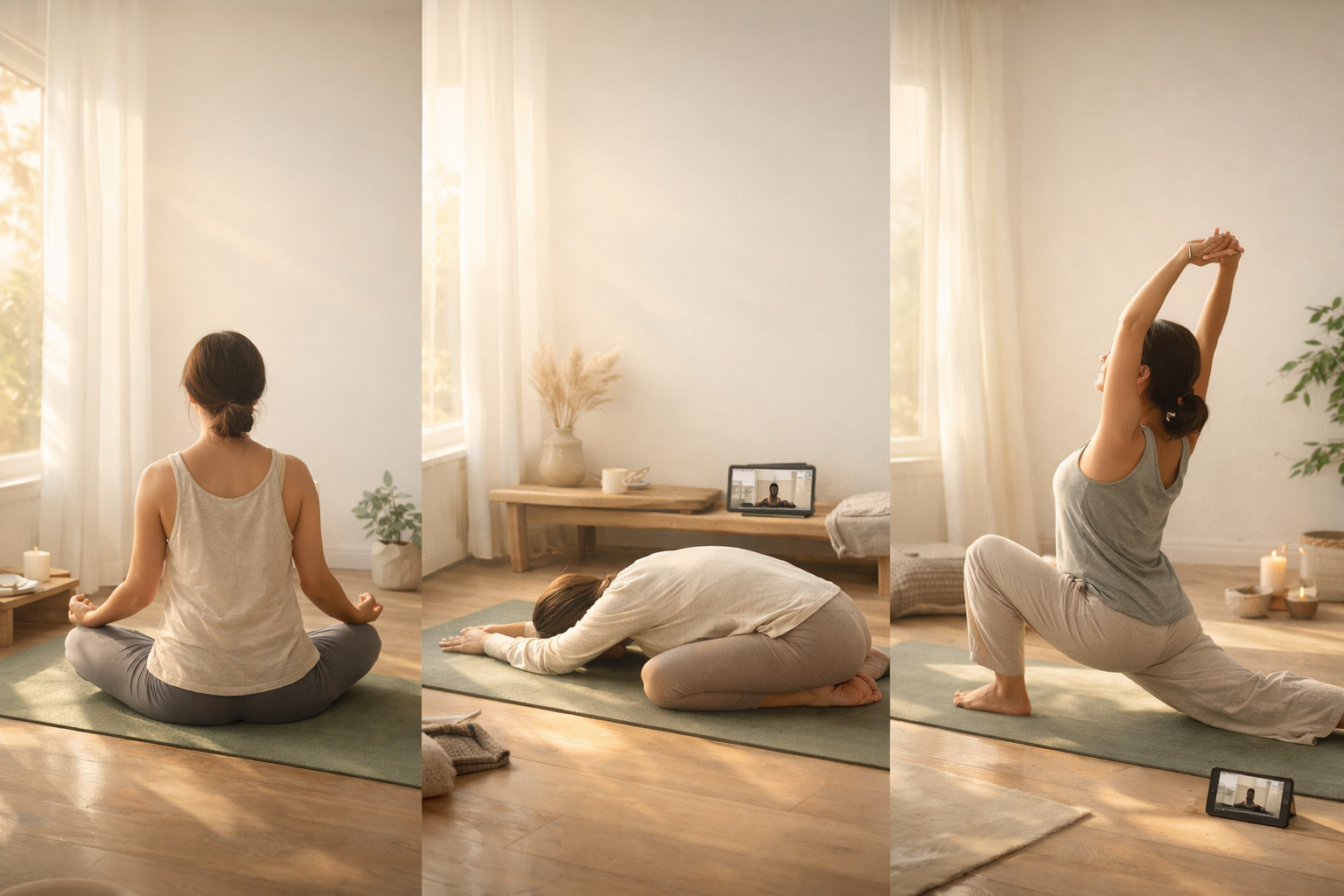 Stress relief
 Neck tension Shoulder tension
The Yoga That Actually Works
Early morning. Before the children wake up, before the first meeting begins, before the phone fills with notifications. For a brief moment, the house is quiet. You roll your shoulders. They are tight again. The tension didn’t appear overnight. It built slowly — through emails, deadlines, school runs, and the invisible mental load of modern life. For many people in their 30s and 40s, yoga becomes a refuge. A place to breathe. A place to stretch. A place to recover. And yet, many people quietly feel something puzzling. “I’m doing yoga… but it doesn’t always feel right.” The answer may be simpler than we think. Not all yoga is meant for every body. And this is where an ancient wisdom begins to make sense. More than 5,000 years ago, the traditional Indian science of Ayurveda described human constitution through three energetic patterns: Vata Pitta Kapha These are known as doshas . Each person carries a unique combination of them, and understanding your dominant dosha can help you choose the yoga style that supports your body instead of fighting against it. Because yoga, at its core, is not about flexibility. It is about balance . Vata The restless energy of modern life Vata represents the energy of air and movement. People with strong Vata energy tend to be creative, fast-thinking, and constantly multitasking. Many busy professionals and parents fall into this category. But this movement often comes with tight shoulders shallow breathing anxiety restless sleep For Vata types, the most effective yoga is slow, grounding, and calming . Recommended practices include: gentle Hatha yoga restorative yoga long, slow stretching Breathing practices such as deep diaphragmatic breathing or alternate nostril breathing (Nadi Shodhana) can help calm the nervous system. The goal is simple: to bring the wind back to the ground. Pitta The driven achiever Pitta represents the energy of fire. These are the leaders, decision-makers, and high performers. They are focused, productive, and often highly successful. But the same fire can create tension in the neck and shoulders irritability burnout difficulty relaxing For Pitta types, the most beneficial yoga is not intense. It is cooling and softening . Practices such as Yin yoga restorative yoga slow flow yoga allow the nervous system to reset. Cooling breathing techniques such as Sitali breathing can also help balance excess heat in the body. For Pitta personalities, yoga is not about pushing harder. It is about learning to let go. Kapha The steady foundation Kapha represents earth and water. People with strong Kapha energy tend to be calm, patient, and deeply supportive of others. They often become the emotional anchors of families and teams. However, they may also experience heaviness in the body stiffness in the back and shoulders low motivation to move For Kapha types, yoga should be energizing and stimulating . More dynamic styles such as Vinyasa yoga Power yoga Sun salutations can awaken the body’s energy. Breathing techniques like Kapalabhati breathing can help activate vitality and circulation. For Kapha types, movement is medicine. The deeper purpose of yoga But perhaps the most important insight is this: Yoga is not about mastering poses. It is about understanding your own body. Most of us move through life without listening to the signals our bodies send. We push through fatigue. We ignore tension. We forget to breathe. Yoga creates a rare moment where something shifts. A realization appears. “I have been holding tension for hours… maybe years.” That moment of awareness is where real healing begins. Why busy people need yoga the most Especially in the modern world. People in their 30s and 40s carry an extraordinary amount of responsibility. Career. Children. Relationships. Endless digital noise. That is why even ten minutes of mindful movement can change the entire rhythm of a day. A slow stretch. A quiet breath. A gentle twist. These small practices become powerful anchors. In the end Ayurveda offers a simple idea. Health is not about perfection. It is about living in harmony with your natural rhythm. You do not need the perfect yoga practice. You only need a moment of awareness. And when that awareness appears, yoga becomes something deeper than exercise. It becomes a way of coming back to yourself. And sometimes, in that quiet moment, a surprising thought appears. Maybe life does not have to be pushed so hard. Maybe it can also be lived gently.
Reset Yoga Editorial Team →
This content is for educational purposes only and is not medical advice. If you have pain, injury, pregnancy-related concerns, or a medical condition, consult a qualified healthcare professional before practicing.