Yoga Pose Library
Browse by concern, family & difficulty
Yoga & Science
Why yoga works — stress, sleep, posture & recovery
Browse by concern
 Sharpen focus for work & study
Guided Meditation Videos
5–10 minutes · Watch anytime
 5 min Focus & clarity
 Posture
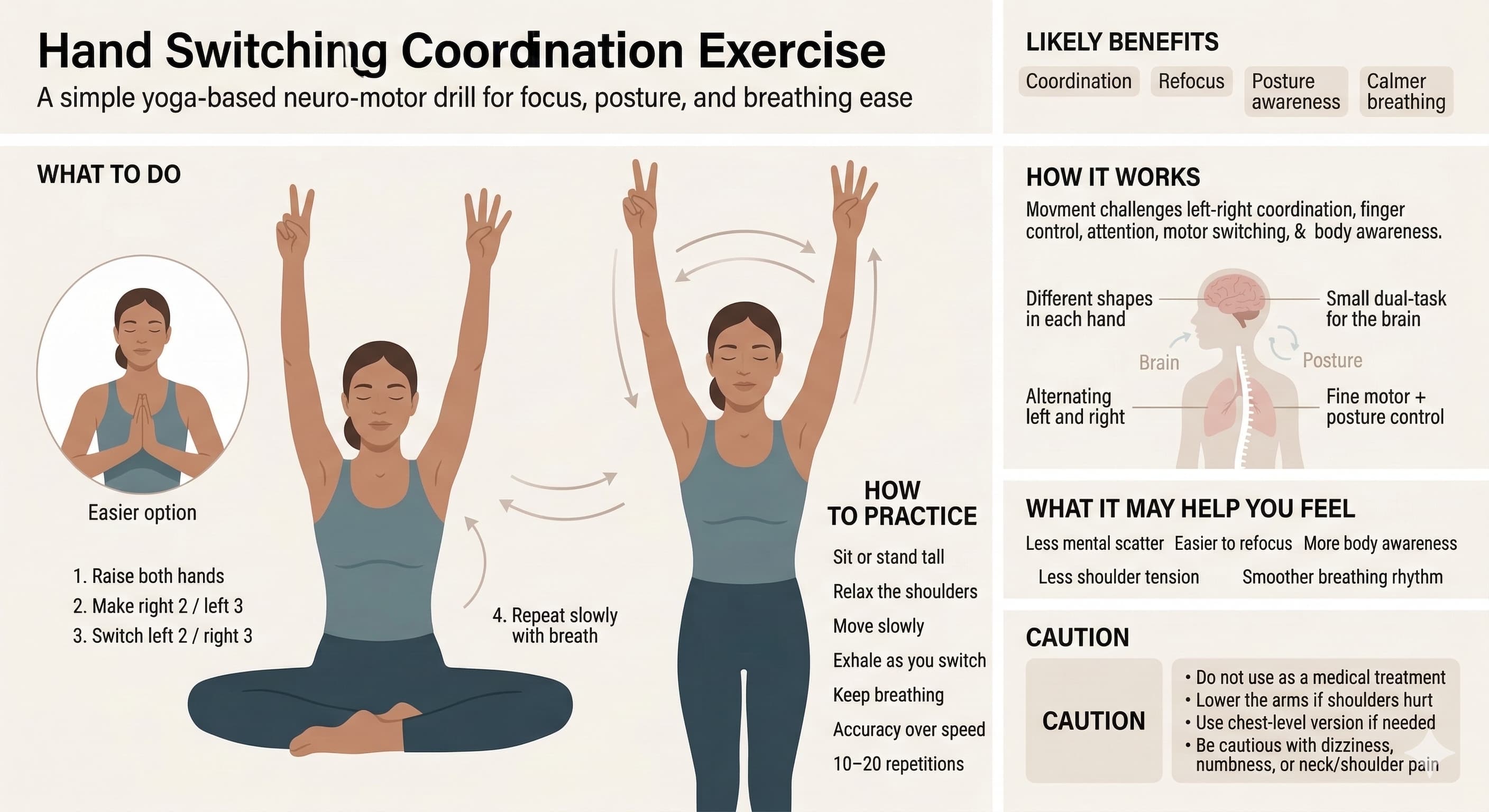
Hand Switching Coordination Exercise
A simple finger-coordination exercise that alternates different shapes in each hand. It may help improve brain-body coordination, mental refocusing, posture awareness, and smoother breathing.
 5 minPremium Focus & clarity
 Eye fatigue
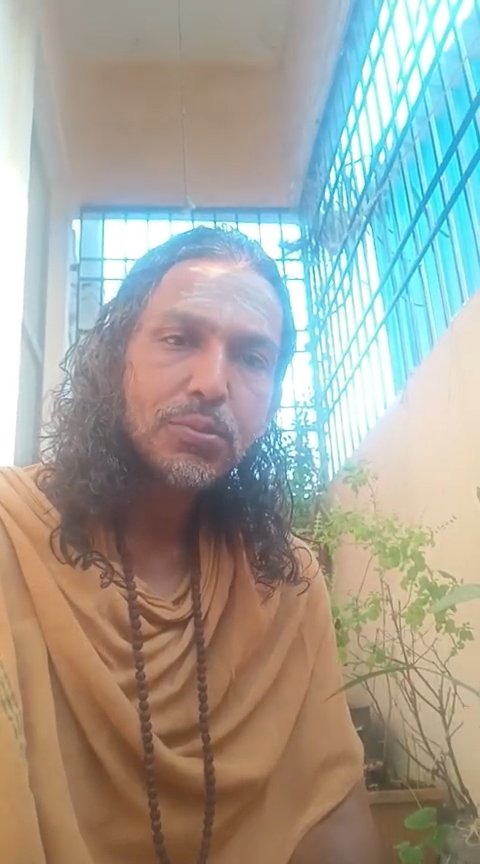
Sutra Neti / சூத்ர நேதி
Sutra Neti is an advanced yogic purification practice in which a thread or soft catheter is inserted through the nose and guided out through the mouth. It is traditionally used to clean the nasal passage and is considered part of the preparatory cleansing practices of Hatha Yoga. Because it can irritate or injure the nasal lining if done incorrectly, it should be learned only under qualified guidance. Benefits Its main purpose is to cleanse the nasal passages and improve ease of breathing. Neti practices are also commonly described as helping reduce mucus buildup, support sinus comfort, and promote mental calmness and clarity, which may help prepare for pranayama and meditation.
 5 minPremium Posture
 Core strength
Peacock Pose / Mayurasana
This pose is connected with a historical and spiritual story about a sacred mountain in India, possibly Marunthuvazh Malai. According to legend, when Lakshmana was seriously wounded, Hanuman carried a mountain of healing herbs to save him. The mountain is regarded as a sacred place of worship in local tradition. People worship Shiva there, and the place is also associated with devotion to Hanuman. I practiced this pose there, so for me it carries a deep spiritual meaning.
Wellness Articles
Browse by concern
 Premium Eye fatigue Focus & clarity
 Neck tension
Resetting Your Gaze When PC Work Makes You Foggy
If you feel foggy during PC work, the problem is often not lack of discipline . It is often the result of fixed gaze, neck tension, shallow breathing, and visual overload . Three essentials: Staring at one distance too long drains focus and stiffens the neck Real recovery means changing gaze distance, direction, and focus — not just closing your eyes A 1-minute gaze reset repeated throughout the day works better than waiting until total fatigue In short: Do not force yourself to look harder. Reset your gaze so your neck and brain can come back online. Resetting Your Gaze When PC Work Makes You Foggy How fixed visual focus steals your neck and concentration — and what to do about it By a certain hour of the afternoon, many people are still looking at the screen but no longer truly seeing it. The words remain legible. The document is still open. The meeting is still happening. And yet attention has thinned. You reread the same line. You forget what the last sentence meant. Your neck feels heavier than it should. Your eyes feel hot, but tired in a strangely dull way. This kind of fog is often mistaken for laziness or poor discipline. In reality, it is often something more physical — and more specific. When people become mentally blurry during PC work, the problem is frequently not motivation. It is a visual system that has been held too still for too long. And because vision is connected to the neck, posture, breathing, and attention, the consequences extend far beyond the eyes. Modern work has turned gaze into labor. Hour after hour, the eyes are asked to do something astonishingly narrow: look forward, at the same distance, with the same kind of precision, for prolonged stretches of time. Emails. Sheets. Slides. Chats. Video calls. Search results. The body adapts to whatever the eyes are doing. If the gaze stays fixed, the head stays fixed. If the head stays fixed, the neck begins working quietly in the background. If that work continues long enough, breathing narrows, posture drifts forward, and mental clarity begins to dim. This is not dramatic strain. It is low-grade, continuous effort. And continuous effort is often more exhausting than obvious effort because it goes unnoticed. People think they are just “looking.” In fact, they are stabilizing, bracing, adjusting, processing, and suppressing variation. That is a lot of work for one narrow visual channel. The first mistake most people make is to treat eye fatigue as if it belongs only to the eyes. They rub them. Close them briefly. Look away for a second. These can help. But they do not fully solve the problem, because what PC work often steals is not just ocular comfort. It steals variety. Variety of distance. Variety of direction. Variety of focus. Variety of coordination between eyes, head, neck, and breath. This is why the most useful intervention is not simply “resting the eyes.” It is resetting the gaze . That means restoring movement and range to the visual system. Look far. Look near. Look wide. Look side to side. Stop demanding sharp focus for a moment. Let the eyes and neck remember that vision is not supposed to be fixed in one narrow lane all day. That is not a luxury. It is maintenance. A practical reset can take less than a minute. First, look away from the screen and direct the eyes toward something farther away — a window, a wall, the far end of the room. Stay there for ten seconds. Then move the eyes gently left and right a few times without moving the head much. After that, let the head follow and turn softly side to side. Finally, instead of focusing sharply on one object, widen the field. Let the whole room enter the eyes at once. This final step matters more than it sounds. Most screen work trains a hunting gaze — narrow, precise, extracting information. A broader gaze invites the nervous system to soften. The body stops behaving as if it must seize and parse every detail. Add one longer exhale here, and the reset deepens. Because by this point, it is not only the eyes that need variation. It is the whole organism. Yoga understands something modern productivity often forgets: A body part does not tire alone. A strained gaze changes the neck. A strained neck changes the breath. A strained breath changes the quality of thought. This is why gaze reset is not a tiny ergonomic trick. It is a way of restoring conditions for better cognition. A person whose visual system is locked into one distance for hours becomes mentally narrower as well. They may still be working, but with less freshness, less breadth, less ease. That is why pushing harder often fails. The body is not asking for more force. It is asking for more options. And options are what a good reset provides. What makes this especially important for busy professionals is that fog often arrives before it is acknowledged. People continue pushing. They assume they need more caffeine, more urgency, more pressure. But often the smarter move is smaller. Step out of the fixed frame. Let the eyes change task. Let the neck stop serving as a tripod for a screen-bound head. Let the breath resume full citizenship in the body. This is not stepping away from work. It is returning to work with better hardware. And that is the more accurate way to understand it. Visual reset is not avoidance. It is performance design. The brain works better when the eyes are not trapped. The neck feels better when the gaze is not frozen. Thought becomes more coherent when the body stops mistaking concentration for immobility. There is also a larger metaphor here. Many people believe attention means staring harder. Pushing closer. Holding tighter. Reducing everything to one narrow channel. But some of the best thinking happens not when vision contracts endlessly, but when it regains range. A wider gaze often makes for a wiser mind. Not because precision disappears, but because the body is no longer locked into a state of visual emergency. That is why a brief gaze reset can sometimes restore more than comfort. It can restore perspective. And perspective is often what disappears first when work becomes too screen-shaped. The next time you feel yourself fading at the computer, do not immediately blame your character. Ask different questions. How long have I been looking at the same distance? Has my neck been holding my head in one exact relationship to the screen? Has my breathing become too small to support clear thought? Has my gaze forgotten how to widen? If the answer is yes, then your mind may not need more pressure. It may need release. Look far. Look wide. Move the eyes. Move the head. Exhale slowly. Then return. Because what fixed screen work steals is not only energy. It steals flexibility of attention. And sometimes the shortest path back to focus begins not with trying harder to think — but with teaching the eyes, the neck, and the nervous system that they are allowed to move again.
Reset Yoga Editorial Team →
 Premium Eye fatigue Focus & clarity
 Recovery
Morning Yoga to Reset a Distracted Brain
If you cannot focus in the morning, it is often not a motivation problem. More often, your brain and nervous system are simply not ready for work mode yet . Three essentials: Morning focus depends less on willpower and more on nervous-system activation Short morning yoga helps switch on attention by organizing breath, spine, posture, and gaze The most effective sequence is: open the breath → move the spine → steady the axis and eyes In other words: Before blaming yourself for poor focus, spend 5–10 minutes helping your system become focus-ready. English Title Morning Yoga to Reset a Distracted Brain English Subtitle Why poor focus is often a nervous-system issue, not a motivation problem — and how to enter work mode in minutes English Column Morning Yoga to Reset a Distracted Brain — Why lack of focus is often a nervous-system issue, not a motivation problem There are mornings when the mind feels scattered before the work has even begun. The laptop is open. The to-do list is visible. You know what matters. You know what should come first. And yet attention slips. You open an email and forget why. You move from one tab to another. You begin something, then drift. The minutes pass, not in effort, but in fragmentation. On mornings like these, many professionals make the same mistake. They turn the problem into a moral one. I am not disciplined enough. I have lost my edge. I need more drive. I need to try harder. But often the issue is simpler, and kinder, than that. A distracted brain in the morning is not always unmotivated. It is often just not yet properly organized for work. That distinction matters. Because if the problem is character, the only response is self-criticism. If the problem is readiness, the response becomes preparation. And this is where morning yoga becomes far more practical than many people assume. Not as exercise. Not as self-improvement theatre. But as a way of telling the nervous system: you may now enter focused work. Most people have rituals for turning on their machines. They open the laptop. Check the calendar. Read messages. Make coffee. What they often lack is a ritual for turning on themselves. Modern mornings begin with immediate input. Notifications. News. Schedules. Children. Requests. The small administrative noise of being alive. Attention is pulled outward almost instantly. Meanwhile, the body is often still carrying the inertia of sleep: shallow breath, stiff spine, collapsed chest, eyes that are awake but not yet settled. In that condition, the brain can be technically alert and still not be ready for deep work. That is because concentration is not just a mental event. It is a whole-body state. Breath influences it. Posture influences it. The position of the head influences it. The steadiness of the gaze influences it. The nervous system must sense coherence before the mind can sustain it. This is why mornings can feel mentally messy even when motivation is present. The system has input, but not yet enough organization. The real value of morning yoga lies here. Its purpose is not merely to “wake up the body.” Its deeper purpose is to create the physical conditions under which the brain can focus. Start with breath. People who cannot concentrate in the morning are often already breathing in a narrow, upper-chest pattern. The inhale is short. The exhale unfinished. The system remains somewhere between sleep and stress. A few moments of conscious breath can change that. Standing or sitting, inhale through the nose and let the breath widen into the side ribs and back body. Exhale slowly and feel the shoulders descend without force. This is not dramatic. But it begins to reduce internal static. Then move the spine. Concentration suffers when the body remains in the collapsed geometry of sleep or screen posture. A rounded upper back, a forward head, a stiff rib cage — all of these make attention more reactive and less stable. A few rounds of cat-cow, a gentle forward fold, a mild twist: these movements are not just stretches. They are signals. They tell the body that the day is beginning not only cognitively, but structurally. The ribs begin to move. The spine wakes up. Breath gains room. And the brain receives a very old message: we are readying ourselves now. Finally, restore axis and gaze. Focus is not the same as stimulation. A person can be highly stimulated and still completely uncentered. What work requires is a quieter kind of alertness — one in which attention can gather rather than scatter. This is why even simple standing postures matter. Mountain pose. Standing balance on one foot. A calm, grounded stance with the eyes resting on one point. The point is not to eliminate all wobbling. The point is to remember how to return. That, in many ways, is the essence of concentration itself. A morning practice does not need to be long to be effective. For busy professionals, shorter is often better because shorter becomes repeatable. Five minutes can be enough. One minute of fuller breathing into the ribs and back body. Two minutes of spinal movement — cat-cow, fold, twist. Two minutes of standing, grounding, and finding a stable gaze. The sequence matters. Open the breath. Mobilize the spine. Organize the axis. Steady the eyes. This is not random. It is a progression from internal chaos toward usable orientation. And that is what focus really is. Not a heroic mental effort. A state of organized readiness. This is also why morning yoga should not become another performance metric. The goal is not to prove discipline before breakfast. The goal is to create the conditions under which discipline becomes less necessary because the system is already cooperating. Modern culture talks about focus as though it were mostly a psychological virtue. Be stronger. Be more disciplined. Resist distraction. Push through. But actual concentration is far less abstract than that. It depends on whether the nervous system feels coherent enough to sustain a direction. After a poor night of sleep, after emotional strain, after too much screen time, after carrying family and work into the same mind at once, the answer is often no — at least not immediately. This is not weakness. It is physiology. And physiology can be influenced. Not always with force. Often with sequence. A deeper breath. A moving spine. A steadier head. A quieter gaze. A body that no longer feels half asleep and half under attack. This is what morning yoga can offer. Not motivation on command. Something more useful. A bridge from scattered wakefulness to functional presence. If your mind feels fragmented in the morning, resist the urge to treat yourself like a failing machine. Try another question instead: Am I truly unable to focus? Or have I simply not yet entered the state from which focus becomes possible? If it is the second — and often it is — then there is good news. That state can be helped. And it does not always take much. A few breaths. A few spinal waves. A few moments of standing in your own center before giving yourself to the day. Morning yoga is not magic. But it can be a remarkably intelligent way of preparing the body for thought. And in a world where attention is constantly being fragmented, that may be one of the most practical forms of self-respect available.
Reset Yoga Editorial Team →
 Premium
 Stress relief
 Restless nights Focus & clarity
Three Breathing Pathways for Restless Days
When your mind feels unsettled, “just take a deep breath” is often too vague. What works is choosing the right breathing route for your actual state . If your mind is racing with anxiety → Use a long exhale to slow the nervous system. If you feel irritated or overheated → Use a cooling breath to lower emotional intensity. If you are exhausted but cannot switch off → Use back-body breathing to help the system land. Breathwork is not about erasing emotion. It is about creating a body state in which emotion no longer controls you. English Column Three Breathing Pathways for Restless Days — How to calm emotional waves by choosing the right breath for the state you are actually in Some days feel unsettled before anything has even happened. The inbox is not yet overwhelming. The meeting has not yet gone badly. No crisis has formally announced itself. And still, something inside feels unquiet. The chest is a little tight. The mind is slightly ahead of the moment. A minor comment lingers too long. A future scenario begins playing before the present one has even finished. Busy professionals know this feeling well. It is not dramatic enough to be called collapse. It is not simple enough to be dismissed as mood. It is a kind of inner weather — a low, persistent agitation that moves through the day while you continue functioning. In those moments, many people give themselves familiar advice. Calm down. Don’t overthink. Take a deep breath. Well meant, certainly. But often too general to help. Because not all emotional unrest is the same . And not every breath meets every state. There is the restlessness of anxiety. The restlessness of irritation. The restlessness of exhaustion that still cannot downshift. These may all look like “stress” from the outside. Inside, they are different climates. And different climates require different routes home. That is the real usefulness of breathwork. Not that it removes emotion. But that it gives the nervous system a more intelligent response than force of will. 1. When anxiety makes the mind run ahead Take the long-exhale route This is the kind of unrest that thinks in loops. You replay a message you sent. You anticipate the next meeting. You imagine consequences before there are facts. Your body is seated, but your mind is already in tomorrow. The defining feature here is speed. Thought moves quickly. Breath becomes short and high. The body remains subtly prepared for something it cannot yet name. What helps is not a pep talk. What helps is deceleration. A simple and effective practice is this: inhale through the nose for four counts, then exhale for six to eight. That longer exhale matters. The body reads a full exhale as a signal of reduced threat. It interrupts momentum. It tells the nervous system that urgency may loosen its grip. On anxious days, inhaling is often not the problem. Exhaling completely is. Which is precisely why this route works. It does not argue with the anxious mind. It changes the speed at which the body is living. 2. When irritation or emotional heat is rising Take the cooling route There are days when the problem is not fear, but heat. You are quicker to react. A colleague’s tone feels sharper than it probably is. A minor delay feels like an insult. The jaw tightens. The shoulders lift. The chest carries a small internal fire. This state does not need more reasoning at first. It needs cooling. One useful approach is to purse the lips and exhale slowly and steadily, as if releasing heat from the chest. Another is a gentle cooling-style breath: a light inhale through the mouth and a slow exhale through the nose. The point is not technical perfection. The point is to lower the temperature of the system. Irritation is often tied to a sense of rightness. That is why thinking your way out of it can be difficult. The body is already energized around its position. Breath offers a quieter solution. It does not invalidate the feeling. It simply stops feeding the heat. And very often, once the heat lowers, clarity returns without force. 3. When you are tired but still cannot switch off Take the back-body route This may be the most contemporary form of restlessness. The body is fatigued. The day has already taken too much. And yet, when evening comes, the system does not know how to land. You are not energized. You are merely still activated. This state benefits from a different kind of breath — one that expands not only the front of the chest, but the sides and back of the ribs. Sit deeply in a chair or lie down. Place one hand on the chest and the other on the side ribs or back body. As you inhale, feel for expansion not only forward but outward and behind. As you exhale, let the throat and shoulders soften. This works because many exhausted people try to “relax” by taking effortful deep breaths into the upper chest, which only creates more work. Back-body breathing feels different. It is less performative. More supportive. It gives the nervous system somewhere to settle. On tired nights, what the body often needs is not stimulation, not distraction, not even motivation. It needs a broader internal surface of safety. The deeper lesson is not that one breathing method is superior. It is that discernment matters. What exactly are you feeling? Anxiety? Heat? Wired exhaustion? That question alone changes the relationship. Many adults treat all internal discomfort as one category: stress. But stress has textures. Temperatures. Directions. When you begin to distinguish them, you stop treating yourself so bluntly. That is no small thing. In modern professional life, people are often harsh with themselves by habit. I should be calmer. I should be stronger. I should not be affected by this. But the nervous system does not respond well to criticism. It responds to signal. Breath is one of the clearest signals we have. It reaches the body before language does. It adjusts state before thought catches up. It gives a person a way to intervene not only psychologically, but physiologically. That is why breathwork belongs not only in yoga studios, but in boardrooms, between meetings, in parked cars, outside homes, before difficult conversations, and at the edge of sleep. The next time your mind feels noisy and your body feels slightly displaced from itself, do not rush to fix the feeling with philosophy. Pause. Ask a more practical question: What kind of wave is this? The wave of anxiety? The wave of heat? The wave of depletion that no longer knows how to rest? Then choose accordingly. Lengthen the exhale. Cool the system. Breathe into the back body. This is not about becoming emotionless. It is about becoming less capturable by emotional weather. And that may be one of the most useful leadership skills in modern life — not the ability to never feel turbulence, but the ability to return from it without losing yourself. Calm is not the absence of challenge. It is the capacity to come back to center while challenge is still present. Breath knows that route. Often more quickly than thought. Often more honestly than self-talk. And the remarkable thing is how near that route usually is. Sometimes it begins with a long exhale at your desk. Sometimes with a cooling breath before a hard conversation. Sometimes with one quiet expansion into the back ribs before bed. The path back is rarely dramatic. But it is real. And very often, it is only one conscious breath away.
Reset Yoga Editorial Team →
 Premium
 Shoulder tension Neck tension Focus & clarity
Desk Workers Are Moving Their Shoulder Blades the Wrong Way
By mid-afternoon, the upper back starts to feel like a wall. The neck narrows. The shoulders harden. Something between the shoulder blades begins to ache with a dull, familiar persistence. At that point, many desk workers do exactly what they have been taught. They sit up taller. They pull the shoulders back. They try to squeeze the shoulder blades together. The intention is understandable. Improve posture. Open the chest. Undo the damage of sitting. And for a moment, it may even feel effective. But often, something else happens. The neck gets tighter. The shoulders climb upward. The lower back overarches. Within minutes, the body slips back into the same uncomfortable shape. This is not because the body is stubborn. It is because the strategy is incomplete. The problem is not that desk workers fail to move their shoulder blades. The problem is that they often try to move them before restoring the conditions that make healthy movement possible. Shoulder blades do not respond well to command alone. They need context. They need space. They need a body that is prepared for movement, not merely instructed to perform it. Modern work is not kind to the shoulder blades. Human arms were designed to reach in many directions. The shoulder blades were designed to glide over the rib cage in response — widening, narrowing, rotating, settling, lifting, returning. That is their job. But desk work puts the arms in one dominant relationship: forward. Hands on keyboard. Hands on mouse. Hands on phone. Eyes fixed ahead. Head slightly drifting forward. Chest narrowing. Upper back rounding. Over time, the shoulder blades adapt to this environment. They settle into a pattern of quiet forward drift and relative immobility. Then, once discomfort arrives, many people try to solve it with the cue they know best: Pull them back. But the shoulder blades are not simply two flat pieces on a wall waiting to be pinched together. They are living structures that glide over a curved, breathing rib cage. That matters. Because if the rib cage is stiff, if the breath is shallow, if the head has moved forward, then “pulling the shoulder blades back” often becomes a superficial correction. The deeper system remains unchanged. And so the neck compensates. The upper traps overwork. The lower back flares. The pose of “good posture” appears, but the body itself feels worse. This is why the sequence matters. Before the shoulder blades can move well, the body must become more moveable beneath them. The first thing most desk workers need is not retraction. It is breath into the rib cage . Shoulder blades glide on ribs. If the ribs have stopped moving, the shoulder blades have lost their terrain. Many people who sit for long hours breathe only into the upper front chest. The side ribs and back ribs become quiet. The thorax becomes less responsive. The shoulder blades lose space. So the first mini-yoga intervention is remarkably simple. Sit with both feet on the floor. Let the chin soften slightly back. As you inhale, do not try to lift the chest dramatically. Instead, feel for breath widening into the side ribs and back body. As you exhale, allow the tops of the shoulders to soften. This is not dramatic. But it changes the environment. The second step is repositioning the head . A slightly forward head places continuous demand on the muscles around the neck and upper shoulders. Then, when a person tries to “move the shoulder blades,” the neck often takes over the task. So before asking the shoulder blades to organize, bring the ears a little more over the shoulders. Lengthen the back of the neck. Let the crown rise. This adjustment does not make the body rigid. It gives the shoulder blades a chance to stop negotiating with a neck that is overworking. Only then does movement become useful. Now the shoulder blades can begin to slide , not just squeeze. That distinction matters. A practical mini-yoga drill at a desk might look like this: Reach both arms forward. As you exhale, let the upper back round slightly and feel the shoulder blades widen. Then inhale and gently open the chest just enough for the shoulder blades to move a little closer together behind you. Do not exaggerate. Do not force a military posture. Do not let the neck harden. The point is to rediscover glide. Not a static ideal. A living motion. Another valuable movement is a one-arm reach overhead. Raise one arm slowly from the front. Do not suppress all upward movement in the shoulder. Allow the shoulder blade to rotate naturally on the rib cage. This is especially important because many adults think the shoulder should never rise. But healthy shoulder blades do rise when needed. They rotate. They respond. The problem is not movement. The problem is dysfunctional movement emerging from a poorly prepared base. So the mini-yoga sequence becomes clear: First restore breath. Then restore head-neck organization. Then teach the shoulder blade to move on a rib cage that is alive again. This reveals a broader misconception about posture. Many people believe good posture means lifting the chest, pulling the shoulders back, and holding the shoulder blades close together. But functional posture is not a fixed performance. It is the capacity to remain organized while breathing and moving. The shoulder blades are not meant to stay pinched together all day. They are meant to be responsive — able to widen, narrow, lift, rotate, and settle according to what the arms and breath require. So the true goal is not permanent retraction. It is adaptability. This is where yoga offers something wiser than many posture hacks. Yoga is not only interested in shape. It is interested in whether breath moves through the shape, whether effort is distributed wisely, whether the system is organized without unnecessary strain. Applied to shoulder blades, this means the key question is not: Can I squeeze them back? But rather: Have I restored the conditions that allow them to move without compensation? For busy professionals, the good news is that this does not require a long class. It requires moments. One minute to breathe into the side ribs and back body. A few seconds to let the head return from its forward drift. A few gentle glides of the shoulder blades. A slow arm raise that invites movement without neck tension. These are small acts. But small acts matter because they interrupt the body’s autopilot. They remind the system that movement is not something to be forced after stiffness appears. It is something to be prepared for. And perhaps there is a lesson here beyond the body. Modern life often encourages people to solve problems by demanding the correct output immediately. Better performance. Better posture. Better focus. Better resilience. But very often, the more intelligent question is not what action to perform. It is what condition needs to be restored first. The shoulder blades are no exception. Do not begin with squeezing. Begin with breath. Begin with space. Begin with enough inner support that movement does not become another form of strain. Once that foundation is there, the shoulder blades stop feeling like stubborn structures that must be fixed. They become what they were meant to be all along: responsive, gliding participants in a body that knows how to breathe and move again. If your upper back feels like stone by the end of the workday, resist the urge to correct it aggressively. Instead, restore the sequence. Breathe into the ribs. Reorganize the head. Let the shoulder blades slide. Real relief rarely begins with force. It begins when the body remembers the conditions under which movement can happen naturally.
Reset Yoga Editorial Team →
 Premium Stress relief Core strength Focus & clarity
For Those Whose Poses Improve, but Whose Yoga Does Not Feel Deeper
At some point, many practitioners notice a quiet success. The forward fold is deeper now. Balance is steadier. A posture that once felt impossible has become recognizable, even competent. The body obeys more easily. The shape, from the outside, has improved. And yet something unexpected can happen alongside that progress. A strange flatness enters the practice. The poses are better, but the yoga does not necessarily feel deeper. The movements are more polished, but the inner experience feels thinner than it once did. There is skill, but less surprise. There is achievement, but less intimacy. This is a subtle turning point, and an important one. Because when visible progress stops bringing a sense of inward growth, many people respond in the same way: they look for a harder pose. A deeper bend. A stronger arm balance. A more impressive challenge. But often the next stage of yoga is not found in a more advanced shape. It is found in a more refined way of paying attention. Yoga may begin with form. But it does not mature there. Modern culture loves visible excellence. We admire what can be seen, measured, compared, displayed. Yoga is not immune to this. A powerful backbend, a stable inversion, an elegant standing pose — these carry immediate meaning in a visual world. They signal progress in a way that is socially legible. They look like mastery. And there is nothing inherently wrong with that. Physical development matters. The body is part of the path. But when external shape becomes the primary marker of growth, yoga can quietly shift from inquiry into performance. The attention begins moving outward. How do I look? Am I deeper than before? Is this correct? Am I improving fast enough? How does this compare with others? And the more polished the pose becomes, the easier it can be to miss what is happening inside it. That is the paradox. A person may become more skillful in form while becoming less sensitive in awareness. So what does deepening actually mean? Not necessarily more complexity. Not necessarily more years. Not necessarily more knowledge. A deepening practice is one in which the practitioner begins to perceive what was previously too subtle to notice. The slight holding of the jaw. The breath that shortens at the edge of difficulty. The way weight escapes into one side. The reflex to rush when discomfort appears. The moment ego quietly enters and says, now prove something. From the outside, the pose may look identical to yesterday. Inside, it is a different world. Take a simple balance posture. At first, the task may be obvious: do not fall. Later, the inquiry changes. Where is the foot actually meeting the floor? What happens to the breath when instability arises? Can I remain present in the wobble, or do I become urgent? What is the quality of my attention here? This is where yoga stops being a sequence of shapes and becomes a relationship with consciousness. What many people discover, if they stay long enough, is that yoga reveals not only the body, but the patterning of the self. How do I respond when I struggle? Do I force? Do I withdraw? Do I become self-critical? Do I perform confidence while internally bracing? These are not merely questions about movement. They are questions about character. The reason yoga can become profound is that the mat often amplifies the same reactions that appear in the rest of life. How you meet resistance in a posture may resemble how you meet uncertainty in work, disappointment in relationships, or pressure at home. That is why the breath matters so much. Breath is not just technique. It is feedback. It reveals when effort becomes aggression. When ambition outruns sensitivity. When “doing well” begins to cost too much. A beautiful pose with broken breath may still contain violence. An imperfect pose with steady breath may contain real practice. This is a difficult truth for achievement-oriented people, which is to say, for many adults. We are used to believing that better visible outcomes mean deeper value. Yoga gently interrupts that assumption. To say that practice should be measured by sensation, breath, and awareness is not to speak vaguely. It is, in fact, extremely practical. It means asking different questions. Am I actually breathing here? Where is unnecessary effort hiding? Am I so focused on correct form that I have left my own body behind? Can I remain in this moment without mentally rushing ahead to the next one? These questions do not weaken the pose. They animate it. They turn posture from a photograph into an experience. And then something remarkable begins to happen. A practice can feel rich without being spectacular. A simpler class can feel more transformative than a difficult one. A day of “less successful” movement can become more revealing than a day of visible accomplishment. Because the center of gravity has shifted. The practice is no longer primarily about doing more. It becomes about relating more honestly. To the body. To the breath. To the mind. To the self that appears when things are not going perfectly. This matters even more as life grows fuller. When people are younger, physical progress alone may feel sufficient. The pleasure of movement is often enough. The body opens, strength increases, and improvement is gratifying in itself. But over time, life becomes more layered. Fatigue accumulates. Responsibilities deepen. The nervous system carries more. The body stores more history. At that point, what many people need from yoga is not proof that they can still achieve. They need a place where they can actually meet themselves. Not the ideal self. Not the photographed self. Not the high-performing self. The actual self. A yoga practice built only around outward refinement may not be able to offer that. But a yoga practice attentive to sensation, breath, and awareness can. And when that happens, yoga begins to extend beyond the mat. A person who can detect unnecessary tension in a posture may begin to notice it in a conversation. A person who learns not to panic in a wobble may become less reactive in uncertainty. A person who can stay with a breath inside difficulty may become more available to life without always needing to control it. That is what true deepening looks like. Not just more advanced shapes. A more conscious way of inhabiting experience. If your poses have improved but your practice feels strangely shallow, do not assume something is wrong. You may simply be arriving at the next layer. And the next layer is quieter. It will not necessarily impress anyone. It may not look like progress at all. It might be the choice to come out of a pose sooner because the breath disappeared. It might be the willingness to notice comparison without feeding it. It might be the discipline to value steadiness over ambition. It might be the humility to realize that the deepest part of practice is not always the most visible part. Yoga is not only a way of becoming capable. It is a way of becoming perceptive. And perhaps that is what mature practice finally asks of us: not just to shape the body beautifully, but to refine our sensitivity to what cannot be seen. Because in the end, the question is not how finished the pose looks. It is how fully you are there inside it. And that may be the real sign that yoga is deepening: not that the form becomes perfect, but that your relationship to breath, sensation, and awareness becomes honest enough to transform the rest of your life.
Reset Yoga Editorial Team →
 Premium Stress relief Restless nights Focus & clarity
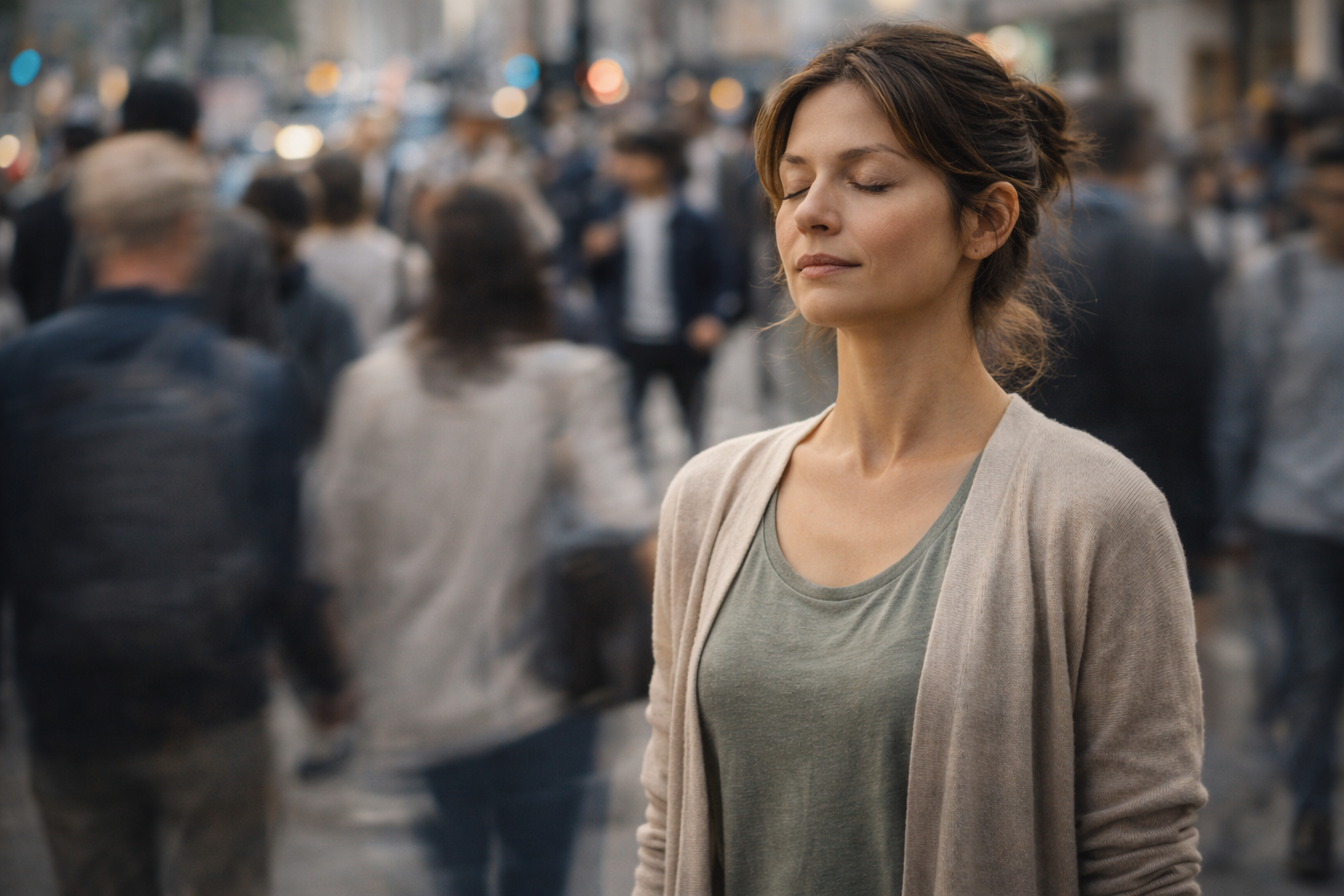
Change the Breath, and the Tempo of Life Changes
Busy people rarely forget to breathe. They simply forget that breathing has a quality. The day begins before the body has truly arrived. A phone glows. A schedule reappears. Messages wait. Children need breakfast. A meeting is already forming in the mind before the first cup of coffee has finished. Air moves in and out, certainly. But for many people, breathing is no longer something they do with awareness. It is something that happens while they hurry. Shallowly. Quickly. Incompletely. As if the body has accepted urgency as its native rhythm. Over time, this begins to feel normal. That is one of the great quiet distortions of modern life: a dysregulated pace can become so familiar that people stop recognizing it as a pace at all. It simply becomes “how life is.” And yet, hidden inside that ordinary habit is a profound possibility. When breath changes, what changes is not merely stress level. What changes is the tempo through which a person experiences life. This is why breathwork deserves to be understood as more than a relaxation trick. It is a method for changing the quality of daily existence from the inside out. Most people try to improve life externally. They optimize schedules. They adjust diets. They seek better productivity systems, better sleep, better routines, better boundaries. These things matter. But beneath all of them lies an internal pace — a bodily speed at which life is processed. And that pace is often overlooked. The same conversation feels different depending on the breath. The same problem lands differently depending on the breath. The same family dinner, work meeting, or commute can feel manageable or overwhelming not only because of what is happening, but because of the speed at which the nervous system is receiving it. In this sense, many people are not simply tired because life is demanding. They are tired because their internal tempo is too fast for sustained aliveness. Breathwork addresses that tempo directly. It does not merely calm a person after the damage is done. It helps determine the state in which life is lived. Breathwork is often reduced to a wellness accessory. Something to do at the end of yoga. Something to try when anxious. Something soft, optional, secondary. But this understates its importance. Breath is one of the few physiological processes that is both automatic and influenceable. It stands at the border between body and will. That is why it is so powerful. By changing the breath, a person can send a message to the nervous system that thought alone often cannot deliver. Slow down. You are not under immediate threat. You do not need to react this quickly. You may remain here without bracing. This has consequences far beyond feeling calm for five minutes. When the breath is rushed, life is interpreted through haste. Words become sharper. Attention narrows. Decisions become more reactive. Patience thins. The world begins to feel more hostile than it may actually be. When the breath lengthens, even slightly, another possibility emerges. There is a pause before reaction. A little more room in a conversation. A little less urgency in the body. A little more choice in how to meet what is difficult. These shifts seem small. But life is made of small shifts repeated. And repeated enough times, they become character, climate, and destiny. The yogic traditions understood something here that modern life often forgets. Breath is not merely support for life. It is one of the primary ways life is shaped. That idea may sound poetic, but it is also practical. A person who lives in a hurried breath often lives in a hurried nervous system. A person who never fully exhales often never fully arrives in rest. A person whose breathing remains high in the chest through most of the day may begin to experience even ordinary responsibilities as low-level threat. Seen this way, breathwork is not about escaping reality. It is about changing the physiological lens through which reality is met. The same workload may remain. The same children. The same inbox. The same unfinished tasks. But with a different inner rhythm, the day stops feeling like a series of collisions. It becomes something more inhabitable. What makes breathwork transformative is not complexity. It is portability. You do not need a studio. You do not need perfect silence. You do not need a long spiritual ritual. You need moments. Before opening the laptop: exhale longer. Before walking into a meeting: take three conscious breaths. Before answering a child impatiently: soften the shoulders and let the breath finish. Before sleep: inhale gently, exhale a little longer than the inhale. This is where breathwork stops being an isolated practice and becomes a life technology. A simple pattern such as inhaling for four counts and exhaling for six can be enough. Not because the numbers are magical, but because the longer exhale interrupts the body’s momentum toward speed and defense. The point is not to achieve an altered state. The point is to recover a usable one. To remind the body, again and again, that life does not need to be lived at the pace of panic in order to be effective. Modern adults are extraordinarily trained in acceleration. Reply faster. Decide faster. Travel faster. Produce faster. Move on faster. This has made many outer systems more efficient. But it has also made many inner systems more brittle. Recovery becomes harder. Attention becomes more fragmented. Stillness begins to feel unfamiliar, even threatening. Breathwork is a quiet refusal of that pattern. It says that speed is not the only measure of usefulness. It says that efficiency purchased with chronic internal strain is too expensive. It says that a good life is not only one that gets many things done, but one in which the self is not continually abandoned in the process. This may be especially important for those in the middle years of adult life — professionals, parents, caregivers, managers, builders of families and futures. These are often the years when outer responsibility expands while inner rhythm quietly deteriorates. And because the deterioration is gradual, it can go unnoticed. Until irritability increases. Until fatigue lingers. Until joy begins to feel delayed. Until even success feels strangely breathless. This is where breathwork becomes more than wellness. It becomes reclamation. To change the breath is, in a real sense, to reclaim authorship over tempo. Not the tempo of the calendar. Not the tempo of notifications. Not the tempo of other people’s demands. But the tempo of your own organism. And when that tempo shifts, the day changes with it. Problems may still exist. Pressure may still exist. Grief, deadlines, parenting, uncertainty — none of these disappear. But they are no longer met by a body that is constantly one beat away from alarm. That alone can change the quality of a life. If your days have begun to feel as though they are passing in fast-forward, do not assume the only solution is to redesign your entire life immediately. Perhaps begin somewhere smaller. Perhaps begin where you still have access. With the next exhale. Lengthen it. Let it finish. Allow the body to feel one moment of not rushing. Life’s tempo does not always change through dramatic decisions. Sometimes it changes through the quiet repetition of a new internal rhythm. And sometimes that rhythm begins with something as ordinary, and as powerful, as the way you breathe.
Reset Yoga Editorial Team →
 Premium Neck tension Eye fatigue Focus & clarity
Eye Strain Does Not Go Away by Resting the Eyes Alone
By late afternoon, the words begin to blur. You look away from the laptop and down at your phone, and there it is again — the dull heaviness behind the eyes. You close them for a moment. You blink. Perhaps you use eye drops. Perhaps you stare out the window. It helps, a little. But not enough. This is one of the quiet frustrations of modern life: eye strain rarely stays in the eyes. It spreads. Into the temples. Into the back of the neck. Into the breath, which grows shallower without permission. Into the mind, which begins to feel not only tired, but crowded. What many people call tired eyes is often not a local problem at all. It is a whole-system fatigue wearing the mask of vision. And that is why simply resting the eyes is often not enough. We are living through a period of human history in which vision is under near-constant demand. From the first glance at a phone in the morning to the last lighted screen at night, the eyes are rarely asked to soften. They are asked to focus, process, compare, interpret, scan, decide. Even leisure has become visual labor. Streaming, scrolling, reading, replying, watching, checking. The eyes may appear passive, but they are participating in a relentless economy of attention. And the eyes do not work alone. Whenever we stare, the neck organizes around that stare. The head subtly moves forward. Blinking often decreases. The jaw may tighten. Breathing shifts upward into the chest. Concentration, especially digital concentration, has a way of making the whole body quieter on the outside and more strained on the inside. This is why eye fatigue so often arrives with a sore neck and a foggy mind. The system has been bracing around the act of seeing. To understand this more clearly, it helps to stop thinking of vision as merely optical. Seeing is neurological. The eyes gather information, but the brain does the interpreting. Words, notifications, faces, icons, charts, messages, color, movement — all of it requires processing. So when the eyes feel exhausted, the brain is often exhausted too. That is why eye strain can feel strangely emotional. Not sad, exactly. Not anxious in a dramatic way. Just full. A person may close their eyes and still feel no relief because the visual world is still active inside them. The unfinished email remains. The flashing notification is remembered. The meeting is replayed. Tomorrow’s tasks continue to hover behind the forehead. The eyes are closed. But the mind is still staring. This is the deeper reason recovery often fails when it is aimed only at the eyeballs. Because what needs rest is not just the visual organ. It is the entire chain of effort surrounding it: the gaze, the neck, the breath, the cognition, the vigilance. This is where yoga becomes unexpectedly relevant. Yoga does not merely ask where the discomfort is. It asks what patterns are organizing the discomfort. If the eyes are tired, yoga does not respond only by saying, “close them.” It also asks: What is the neck doing? What has happened to the breath? How much effort is being held in the forehead, jaw, and shoulders? Has attention become trapped in a mode of endless outward seeking? Recovery begins when these relationships are addressed together. A useful first step is simple: stop asking the eyes to keep searching. Look far away. Or better yet, look at nothing. Close the eyes not as a gesture of escape, but as a way of reducing demand. Then bring attention to the back of the neck. Many people who are visually fatigued carry the head slightly forward. A small adjustment — softening the chin back, lengthening the back of the neck — can reduce a surprising amount of strain. Next comes the breath. Not a dramatic inhale. Not a performance of wellness. Just a longer, quieter exhale. When the exhale lengthens, the whole body begins to shift away from the effort of processing and toward the possibility of release. This matters because visual strain is often accompanied by subtle physiological urgency. The system remains in a state of low-level pursuit: read one more thing, answer one more message, resolve one more input. A slower exhale interrupts that pursuit. Certain yoga shapes are especially helpful because they reduce visual stimulation and redistribute effort away from the head. A gentle child’s pose. A soft forward fold. Legs up the wall. A supported reclining shape where the face can soften and the eyes are no longer tasked with orienting outward. These poses do not fix the eyes directly. They do something more intelligent. They remove the conditions under which the eyes must remain vigilant. That distinction matters. Modern people are often taught to solve fatigue by isolating the tired part. Dry eyes? Use drops. Stiff neck? Get a massage. Brain fog? Take a break. Sometimes those help. But often what is needed is not a fragmented solution. It is a systemic one. Because eye strain is not just an eye problem. It is a postural problem. A breathing problem. An attention problem. A nervous-system problem. And therefore recovery must also be systemic. There is something revealing about how many adults feel at the end of a screen-heavy day. It is not only that their eyes hurt. It is that they feel unable to take in any more of the world. That feeling deserves more respect than it usually receives. It may be the body’s way of saying: Enough input. Enough brightness. Enough vigilance. Enough interpretation. In that sense, eye strain can be understood not merely as overuse, but as a boundary signal. The body is asking not just for less seeing, but for a different way of being. Less pursuit. Less reaching outward. More return inward. This is why recovery is not ultimately about closing the eyes for a minute and then resuming the same intensity. It is about changing modes. From scanning to sensing. From processing to breathing. From outward fixation to inward contact. If your eyes have been tired for too long, do not blame the eyes alone. Rest them, yes. But also release the neck. Soften the jaw. Lengthen the exhale. Step away from the demand to keep focusing. Choose shapes that narrow the visual field and widen inner awareness. Because true relief begins not when the eyelids close, but when the whole system understands that it no longer needs to keep searching. And perhaps that is one of the quiet lessons of modern fatigue: Sometimes what hurts is not the organ. It is the way an entire life has been asked to remain alert. The eyes are simply where that truth becomes visible. And healing begins when we stop treating vision as an isolated task and remember that to see well, a human being must also know how to soften, breathe, and return.
Reset Yoga Editorial Team →
 Premium Stress relief Restless nights Focus & clarity
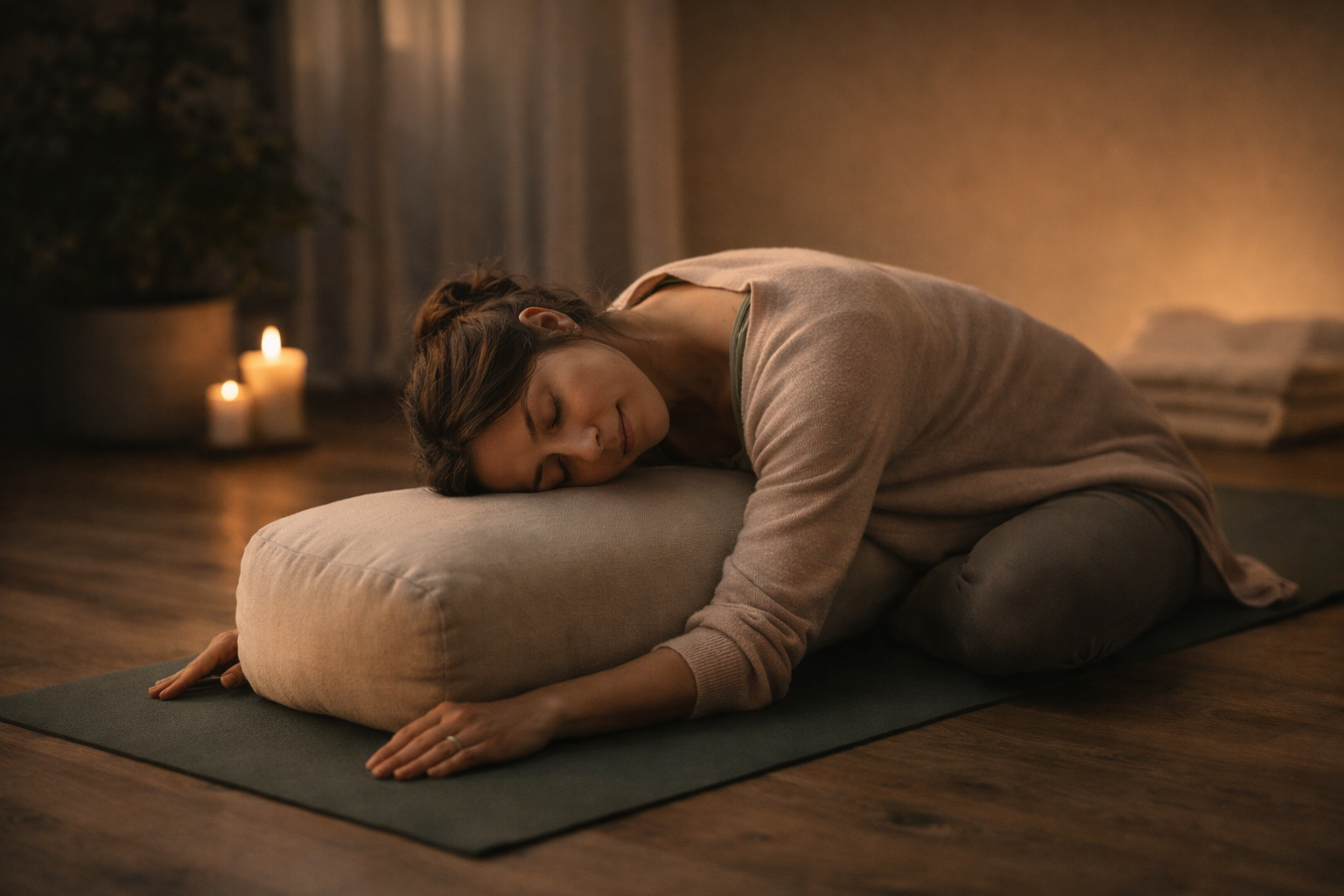
If Stress Never Really Leaves You, You May Be Resting the Wrong Way
At the end of the day, everything is finally quiet. The children are asleep. The last email has been answered. The kitchen has been restored to a version of order. You sink into the sofa, pick up your phone, and tell yourself the sentence so many modern adults whisper at night: Now I can rest. And yet, half an hour later, something still feels unsettled. The body is technically still, but the mind is not. The chest remains slightly tight. Thoughts continue to flicker like lights in windows that never quite go dark. This is one of the quiet frustrations of modern life: many people are stopping, but very few are truly recovering. We often imagine rest as the absence of activity. No work. No chores. No obligations. No movement. But for a nervous system that has spent all day bracing, performing, deciding, and absorbing, the absence of action is not always the same as the presence of restoration. A body can be motionless and still not feel safe enough to let go. That is why so many people wake after a weekend, or rise from an evening on the couch, and still feel oddly unrefreshed. They rested in the ordinary sense. They paused. But they did not truly come down. The modern problem is not merely that people are tired. It is that many no longer know how to cross the inner distance between alertness and recovery. We live in an age that trains the nervous system to remain partially activated at all times. Notifications arrive before breakfast. Messages interrupt conversations. Work seeps into evenings. Parenting, commuting, planning, responding, remembering — all of it creates a low, constant hum of vigilance. Even leisure has become strangely stimulating. We scroll to relax. We stream to unwind. We consume in order to recover. But the nervous system does not always interpret this as rest. It often experiences it as more input. And so a curious thing happens: people spend hours “off,” yet remain internally on. This is where the popular idea of rest begins to fail. Because rest is not simply the opposite of work. Rest is a physiological shift. It is the body’s ability to move from guarding to softening, from scanning to settling, from effort to repair. In other words, real rest requires a change of state , not just a change of schedule. This is why yoga matters in a way that goes beyond flexibility, posture, or fitness. At its deepest level, yoga is not merely movement. It is a method of communication with the nervous system. It says, in effect: You are allowed to stop preparing for the next thing. You are allowed to release what you have been unconsciously holding. You are allowed to return. For many people, especially those in their thirties and forties, this message is not easy to receive. These are often the years of layered responsibility — career, children, family, finances, invisible emotional labor. A person can become so practiced at functioning that they lose contact with the internal sensation of ease. They may know how to endure. They may know how to perform. They may even know how to “take a break.” But they no longer know how to feel safe enough to exhale fully. That is why doing nothing is sometimes not enough. Because when the body has forgotten how to downshift, rest must become intentional. Not dramatic. Not complicated. But intentional. A restorative yoga habit begins with a simple recognition: The nervous system changes through cues, not commands. You cannot order yourself to calm down in the same way you answer an email or finish a task. But you can create conditions in which calm becomes more likely. Breath is one of those conditions. Under stress, most people breathe too high in the chest and too fast to register. The inhale becomes urgent. The exhale becomes incomplete. The body remains subtly prepared for action. But when the exhale lengthens, the entire internal climate begins to shift. Heart rate softens. Jaw and shoulders loosen. Attention widens. A longer exhale is one of the body’s oldest signals of safety. This is why even a few minutes of conscious breathing can feel more restorative than a distracted hour of passive downtime. The body is not asking for more entertainment. It is asking for permission to come out of defense. A useful evening yoga ritual does not need to be impressive. In fact, the more exhausted a person is, the more simplicity matters. Dim the lights. Sit on the floor or on a chair. Begin with breath: inhale gently for four counts, exhale for six. Repeat this slowly, without strain. Already, something begins to change. Then soften the body not by forcing it, but by unhooking it from the day. A small forward fold. A gentle twist. A supported child’s pose. A posture where the body can feel held rather than asked to perform. The purpose is not to stretch deeply. The purpose is to change the message the body has been receiving all day. Not: do more. Not: improve. Not: achieve. But: enough now. Finally, lie down for a minute or two without reaching for the phone. Let gravity do what effort no longer should. This kind of practice may look too small to matter. But that is one of the great misunderstandings of healing. What the nervous system trusts is not intensity. It is consistency. A five-minute ritual repeated gently each night can teach the body more about safety than a single perfect class taken once a month. Many ambitious people measure rest the same way they measure work. How long did I sleep? How much time did I take off? Did I optimize recovery? But perhaps the better question is quieter: Did my system actually shift? Did my breathing slow? Did my mind stop bracing for what comes next? Did my body receive the message that, for this moment, it does not need to defend, decide, or deliver? If the answer is no, then even hours of inactivity may not restore very much. If the answer is yes, then even ten careful minutes can feel like rescue. This is not laziness. It is literacy. It is learning to read the language of the nervous system in a culture that rarely teaches it. And that may be one of the most necessary forms of wisdom in modern adulthood. For too long, many people have treated rest as empty space — the blank margin around the serious business of life. But real recovery is not empty. It is active in a quieter way. It is the deliberate rebuilding of inner conditions. It is the shift from being managed by stress to being met by care. Yoga offers this not because it is ancient, though it is. Not because it is fashionable, though sometimes it is. But because it understands something modern life often forgets: A human being does not recover merely by stopping movement. A human being recovers by re-entering safety. If stress never seems to leave you, it may not be because you are weak, undisciplined, or doing life badly. It may simply be that your way of resting has never truly reached the place where stress is held. The good news is that the doorway is often smaller than people imagine. A longer exhale. A darkened room. A posture of surrender rather than performance. A few minutes without demand. Sometimes recovery does not begin with a vacation or a breakthrough. Sometimes it begins with the body hearing, perhaps for the first time all day: You do not have to stay ready anymore. And in that moment, rest stops being the absence of work. It becomes the return of self.
Reset Yoga Editorial Team →
 Premium Stress relief Restless nights Focus & clarity
The Simplest Wellness Practice in the World
Morning commute. The train is quiet except for the soft rhythm of movement. Passengers stare into their phones. Later, before a meeting, shoulders tighten over keyboards as emails are sent in haste. At night, after children finally fall asleep, the mind begins planning tomorrow. Modern life moves quickly. Yet in the middle of this constant motion, something subtle often disappears. Our breath. Most people rarely notice it. But stress changes it instantly. Breathing becomes shallow. Faster. Tighter. In yoga philosophy, breath is not merely air entering the lungs. It is life energy. The ancient yogic science of breathing is called Pranayama . The word combines two Sanskrit ideas: Prana — life force Ayama — expansion or control In simple terms, pranayama is the art of working with breath to influence body and mind. And its central insight is remarkably powerful. Change the breath, and you change the state of your entire system. The Breath We Forget The average person takes more than twenty thousand breaths every day. Yet we rarely notice a single one. Breath changes automatically with emotion. Anxiety speeds it up. Stress makes it shallow. In that sense, breath acts like a mirror of the mind. But pranayama introduces a reversal of this relationship. Instead of the mind controlling breath, breath can guide the mind. Slow the breath, and the nervous system begins to calm. Lengthen the exhale, and the body relaxes. Modern neuroscience increasingly confirms what yogis discovered centuries ago. Breath is one of the most direct pathways to regulating the nervous system. Three Simple Practices for Beginners Pranayama may sound ancient and mysterious, but its entry point is surprisingly accessible. Here are three gentle practices. 1. Deep Diaphragmatic Breathing Inhale slowly through the nose, allowing the belly to expand. Exhale gently. This simple breathing pattern activates the body’s relaxation response and releases tension. Even one minute can make a difference. 2. Alternate Nostril Breathing (Nadi Shodhana) Using the fingers, close one nostril and inhale through the other. Then switch sides. This technique is believed to balance the two hemispheres of the brain and create mental clarity. Many practitioners use it before focused work or meditation. 3. 4-4-6 Breathing Inhale for four seconds. Hold the breath for four seconds. Exhale slowly for six seconds. The longer exhale signals safety to the nervous system and encourages deep relaxation. It can be particularly helpful before sleep. Why Busy People Need Breath the Most Modern wellness culture often focuses on complexity. New technologies. New supplements. New training routines. Breathing asks for something simpler. Attention. No equipment is required. No membership is needed. Just awareness. Especially for people in their thirties and forties — often the busiest years of life — a few minutes of conscious breathing can change the tone of an entire day. Breath as a Doorway to the Present Our minds often live in two places. The past. Or the future. Regret. Worry. Breath, however, exists only in the present moment. This is why focusing on breath can feel grounding. It quietly pulls attention back to the now. In that sense, pranayama becomes a form of moving meditation. In the End Yoga contains many postures. Some elegant, some physically demanding. But at its center lies something far simpler. Breath. If today feels overwhelming, there is no need for an elaborate practice. Sit down. Close your eyes. Take a slow inhale. And an even slower exhale. The body will begin to remember something it has always known. Its natural rhythm. And in that quiet rhythm, you may discover that calm was never far away. It was there all along, waiting in the next breath.
Reset Yoga Editorial Team →
 Premium Stress relief Shoulder tension Recovery
The Quiet Secret to Better Yoga
Early morning. The world is still quiet. Before the children wake up, before the inbox fills with messages. You roll out your yoga mat. A deep breath. Arms reach toward the ceiling. For many people in their 30s and 40s, yoga has become a small ritual of recovery — a way to reconnect with the body after long hours of work, parenting, and digital noise. And yet, there are days when something feels different. On some mornings, the body feels light and responsive. On others, every movement feels heavy, slow, resistant. The poses are the same. So what changed? Often, the answer is surprisingly simple. What — and when — you ate. Most of us pay attention to what we eat. But very few of us consider how food interacts with movement. Yoga traditions have long understood that the relationship between food and practice is essential. Because yoga is not simply exercise. It is an activity that works with the body’s internal energy and breath. And digestion is part of that energy. Eating Before Yoga Lightness Creates Freedom Imagine trying to fold forward with a full stomach. The abdomen feels compressed. Breathing becomes shallow. The body instinctively resists movement. For this reason, many yoga teachers recommend finishing a meal two to three hours before practice. If hunger is unavoidable, a very light snack can help. Examples include: a banana yogurt a handful of nuts a smoothie These foods digest relatively quickly and provide gentle energy without burdening the body. The guiding principle is simple: Before yoga, keep the body light. When the body feels light, breathing deepens. And when breathing deepens, the mind begins to settle. Eating After Yoga The Body Becomes Receptive After yoga practice, something subtle happens. Circulation improves. The nervous system relaxes. Digestion becomes more active. In other words, the body is ready to receive nourishment. This makes the post-yoga meal especially meaningful. The most supportive foods are simple and natural. For example: vegetable-based meals warm soups whole grains such as brown rice fresh fruits In Ayurveda, these foods are known as sattvic foods — foods that promote clarity and balance. They nourish not only the body, but also the mind. Heavy meals, excessive oils, or too much sugar can disrupt the calm state that yoga has created. Food Is Not Just Fuel Modern life often treats food as a quick transaction. We eat between meetings. We scroll through phones while chewing. Yoga quietly challenges that habit. It reminds us that eating is not only about calories. It is a conversation with the body. Does this food create lightness? Or heaviness? Energy, or fatigue? Simply asking that question begins to transform the relationship we have with food. Why Busy People Need This the Most People in their thirties and forties often carry the greatest load. Career pressure. Children. Responsibility. Time becomes scarce. That is why yoga matters so much. But the benefits of yoga multiply when the surrounding habits support it. A small change in meal timing can dramatically affect flexibility breath depth mental focus It is one of the simplest improvements anyone can make. In the End Yoga is not about mastering poses. It is about rebuilding a relationship with the body. And that relationship continues beyond the yoga mat. It continues at the table. The next time you practice yoga, pay attention to when you last ate. Notice how your body responds. You may discover something subtle but powerful. The body is always communicating. And sometimes, the smallest habits quietly reshape the quality of an entire day.
Reset Yoga Editorial Team →
 Stress relief Neck tension Shoulder tension
The Yoga That Actually Works
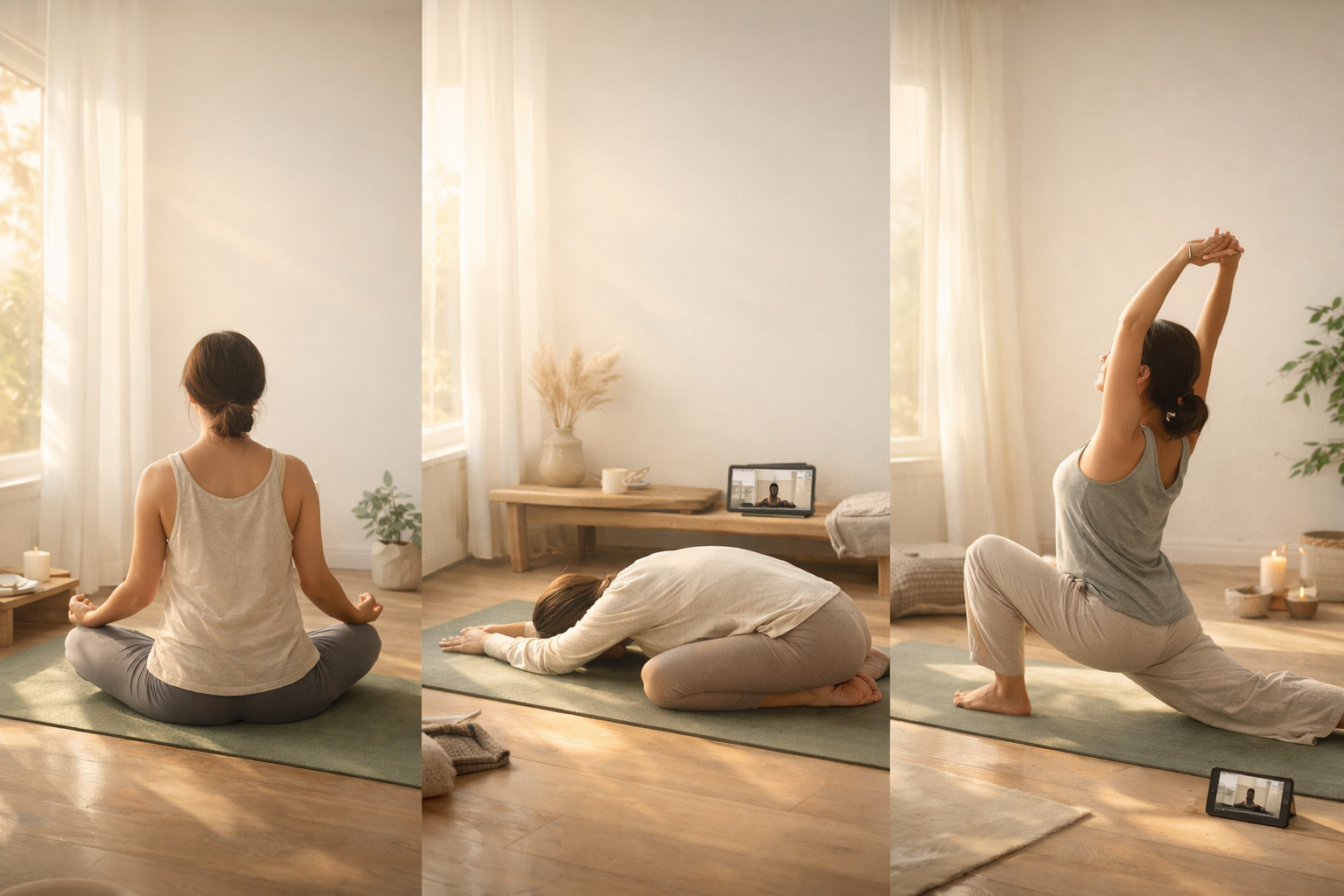
Early morning. Before the children wake up, before the first meeting begins, before the phone fills with notifications. For a brief moment, the house is quiet. You roll your shoulders. They are tight again. The tension didn’t appear overnight. It built slowly — through emails, deadlines, school runs, and the invisible mental load of modern life. For many people in their 30s and 40s, yoga becomes a refuge. A place to breathe. A place to stretch. A place to recover. And yet, many people quietly feel something puzzling. “I’m doing yoga… but it doesn’t always feel right.” The answer may be simpler than we think. Not all yoga is meant for every body. And this is where an ancient wisdom begins to make sense. More than 5,000 years ago, the traditional Indian science of Ayurveda described human constitution through three energetic patterns: Vata Pitta Kapha These are known as doshas . Each person carries a unique combination of them, and understanding your dominant dosha can help you choose the yoga style that supports your body instead of fighting against it. Because yoga, at its core, is not about flexibility. It is about balance . Vata The restless energy of modern life Vata represents the energy of air and movement. People with strong Vata energy tend to be creative, fast-thinking, and constantly multitasking. Many busy professionals and parents fall into this category. But this movement often comes with tight shoulders shallow breathing anxiety restless sleep For Vata types, the most effective yoga is slow, grounding, and calming . Recommended practices include: gentle Hatha yoga restorative yoga long, slow stretching Breathing practices such as deep diaphragmatic breathing or alternate nostril breathing (Nadi Shodhana) can help calm the nervous system. The goal is simple: to bring the wind back to the ground. Pitta The driven achiever Pitta represents the energy of fire. These are the leaders, decision-makers, and high performers. They are focused, productive, and often highly successful. But the same fire can create tension in the neck and shoulders irritability burnout difficulty relaxing For Pitta types, the most beneficial yoga is not intense. It is cooling and softening . Practices such as Yin yoga restorative yoga slow flow yoga allow the nervous system to reset. Cooling breathing techniques such as Sitali breathing can also help balance excess heat in the body. For Pitta personalities, yoga is not about pushing harder. It is about learning to let go. Kapha The steady foundation Kapha represents earth and water. People with strong Kapha energy tend to be calm, patient, and deeply supportive of others. They often become the emotional anchors of families and teams. However, they may also experience heaviness in the body stiffness in the back and shoulders low motivation to move For Kapha types, yoga should be energizing and stimulating . More dynamic styles such as Vinyasa yoga Power yoga Sun salutations can awaken the body’s energy. Breathing techniques like Kapalabhati breathing can help activate vitality and circulation. For Kapha types, movement is medicine. The deeper purpose of yoga But perhaps the most important insight is this: Yoga is not about mastering poses. It is about understanding your own body. Most of us move through life without listening to the signals our bodies send. We push through fatigue. We ignore tension. We forget to breathe. Yoga creates a rare moment where something shifts. A realization appears. “I have been holding tension for hours… maybe years.” That moment of awareness is where real healing begins. Why busy people need yoga the most Especially in the modern world. People in their 30s and 40s carry an extraordinary amount of responsibility. Career. Children. Relationships. Endless digital noise. That is why even ten minutes of mindful movement can change the entire rhythm of a day. A slow stretch. A quiet breath. A gentle twist. These small practices become powerful anchors. In the end Ayurveda offers a simple idea. Health is not about perfection. It is about living in harmony with your natural rhythm. You do not need the perfect yoga practice. You only need a moment of awareness. And when that awareness appears, yoga becomes something deeper than exercise. It becomes a way of coming back to yourself. And sometimes, in that quiet moment, a surprising thought appears. Maybe life does not have to be pushed so hard. Maybe it can also be lived gently.
Reset Yoga Editorial Team →
This content is for educational purposes only and is not medical advice. If you have pain, injury, pregnancy-related concerns, or a medical condition, consult a qualified healthcare professional before practicing.