Yoga Pose Library
Browse by concern, family & difficulty
Yoga & Science
Why yoga works — stress, sleep, posture & recovery
Browse by concern
Guided Meditation Videos
5–10 minutes · Watch anytime
 5 min
5 min Focus & clarity
 Posture
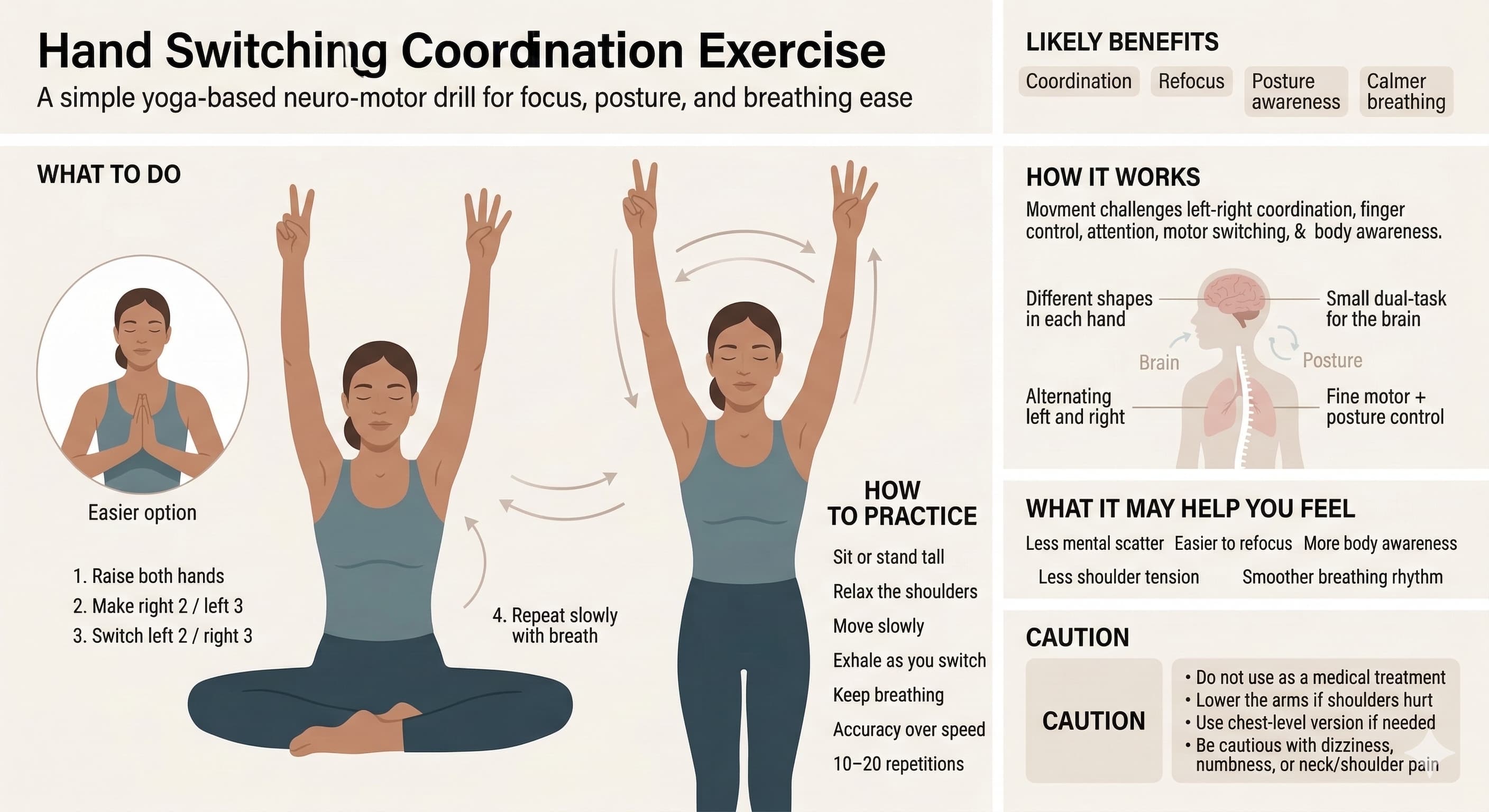
Hand Switching Coordination Exercise
A simple finger-coordination exercise that alternates different shapes in each hand. It may help improve brain-body coordination, mental refocusing, posture awareness, and smoother breathing.
 5 minPremium Focus & clarity
 Eye fatigue
Sutra Neti / சூத்ர நேதி
Sutra Neti is an advanced yogic purification practice in which a thread or soft catheter is inserted through the nose and guided out through the mouth. It is traditionally used to clean the nasal passage and is considered part of the preparatory cleansing practices of Hatha Yoga. Because it can irritate or injure the nasal lining if done incorrectly, it should be learned only under qualified guidance. Benefits Its main purpose is to cleanse the nasal passages and improve ease of breathing. Neti practices are also commonly described as helping reduce mucus buildup, support sinus comfort, and promote mental calmness and clarity, which may help prepare for pranayama and meditation.
 5 minPremium Posture
 Core strength
Peacock Pose / Mayurasana
This pose is connected with a historical and spiritual story about a sacred mountain in India, possibly Marunthuvazh Malai. According to legend, when Lakshmana was seriously wounded, Hanuman carried a mountain of healing herbs to save him. The mountain is regarded as a sacred place of worship in local tradition. People worship Shiva there, and the place is also associated with devotion to Hanuman. I practiced this pose there, so for me it carries a deep spiritual meaning.
Wellness Articles
Browse by concern
 Premium
 Restless nights
Sleep Arrives on the Exhale: 4-7-8 Breathing for Rainy Nights
The rain has been falling since evening, and now you are in bed, wide awake. Your body feels heavy, your eyes are tired, and yet your mind keeps circling the day. If the rainy season fills your nights with this restless, foggy wakefulness, you are far from alone. Tonight, instead of trying harder to fall asleep, try giving your mind one simple job: counting your breath. The 4-7-8 method is a quiet practice rooted in pranayama, the yogic art of breath regulation — and you can do the whole thing without leaving your bed. Why Rainy Nights Feel Different Many people notice that on low-pressure days the body wants to rest but the mind will not switch off. You lie down exhausted, and somehow become more alert the moment the lights go out. The harder you chase sleep, the shallower and faster your breathing tends to become — which is precisely the breathing pattern of staying awake. Add the white-noise hum of rain and a duvet that feels a touch too humid, and it is no wonder June nights can seem longer than they should. Here is the small insight at the heart of the 4-7-8 breath: the exhale is twice as long as the inhale. A long, slow out-breath is something many practitioners find supportive for easing toward rest mode. And the rain outside does not have to be the enemy. Its rhythm is steady and patient — let it become the backing track for your counting. The 4-7-8 Breath, Step by Step Start with the detail most people skip: the tongue. Place the tip of your tongue gently against the ridge of gum just behind your upper front teeth, and keep it there for the entire practice. This anchors the mouth and gives the exhale its soft, whooshing sound. First, exhale once completely through your mouth, making an audible whoosh and emptying your lungs. Close your mouth and inhale quietly through your nose for a count of four. Hold your breath for a count of seven. Exhale through your mouth, whooshing softly, for a count of eight. That is one cycle. Do four cycles, then stop. Even once the practice feels familiar, cap a single session at eight cycles. This is not a "more is better" technique — what matters is the ratio, not the volume. About that ratio: the counts do not need to be seconds. Keep the 4:7:8 proportion at whatever tempo feels comfortable. If holding for seven is a strain, halve everything — two, three and a half, four — and grow from there. And if you feel light-headed at any point, simply return to normal breathing and rest. Dizziness is your body asking you to slow down, not a wall to push through. One practical note before you begin: put your phone out of reach and dim the lights. Counting holds your attention far better in a dark, quiet room. Positions You Can Take Without Getting Up You do not need to sit up cross-legged for this practice. In fact, staying in your sleeping position is the point. Lie on your back with your knees bent, or slide a pillow under your knees to soften the lower back. Rest one hand on your belly and one on your chest. As you inhale, feel the belly hand rise first. If lying on your back is uncomfortable, turn onto your side and hug a pillow; it gives the chest room to soften. Pull the duvet up to your chest rather than over your shoulders, so the breath has somewhere to go. Check your shoulders and jaw before you start. If they are holding tension, squeeze your shoulders up toward your ears once, then let them drop completely. And when the four cycles are done — do nothing. Resist the urge to check whether it "worked." Keep your eyes closed, let the rain keep its rhythm, and allow your breath to drift back to its own pace. Sleep is not something you chase; it is something you make room for. Into Today's 45 Minutes Counting your own breath while also letting go of effort is surprisingly hard to do alone — in our live classes, the teacher watches your breathing and carries the count for you, so all you have to do is follow. On a rainy night, those 45 quiet minutes might be exactly the room your sleep has been waiting for. This article is general wellness information, not medical advice. If you have pain or a medical condition, consult your doctor before practising.
Reset Yoga Editorial Team →
 Premium Eye fatigue Focus & clarity
 Neck tension
Resetting Your Gaze When PC Work Makes You Foggy
If you feel foggy during PC work, the problem is often not lack of discipline . It is often the result of fixed gaze, neck tension, shallow breathing, and visual overload . Three essentials: Staring at one distance too long drains focus and stiffens the neck Real recovery means changing gaze distance, direction, and focus — not just closing your eyes A 1-minute gaze reset repeated throughout the day works better than waiting until total fatigue In short: Do not force yourself to look harder. Reset your gaze so your neck and brain can come back online. Resetting Your Gaze When PC Work Makes You Foggy How fixed visual focus steals your neck and concentration — and what to do about it By a certain hour of the afternoon, many people are still looking at the screen but no longer truly seeing it. The words remain legible. The document is still open. The meeting is still happening. And yet attention has thinned. You reread the same line. You forget what the last sentence meant. Your neck feels heavier than it should. Your eyes feel hot, but tired in a strangely dull way. This kind of fog is often mistaken for laziness or poor discipline. In reality, it is often something more physical — and more specific. When people become mentally blurry during PC work, the problem is frequently not motivation. It is a visual system that has been held too still for too long. And because vision is connected to the neck, posture, breathing, and attention, the consequences extend far beyond the eyes. Modern work has turned gaze into labor. Hour after hour, the eyes are asked to do something astonishingly narrow: look forward, at the same distance, with the same kind of precision, for prolonged stretches of time. Emails. Sheets. Slides. Chats. Video calls. Search results. The body adapts to whatever the eyes are doing. If the gaze stays fixed, the head stays fixed. If the head stays fixed, the neck begins working quietly in the background. If that work continues long enough, breathing narrows, posture drifts forward, and mental clarity begins to dim. This is not dramatic strain. It is low-grade, continuous effort. And continuous effort is often more exhausting than obvious effort because it goes unnoticed. People think they are just “looking.” In fact, they are stabilizing, bracing, adjusting, processing, and suppressing variation. That is a lot of work for one narrow visual channel. The first mistake most people make is to treat eye fatigue as if it belongs only to the eyes. They rub them. Close them briefly. Look away for a second. These can help. But they do not fully solve the problem, because what PC work often steals is not just ocular comfort. It steals variety. Variety of distance. Variety of direction. Variety of focus. Variety of coordination between eyes, head, neck, and breath. This is why the most useful intervention is not simply “resting the eyes.” It is resetting the gaze . That means restoring movement and range to the visual system. Look far. Look near. Look wide. Look side to side. Stop demanding sharp focus for a moment. Let the eyes and neck remember that vision is not supposed to be fixed in one narrow lane all day. That is not a luxury. It is maintenance. A practical reset can take less than a minute. First, look away from the screen and direct the eyes toward something farther away — a window, a wall, the far end of the room. Stay there for ten seconds. Then move the eyes gently left and right a few times without moving the head much. After that, let the head follow and turn softly side to side. Finally, instead of focusing sharply on one object, widen the field. Let the whole room enter the eyes at once. This final step matters more than it sounds. Most screen work trains a hunting gaze — narrow, precise, extracting information. A broader gaze invites the nervous system to soften. The body stops behaving as if it must seize and parse every detail. Add one longer exhale here, and the reset deepens. Because by this point, it is not only the eyes that need variation. It is the whole organism. Yoga understands something modern productivity often forgets: A body part does not tire alone. A strained gaze changes the neck. A strained neck changes the breath. A strained breath changes the quality of thought. This is why gaze reset is not a tiny ergonomic trick. It is a way of restoring conditions for better cognition. A person whose visual system is locked into one distance for hours becomes mentally narrower as well. They may still be working, but with less freshness, less breadth, less ease. That is why pushing harder often fails. The body is not asking for more force. It is asking for more options. And options are what a good reset provides. What makes this especially important for busy professionals is that fog often arrives before it is acknowledged. People continue pushing. They assume they need more caffeine, more urgency, more pressure. But often the smarter move is smaller. Step out of the fixed frame. Let the eyes change task. Let the neck stop serving as a tripod for a screen-bound head. Let the breath resume full citizenship in the body. This is not stepping away from work. It is returning to work with better hardware. And that is the more accurate way to understand it. Visual reset is not avoidance. It is performance design. The brain works better when the eyes are not trapped. The neck feels better when the gaze is not frozen. Thought becomes more coherent when the body stops mistaking concentration for immobility. There is also a larger metaphor here. Many people believe attention means staring harder. Pushing closer. Holding tighter. Reducing everything to one narrow channel. But some of the best thinking happens not when vision contracts endlessly, but when it regains range. A wider gaze often makes for a wiser mind. Not because precision disappears, but because the body is no longer locked into a state of visual emergency. That is why a brief gaze reset can sometimes restore more than comfort. It can restore perspective. And perspective is often what disappears first when work becomes too screen-shaped. The next time you feel yourself fading at the computer, do not immediately blame your character. Ask different questions. How long have I been looking at the same distance? Has my neck been holding my head in one exact relationship to the screen? Has my breathing become too small to support clear thought? Has my gaze forgotten how to widen? If the answer is yes, then your mind may not need more pressure. It may need release. Look far. Look wide. Move the eyes. Move the head. Exhale slowly. Then return. Because what fixed screen work steals is not only energy. It steals flexibility of attention. And sometimes the shortest path back to focus begins not with trying harder to think — but with teaching the eyes, the neck, and the nervous system that they are allowed to move again.
Reset Yoga Editorial Team →
 Premium
 Stress relief Restless nights
3 Minutes of Breath to Switch the Body Into Sleep Mode
If you want a simple bedtime breathing method, this is enough: Inhale through the nose for 4 counts, exhale through the nose for 6 counts, for 3 minutes. Three essentials: At night, the exhale matters more than taking a huge inhale A longer exhale helps shift the body toward “sleep mode” Do not judge whether it “worked” immediately — let it become a signal, not a task In short: You do not need a long sleep ritual. You need a short breathing pattern that tells the body it is safe to let go. 3 Minutes of Breath to Switch the Body Into Sleep Mode A simple bedtime breathing pattern that works without being long — even for complete beginners There is a particular cruelty to the sleepless night. You are tired enough to know you need rest. But the moment you lie down, the mind becomes brighter than it was an hour before. The room is dark. The body is horizontal. Yet thought continues — unfinished conversations, tomorrow’s tasks, small future worries enlarging in the silence. At that hour, many people believe the answer must be something complicated. A longer routine. A more advanced sleep practice. A better ritual. A more disciplined evening. But often the body does not need something elaborate. It needs something legible. What the sleepless body often needs is not a heroic effort, but a short, repeatable signal that it is finally safe to power down. Breath is one of the clearest ways to send that signal. And it does not need to take long. Three minutes can be enough to begin. Sleep is not something the body can be ordered into. The more a person tries to force it, the more the nervous system often interprets the effort as evidence that something important is still happening. Stay alert. Get this right. Do not fail at sleeping. That inner tone is incompatible with ease. So a useful bedtime breath should not feel like work. It should feel like downshifting. This is why the most beginner-friendly breathing pattern for sleep is so simple: Inhale through the nose for 4 counts. Exhale through the nose for 6 counts. Repeat for 3 minutes. That is all. Not because it is magical. But because it respects something essential about the nervous system. A slightly longer exhale tends to signal reduced urgency. It tells the body: you do not need to prepare for the next thing right now. The inhale receives. The exhale releases. And at night, release is what matters most. Many beginners assume that good breathing means very deep breathing. So when they try to relax, they over-inhale. The chest lifts too much. The neck tightens. The shoulders become involved. What was meant to calm the body begins to activate it instead. This is why sleep breathing should remain modest. The goal is not to fill yourself with air. The goal is to soften the tempo. A 4-count inhale is usually enough. A 6-count exhale is long enough to nudge the system downward without becoming stressful. If six feels too long, five is fine. The exact mathematics matter less than the direction: let the exhale be a little longer than the inhale. That is the key. There are a few gentle rules that make this work better. First, the body position does not have to be perfect. You can lie on your back, lie on your side, or sit propped up in bed. What matters most is that the throat and chest are not compressed. Second, do not force the breath into a single area. Let it move softly through the torso — front, sides, perhaps even a little into the back body if that is accessible. Third, and this may be the most important part: do not turn the breath into a test. The purpose of the 3-minute pattern is not to guarantee immediate unconsciousness. It is to help the body shift toward the physiology of sleep. If, after three minutes, you start evaluating whether it worked, the nervous system may become tasked again. The better response is simpler. Finish the breath. Then remain there. Let the body continue the conversation the breath has started. This shortness matters, especially for busy adults. People with full lives often imagine that real recovery must be elaborate to be effective. A perfect nighttime protocol. An hour of dim lights and ideal habits. A carefully managed sequence. In reality, the most effective practice is often the one a tired person can actually do. Three minutes is small enough not to become another burden. Short enough for late nights. Portable enough for travel. Simple enough not to provoke resistance. And small does not mean weak. The nervous system can respond strongly to repetition, especially when the signal is clear. A short pattern practiced consistently may be more useful than a longer one practiced rarely. Because healing is often less about intensity than direction. Three minutes may not solve everything. But it can point the body toward rest. And at night, direction matters. There is also a larger lesson hidden here. Modern people often think restoration must be earned through scale. Longer sleep. More time off. A bigger intervention. But some of the most meaningful changes begin with smaller acts that the body can trust. A slower exhale. A softer jaw. A rhythm that no longer feels like daytime. What the sleepless body needs is not more command. It needs a reason to stop guarding. The breath can become that reason. Not because it controls sleep directly, but because it changes the conditions in which sleep becomes more possible. That distinction is everything. Sleep cannot be seized. It can only be invited. And invitation is made not through force, but through safety. If tonight feels restless already, begin there. No advanced techniques. No pressure. No attempt to perform calm. Just this: Inhale through the nose for 4. Exhale through the nose for 6. Three minutes. Quietly. Without rushing. Without grading. Let the breath become slower than the day. Let the body notice. Let the nervous system update its assumptions. Perhaps not everything in life is safe and settled. But for these few minutes, maybe the body can stop behaving as if it must remain on duty. That is what makes this pattern powerful. It does not promise perfection. It offers a way back. A way from alertness toward surrender. From defended wakefulness toward possible sleep. And sometimes that is all the body has been waiting for: not a better argument, not a stronger will, but one small, repeated rhythm that says — you may let go now.
Reset Yoga Editorial Team →
 Premium Stress relief
 Recovery
Yoga Is Not for Becoming More Positive — It Is for Coming Back
When your mental state is low, what you need first is usually not positive thinking . You need to help your nervous system feel safe again. Three essentials: You cannot think your way into recovery if your body is still braced Yoga helps by restoring breath, softening tension, and bringing the system back into a safer zone The goal is not to become upbeat immediately, but to return to a place where recovery can begin In short: Yoga is not mainly for making you more positive. It is for helping you come back to yourself. Yoga Is Not for Becoming More Positive — It Is for Coming Back When the mind is worn down, what you need is not optimism first, but a way to bring the nervous system back into safety When people are emotionally worn down, they are often asked to do something strangely violent. They are asked to improve before they have recovered. Think positively. Reframe it. Be resilient. Do not spiral. Move on. The advice is often well intended. Sometimes it even helps. But on certain days, especially the more depleted ones, such advice lands like another demand placed on a system already too burdened to carry itself well. What hurts then is not only the original fatigue or sadness or strain. It is the second burden — the pressure to become better before feeling safe. This is where many people misunderstand both healing and yoga. Yoga is not fundamentally a technology for becoming more positive. It is a technology for returning — returning from overactivation, fragmentation, bracing, and inner exile back toward a place where the body no longer feels under immediate threat. That distinction matters. Because recovery rarely begins with inspiration. It usually begins with safety. Modern life rewards upward motion. More output. More energy. More optimism. More function. Even recovery is often framed as improvement. How can I bounce back faster? How can I become stronger from this? How do I return to peak performance? There is ambition even in our language of healing. But the body does not always heal in an upward line. Sometimes the first task is not to rise. It is to come down. To come down from a racing mind. From a guarded chest. From a jaw that has forgotten it is clenched. From a breath that never quite completes itself. From the subtle internal message that says: stay ready. This is why a person can understand, intellectually, that things are “okay” and still feel profoundly unokay in the body. Thought has moved. The nervous system has not. The body does not organize itself around slogans. It organizes around cues. And when it still feels those cues as threatening — shallow breath, constricted posture, fixed gaze, muscular guarding — positive thinking can feel less like healing and more like performance. This is the deeper wisdom yoga offers. Yoga does not begin by demanding a different personality. It begins by asking what state the organism is in. Can you breathe? Can the exhale lengthen? Can the shoulders drop without force? Can the eyes soften? Can the chest stop acting as though it must defend itself every minute? These are not glamorous questions. They are foundational ones. Because when the nervous system is dysregulated, the first need is rarely meaning. It is regulation. That is why some of the most therapeutic yogic tools are so physically modest. A longer exhale. A child’s pose. Legs up the wall. A forward fold that narrows the world. A quiet hand on the chest or belly. A floor that can be felt beneath the body again. These things do not solve life. They do something earlier and more essential. They tell the body: you may stop guarding for a moment. And that is often the beginning of everything. To “return” is a subtle phrase, but an important one. It does not mean returning to productivity immediately. It does not mean returning to cheerfulness on demand. It does not mean becoming the best version of yourself by force. It means returning to enough internal safety that your own breath feels inhabitable again. Returning to a place where your mind is not running ahead of your body. Returning to a state in which you can feel what is happening without being consumed by it. Returning to a body that is no longer organized entirely around defense. This is why yoga can be so powerful for people whose mental state has dimmed. Not because it makes them instantly hopeful. But because it gives them a route back into themselves that does not begin with argument. No debate with the mind. No lecture about mindset. No compulsory brightness. Just breath, shape, gravity, and sequence. The system settles. Then, perhaps later, the meaning changes too. Many ambitious adults resist this at first. Especially professionals, parents, leaders — people who are used to being the ones who hold things together. For them, returning can feel too passive. Too soft. Too slow. They would rather solve the state than honor it. But what if honoring the state is the more intelligent solution? In business, a distressed team rarely responds best to pressure before safety. Trust must come first. Regulation must come first. The environment must stop signaling danger before creativity and clarity can return. The body operates under similar principles. A person whose nervous system feels endangered will not become more whole because they were told to act more positive. They become more whole when their system stops receiving threat as the dominant message. This is why yoga, at its most mature, is not self-improvement theatre. It is not there to make you impressive in your own eyes. It is there to make you inhabitable to yourself again. For a busy person, this can be a radical shift. It means that on the days when you feel mentally weak, the first assignment is not to become mentally strong. The first assignment is to become physiologically safer. That may mean fewer inputs. A dimmer room. A slower exhale. A lower posture. A hand on the floor. A refusal to perform resilience before the body is ready to carry it. What happens then is subtle, but real. The mind may not brighten instantly. But it stops feeling so hunted. The body may not feel energetic. But it no longer feels as exiled from itself. And from that place, actual recovery can begin. Not glamorous recovery. Not branded recovery. Not “optimized” recovery. Just the ordinary, sacred act of coming back. If you are struggling, you do not need to become inspirational first. You may need first to feel the ground. To lengthen the exhale. To stop asking the mind to do what the nervous system has not yet been allowed to do. To let yoga be what it truly is: not a ladder into a better version of yourself, but a path back toward the self that stress, fear, and exhaustion temporarily made harder to reach. That is not a small thing. In fact, it may be one of the most powerful forms of strength available to an adult life. Because real strength is not permanent positivity. It is the capacity to know how to return. And yoga, on its best days, is exactly that: a way of teaching the body that it is safe enough to come home before asking the mind to be bright again.
Reset Yoga Editorial Team →
 Premium
 Shoulder tension Posture Neck tension
Rounded Shoulders Do Not Improve Through Willpower
Rounded shoulders usually do not improve by simply “pulling them back.” The real issue is often a bad sequence: the front body stays tight, breathing stays shallow, and the back body is asked to compensate too early . Three essentials: First soften the front body Then restore breathing space through the chest, ribs, and back Only then teach the back body to support intelligently In short: Better posture comes less from trying harder and more from restoring the right order. Rounded Shoulders Do Not Improve Through Willpower Why fixing rounded shoulders is less about pulling the chest up and more about softening the front body first, then teaching the back body to work intelligently By late afternoon, many shoulders have already made a decision. They roll inward. The chest narrows. The head drifts slightly forward. The body begins to wear the day like a coat that has grown too heavy. Most people respond in the same earnest way. They pull the shoulders back. Lift the chest. Try to “fix” the shape through effort. For a few seconds, it can even look successful. And then the strain begins. The neck tightens. The lower back overcompensates. The chest becomes rigid rather than open. Soon enough, the shoulders drift forward again. This is the moment many people misread. They assume the problem is lack of discipline. In fact, the problem is often sequence. Rounded shoulders do not usually improve through force because the body is not simply “out of place.” It is organized around a pattern — and patterns have to be changed in order. That order matters more than most posture advice admits. Modern life trains the shoulders to move inward for very practical reasons. The arms spend much of the day in front of the body. Hands on keyboard. Hands on phone. Hands on steering wheel. Eyes forward. Breath shortened. Upper chest narrowed. From the body’s perspective, this is not laziness. It is adaptation. Rounded shoulders are often the posture of efficient forward work. That does not make them ideal. But it means the body has learned them for a reason. And if posture has been learned through repetition, it will not be unlearned through a few stern commands. This is where many well-meaning corrections go wrong. People are told to “open the chest” or “pull the shoulders back.” But if the front body is still tight, and the breathing pattern is still restricted, and the rib cage is still collapsed, then the back body is being asked to fix a problem whose deeper conditions remain unchanged. That is why the correction feels exhausting. The body is trying to stage a result without changing the cause. The first stage of real change is almost always the same: soften the front. Not aggressively stretch it into submission. Not yank the shoulders backward. Soften it. The chest muscles, the tissue beneath the collarbones, the front of the shoulders — these regions often become quietly shortened in desk-heavy life. If they remain dense and guarded, the shoulders cannot truly reposition with ease. They can only be pulled. And pulled shoulders are not restored shoulders. This is why simple opening gestures matter. A hand on a wall. A doorway stretch with restraint instead of force. A breath into the upper chest that does not turn into a dramatic rib flare. A moment of allowing the front body to stop behaving as though it must always protect the screen-facing position. This is subtle work. But subtle work changes the conditions from which posture arises. Then comes breath. Many people with rounded shoulders do not just have a shoulder problem. They have a breathing problem. The breath sits high. The ribs move poorly. The front chest works too hard while the side ribs and back body remain underused. In this condition, “good posture” becomes almost impossible to sustain comfortably because the body cannot breathe well inside it. That is why posture advice so often fails. It ignores respiration. A useful correction is not merely to lift the chest, but to widen the breathing space. Into the side ribs. Into the back body. Into the sternum without thrusting. Into the whole upper torso as a three-dimensional structure rather than a flat front panel. Once breath returns, the shoulders are no longer being asked to live in a shape the lungs cannot support. That changes everything. Only after softening the front and restoring breath does it make sense to train the back body more actively. And even then, the goal is not crude retraction. Many people think posture improves by squeezing the shoulder blades together. Sometimes that cue helps briefly. But often it creates a new problem: too much pinching, too much chest thrusting, too much neck tension. The back body does not need to become dramatic. It needs to become intelligent. This means learning how the shoulder blades rest and move on the rib cage. How the upper back supports the arms. How to press into a wall or the floor without collapsing the neck. How to let the back participate without turning it into a permanent contraction. Wall pushes help. Tabletop work helps. Any movement in which the body learns to press and organize rather than simply pull backward can be powerful. Because the back body’s role is not just to drag the shoulders into place. It is to support the torso and arms in a way that makes a more open posture livable. That is very different. This sequence — front body, breath, back body — may seem almost too simple. But it reflects something true not only about posture, but about change itself. People often try to strengthen what is weak before softening what is rigid. They add effort before restoring possibility. Yet many systems do not improve that way. A relationship does not deepen by pressure alone. A business does not grow cleanly by adding speed to disorder. A body does not open by commanding a new shape while the old tension remains locked inside it. Sometimes what needs to happen first is not more power. It is less holding. Rounded shoulders follow this rule. They do not resolve because the body is bullied into appearing upright. They begin to change when the front no longer needs to cling, when breath no longer stays trapped, and when the back can finally participate with intelligence rather than strain. For busy professionals, the practical implication is reassuring. You do not need to spend an hour a day trying to “fix” your posture. You need brief moments of better sequencing. A breath into the upper chest before the first meeting. A gentle front-shoulder opening at the wall between tasks. A few quiet presses into a desk or floor to wake up the back body. Less forcing. More reorganization. The goal is not to become someone who remembers to stand perfectly all day. The goal is to become someone whose body has better options. That is more sustainable. And more honest. If your shoulders keep rolling forward, do not assume your willpower is the problem. Your body may simply be following the path of least resistance that your environment and habits have taught it. Change the sequence, and the posture can change too. Not through a permanent act of bracing. But through something much more powerful: a body that no longer has to choose between comfort and openness. That is when posture stops being a performance. And becomes a form of quiet freedom.
Reset Yoga Editorial Team →
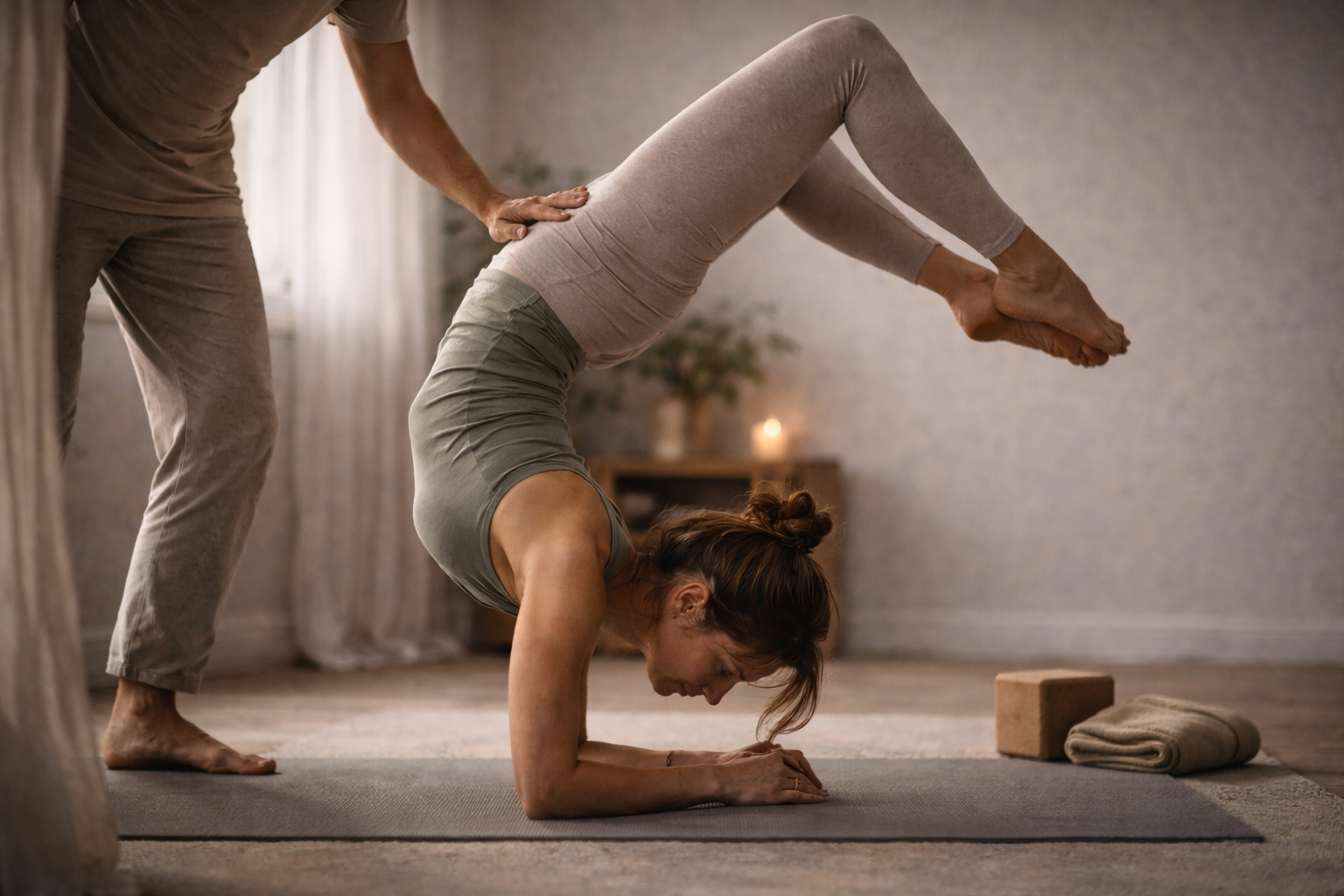 Premium
 Flexibility Core strength
Advanced Poses Need Sequence More Than Flexibility
Advanced poses are usually not unlocked by flexibility alone . They emerge when the body has been prepared in the right sequence . Three essentials: Advanced asana is the result of multiple conditions being ready at once Before chasing the final shape, build breath, load distribution, joint readiness, and recovery capacity The fastest route is often to train prerequisites, not the full pose itself In short: The real edge in advanced yoga is not talent. It is strategic sequencing. Advanced Poses Need Sequence More Than Flexibility Why the real preparation for difficult asana is not bigger range, but a better order of readiness At some point in practice, almost every serious student encounters a pose that feels like a threshold. An arm balance that seems to suspend gravity. A backbend that appears to open the body into another architecture. An inversion that looks as stable as standing. These poses invite admiration, but they also invite a conclusion — and often the wrong one. Most people assume that advanced postures belong to those who are simply more flexible, more gifted, or more fearless. That explanation is tidy. It is also incomplete. What advanced poses usually require is not flexibility alone, but the right sequence of preparation. This is a more strategic way of seeing yoga. It shifts the question from “Why can’t I do the pose yet?” to “What conditions does this pose assume, and which of them have I not built yet?” That change in perspective can save years of frustration — and not a few injuries. Modern culture loves finished shapes. We are drawn to outcomes we can see instantly. A final form is clear. It can be admired, photographed, compared, and measured. Advanced yoga postures fit neatly into that logic. They look like peak performance. And so many students approach them the way ambitious people approach many goals: by trying to get closer to the result as quickly as possible. But the body does not care about how persuasive a finished image is. It cares about whether the necessary systems are truly available. An arm balance is not just arm strength. It is load distribution through the hands, shoulders, ribs, and pelvis. A deep backbend is not just spinal flexibility. It is thoracic mobility, hip readiness, breath capacity, and the ability to avoid dumping into the lower back. An inversion is not just courage. It is shoulder organization, breath regulation, neck safety, and the nervous system’s ability to remain calm while upside down. Seen this way, advanced poses are not “hard versions” of simpler shapes. They are composite demands. And when one piece is missing, another area begins compensating. The wrists overwork. The neck compresses. The lower back absorbs the cost. The hips jam. The breath disappears. What people often call difficulty is sometimes simply mis-sequencing. This is why flexibility, though important, is not the decisive factor many believe it to be. A person may be extremely flexible and still unstable. They may enter the shape but not be able to distribute it well. They may look impressive while loading the wrong structures. They may have range, but not support. Conversely, a person with less spectacular flexibility but better sequencing may progress more safely and more sustainably. Because what advanced poses really ask for is integration. Not just more movement, but movement that is held by breath. Not just more range, but range that does not create panic in the nervous system. Not just more effort, but effort that can return without collapse. That last point matters more than many people realize. A body that can “get into” a pose but cannot exit it cleanly is not ready. A nervous system that can attempt a pose only by bracing excessively is not ready. Readiness includes recovery. That is part of the sequence too. A strategic approach to advanced asana begins by separating the pose from its mythology. Take a deep backbend. Many students assume the task is to become more open. So they stretch more aggressively. But often the real issue is not lack of extension everywhere. It is too much extension in the wrong place and not enough support elsewhere. Before a backbend deepens safely, the ribs must stop thrusting forward uncontrollably. The breath must remain available. The hips must contribute. The thoracic spine must participate. The lower back must stop becoming the default sacrifice. Or take an arm balance. Most people think the problem is lifting the feet. But feet are usually not the first issue. Can the hands root and push? Can the shoulder blades participate without collapsing the neck? Can the trunk organize over the arms? Can the practitioner tolerate instability without turning rigid? These are earlier questions. And until they are answered, the final posture remains more fantasy than function. This is why progression matters so much. A pose does not only have a simpler version. It has prerequisite capacities. Those capacities are what should be trained. For an arm balance, that may mean wall work, leaning drills, scapular protraction, breath under load, and short holds that teach how to distribute weight. For inversions, it may mean shoulder preparation, line awareness, fear management, and the ability to breathe without hardening the throat. For deep binds or forward folds, it may mean hip mechanics, spinal length, and a nervous system that no longer interprets range as threat. This approach often looks less glamorous. It is also far more intelligent. Because the body adapts best when it can understand what it is being asked to do. When the final pose is attempted too early, the lesson becomes confusion. When the prerequisites are developed patiently, the final pose often appears almost unexpectedly — not because it was forced, but because it was finally supported. There is a wider lesson here, one that extends beyond yoga. People often believe progress belongs to those who push hardest. But in complex systems, whether in business or in the body, progress usually belongs to those who prepare in the right order. A company cannot scale well if its operating structure is immature. Revenue without systems produces strain. Growth without sequence creates fragility. The body is no different. Advanced poses are high-leverage conditions. Small inefficiencies become large consequences. That is why strategic sequencing matters. The mature practitioner is not the one who blindly chases the hardest thing in the room. It is the one who can look at a difficult posture and calmly ask: Which condition is missing? Which support is not yet reliable? Which piece of this system still needs to mature? That kind of honesty may not look dramatic. But over time, it is what creates resilient skill. If there is a pose you long to do, do not only stare at its finished image. Interrogate its architecture. Does it require breath under pressure? Do you have that? Does it require shoulder stability without neck tension? Do you have that? Does it require hip motion in one place instead of lumbar motion in another? Do you have that? Can you enter, sustain, and leave the posture without borrowing recklessly from the wrong tissues? These questions do not make ambition smaller. They make it smarter. Because the real secret of advanced yoga is not that some people are blessed with unusual bodies. It is that the body changes most profoundly when the sequence of preparation matches the sequence of demand. Advanced poses do not simply reward courage. They reward order. And perhaps that is why the most impressive practitioners are often not the fastest. They are the ones who respect the invisible layers beneath the visible shape. They build what the pose will ask for before asking the pose to appear. In the end, the body is less interested in how badly you want the final expression. It is more interested in whether you have earned the conditions that make the expression honest. That is why advanced poses need sequence more than flexibility. And why the quiet discipline of preparing the body in the right order is often the most advanced practice of all.
Reset Yoga Editorial Team →
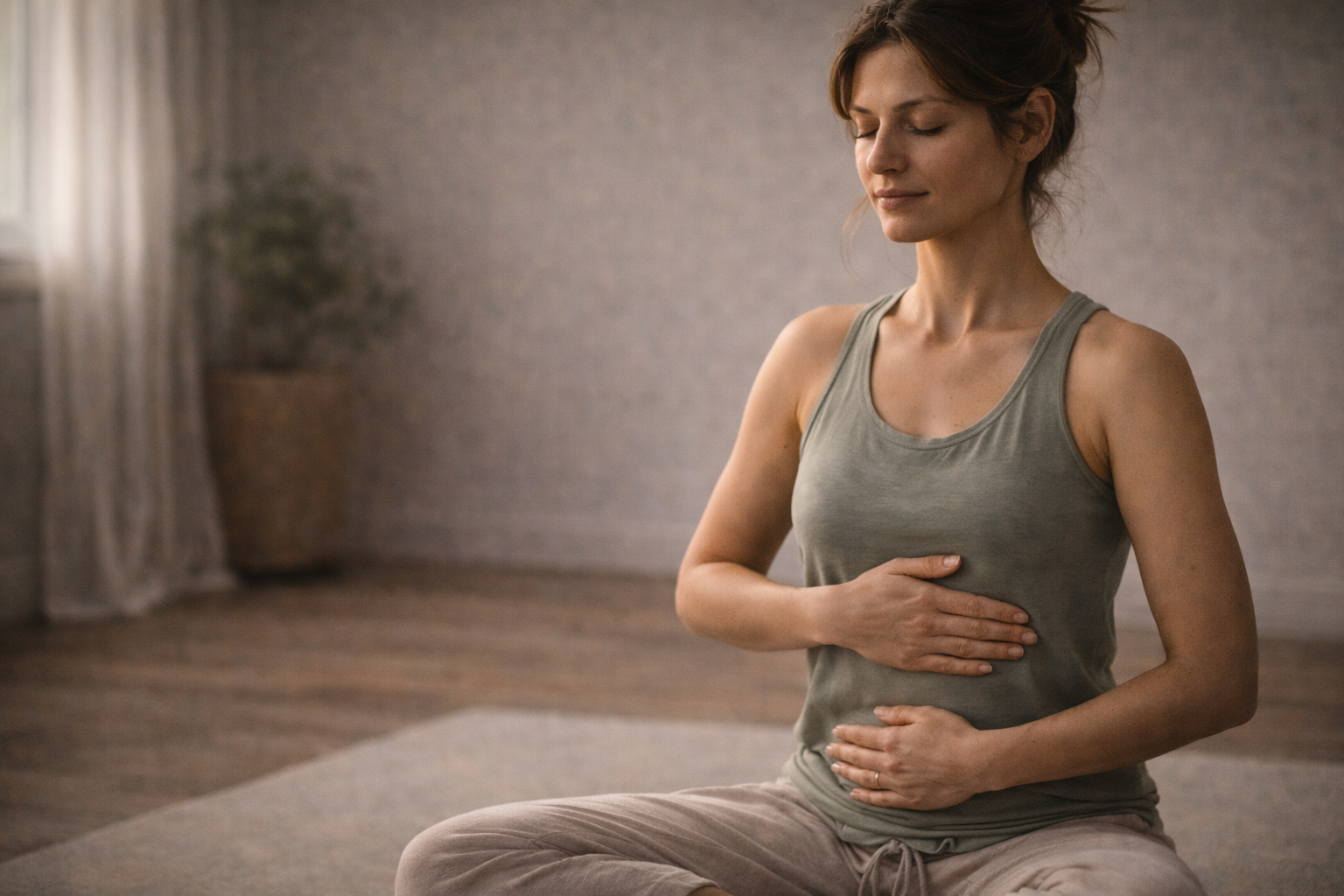 Premium Stress relief Recovery
The Only Breath a Yoga Beginner Really Needs
If you are new to yoga, you do not need advanced breathing techniques first. What you need is one reliable foundation: a quiet, sustainable nasal breath . Three essentials: Breathe in through the nose, and out through the nose Let the breath spread gently through the chest, sides, back, and belly — without forcing If a pose breaks your breath, the pose is too much or the setup needs to change In short: For beginners, the best breathing practice is not the most impressive one — it is the one you can keep while staying calm and present. The Only Breath a Yoga Beginner Really Needs Why a simple foundational breath matters more than advanced techniques at the start When people first begin yoga, they often expect the challenge to be in the poses. What surprises them is that the real mystery sometimes arrives earlier. Breathing. Not breathing in the biological sense, of course. Everyone is already doing that. But breathing as instruction. Breathing as practice. Breathing as something that suddenly seems to matter in a way it never did before. In nearly every beginner class, the cue appears quickly. Breathe. Do not hold the breath. Inhale. Exhale. And somewhere in that repetition, many beginners feel a quiet confusion. What kind of breathing is correct? Should it be deep? Should it be into the belly? Into the chest? Should it be strong? Should it sound a certain way? Yoga traditions contain many breath techniques. Some are subtle, some energizing, some calming, some highly specific. But the beginner’s first task is much simpler than that. The only breath a yoga beginner really needs at first is this: inhale through the nose, exhale through the nose, gently and without strain. It sounds almost too simple to matter. And yet this simple breath is often the most important thing to learn first. Many people assume that “better breathing” means “bigger breathing.” So the moment they try to breathe properly, they begin working hard. The chest lifts dramatically. The shoulders tighten. The neck stiffens. The breath becomes an effort rather than a support. This is especially common in modern adults. Most people spend much of daily life breathing in a shortened, distracted, incomplete way. At screens. In traffic. During meetings. Between notifications. The breath becomes shallow not because they choose it, but because speed and attention quietly narrow it. Then yoga arrives and says: breathe more consciously. For a beginner, trying too hard at that instruction can create more tension than awareness. This is why the foundational breath matters. It is not meant to impress anyone. It is meant to be sustainable. A calm nasal inhale. A calm nasal exhale. A rhythm that does not harden the body. A breath that can remain with you inside movement instead of falling apart the moment something gets difficult. That is the real beginning. In yoga, breath is not merely a support tool for poses. It is one of the clearest ways of knowing what state you are actually in. When breath becomes jagged, something is being forced. When breath disappears, something is being overdone. When breath remains steady, the body is often in a place where learning can happen. This is why the beginner’s first breathing lesson is so powerful. It teaches that yoga is not only about what the body can look like. It is about whether the body can stay in relationship with itself while moving. A pose that destroys the breath may be too deep, too ambitious, or simply mistimed. A simpler pose that allows breathing to continue may be far more valuable. That is a radical idea in a culture obsessed with visible progress. It suggests that internal continuity matters more than outward impressiveness. And for a beginner, this is not just safer. It is wiser. So what is this foundational breath, practically speaking? First, it begins in the nose. Inhale through the nose. Exhale through the nose. This alone tends to create more steadiness than breathing through the mouth, especially for someone learning how to regulate effort. Second, the breath should not be forced into only one region. Beginners are often told to “breathe into the belly,” which can be useful, but incomplete if it becomes rigid. Others over-breathe into the chest. A healthier idea is gentler: let the breath widen the body softly. A little into the front. A little into the sides. A little into the back. A little into the lower torso. Not perfectly. Not dramatically. Just enough that breathing does not feel trapped. Third, the exhale deserves more respect than it usually gets. Beginners often focus on inhaling well. But the exhale is where many bodies first begin to soften. A slow, unhurried exhale can reduce unnecessary tension in the jaw, shoulders, and chest. It tells the body that not every action requires urgency. This is not only helpful in yoga. It is useful in work, parenting, conflict, commuting, and transition. Which is one reason the foundational breath matters so much. It extends beyond the mat. For busy professionals, this matters more than it may seem. Many people move through the day without ever really noticing how their breathing changes under pressure. Emails shorten it. Stress lifts it upward. Decision-making accelerates it. Fatigue makes it thin. Then those same people come to yoga and imagine they need some advanced breathing method to “do it properly.” Usually, they do not. Usually, what they need is to recover the ability to breathe quietly without self-interruption. Before the meeting. Before opening the laptop. Before answering too quickly. Before sleep. A simple nasal breath that can stay with them. This is why the first yogic breath is not only a yoga skill. It is a life skill disguised as a basic instruction. The most important thing, perhaps, is not to become perfectionistic about it. Beginners often want to get the breath right. They monitor it too closely. They correct too aggressively. And in doing so, they make it artificial. Breath does not respond well to being bullied. It responds better to attention than control. So the beginner’s task is not to perform an ideal breath. It is to notice the breath they already have, then guide it gently toward more steadiness. Is it fast? Is it shallow? Does it stop when the pose gets difficult? Do the shoulders rise? Does the jaw tighten? These are not failures. They are information. And once the breath becomes information rather than a test, yoga begins to change. It becomes less about achievement and more about relationship. That may be the most important lesson a beginner can learn. If you are new to yoga and unsure where to begin, begin here. Inhale through the nose. Exhale through the nose. Do not force depth. Do not rush. Do not harden. Let the breath stay with you. That is enough. Truly, at first, that is enough. The advanced techniques can come later. The longer practices can come later. The more refined methods can come later. But this quiet foundational breath is what makes all of them meaningful. Without it, yoga can become shape without presence. With it, even the simplest posture becomes alive. Perhaps that is the deeper truth. The first breath a yoga beginner learns is not small because it is unimportant. It is small because it is fundamental. And sometimes the most life-changing practices do not begin with complexity. They begin with something simple enough to stay with you — one calm breath at a time.
Reset Yoga Editorial Team →
 Premium Recovery Restless nights
Why Sleeping In on the Weekend Still Doesn’t Restore You
Weekend catch-up sleep often fails because your fatigue is not only a sleep debt . What accumulates during the week is also shallow breathing, unresolved muscle tension, nervous-system activation, and nonstop mental input . Three essentials: Sleeping longer on weekends cannot fully undo a weekday body that never really downshifts Recovery works better when it is distributed in small daily resets, not postponed into one big rescue Tiny habits — breathing, micro-movement, screen breaks, and evening downshifts — matter more than they seem In short: Real recovery is less about catching up on weekends and more about building small exits from stress into each day. On Saturday morning, many people wake up with a quiet disappointment. They slept longer. The alarm was off. There was no commute waiting. No meetings. No rush. And yet the body does not feel restored. The heaviness is still there. The mind is less pressured, perhaps, but not clear. The shoulders still seem to remember the week. This is the moment when a familiar assumption begins to crack. If more sleep was supposed to fix the exhaustion, why does the exhaustion still feel so present? The answer is not that sleep does not matter. It matters profoundly. But the reason weekend catch-up sleep often fails is that the fatigue carried through modern life is not only a shortage of sleep. It is also a build-up of things that sleep alone cannot fully erase in one or two mornings: shallow breathing, persistent muscular tension, a nervous system that never really comes down, and a mind that remains flooded with unfinished input. In other words, many people are not just sleep-deprived. They are under-recovered. Modern adults tend to think of fatigue in terms of hours. How much sleep did I get? How many hours did I work? How many hours can I rest this weekend? These are sensible questions. But they can obscure something more important: the state in which the body spends those hours. A person may be technically resting while still physiologically braced. They may be lying down while the nervous system remains at work. They may be sleeping longer while carrying a body that has forgotten how to release. That is why two nights of extra sleep can help, but still not feel like enough. The body is not simply short on time in bed. It is carrying accumulated activation. Work stress. Emotional labor. The posture of screens. The shallow breath of constant response. The subtle muscular gripping of living in a state of permanent readiness. This kind of fatigue is more structural than people realize. It is not just tiredness. It is “not yet off.” This is why the distinction between stopping and recovering matters so much. Stopping means the activity ends. Recovering means the body understands that the activity has ended. Those are not the same thing. A person can finish work and still internally continue it. They can leave the office while their jaw remains tight, their shoulders lifted, their breath abbreviated, their thoughts still rehearsing tomorrow. In that condition, sleep becomes less potent than people expect. Because recovery depends not only on duration, but on whether the system actually entered a state where repair could happen. This is also why people often say, “I slept, but I still feel tired.” The sentence sounds contradictory. In reality, it is precise. They rested in time. They may not have fully rested in state. What changes this is not usually a heroic intervention. It is the introduction of small daily recovery habits. This is where many busy professionals get discouraged. They imagine recovery must mean a long routine, a wellness retreat, an hour of yoga, a perfect evening. But the nervous system does not only respond to grand gestures. It responds to repeated signals. A slower exhale in the morning before opening the phone. A minute of spinal movement between meetings. A moment of looking away from the screen and letting the eyes stop working. A quiet forward fold in the evening. Legs up the wall before bed. Five minutes without input. These acts do not look like much. But they matter because they interrupt accumulation. They stop fatigue from hardening into the body quite so deeply. This is the great hidden power of small recovery. It works not by dramatic rescue, but by reducing how much damage has to be rescued from. The logic is simple. If the week is built from daily deposits of tension, then the body benefits from daily withdrawals of tension as well. Breath is one of the fastest routes in. When the exhale lengthens, the nervous system receives a message of reduced threat. When the ribs begin to move again, the body stops living entirely in the upper chest. When the shoulders lower, not by force but by release, the muscles stop holding the entire week alone. Movement helps too, but not necessarily intense movement. Gentle spinal motion. A neck release. Walking without a screen. A child’s pose. Small, repeatable forms of returning. And then there is perhaps the most difficult practice of all: reducing input. Many people attempt to recover while still consuming. Scrolling. Streaming. Checking. Replying. Thinking. The body is no longer active, but the mind remains fed a constant diet of stimulation. True recovery requires moments in which nothing more is being asked of the system. Not because productivity is bad. But because a human being cannot remain in intake mode indefinitely and expect restoration to happen automatically. This reframes the weekend. The weekend is not useless. Longer sleep can help. A slower morning matters. More time in bed can reduce a true sleep deficit. But if the body has spent five straight days never fully returning from activation, the weekend may feel less like renewal and more like damage control. This is why people who rely entirely on weekend recovery often remain chronically tired. They are postponing repair too long. It is not that they are weak. It is that their recovery rhythm is poorly distributed. And that is an important difference. Because a distributed problem often needs a distributed solution. Not one heroic act of rest. But many small permissions to stop guarding. There is, perhaps, a broader lesson here about how modern adults live. Many people still imagine that life can be run on depletion during the week and repair on the weekend. Work hard now. Recover later. Push now. Repair later. Function first. Feel later. But the body is not a machine that tolerates permanent overdraft without consequence. It carries history. It stores unfinished states. It learns patterns. If the pattern becomes “stay on until collapse,” then collapse will come more often, and recovery will feel more elusive. A wiser model is not endless endurance with occasional rescue. It is rhythm. Work, then release. Effort, then breath. Input, then pause. Structure, then softness. This does not require abandoning ambition. It requires redesigning how ambition is supported. If sleeping late on the weekend is no longer enough, do not assume you are failing at rest. You may simply be asking too much of one solution. The real question may not be: How do I recover everything on Saturday? It may be: How do I stop carrying so much unreleased tension into Friday? That question is quieter. It is also more powerful. Because the answer lives in daily life. A breath before the first meeting. A stretch between tasks. A little less input at night. A little more deliberate downshifting before bed. Fatigue accumulates in small layers. Recovery, perhaps, must be built the same way. Not all at once. But often enough that the body begins to remember how to return. And that may be the real art of modern restoration: not waiting for the weekend to save you, but creating enough moments during the week when you stop being only a worker, a responder, a manager of demands — and briefly become a human being again.
Reset Yoga Editorial Team →
 Premium Posture Core strength
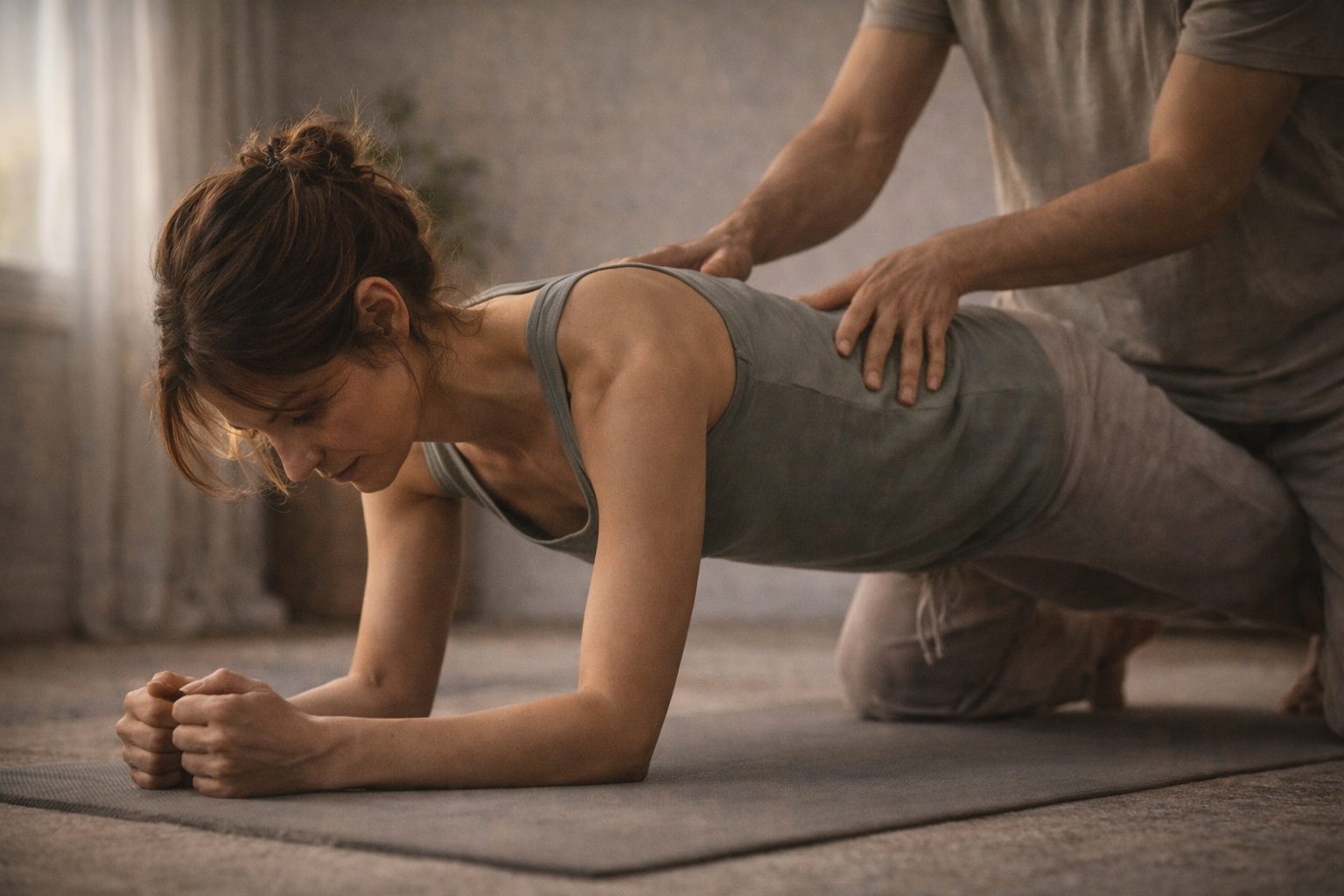
Plank Re-Education for People Who Struggle
If plank feels miserable, the issue is often not weak willpower . More often, it is that your body has not yet learned how to distribute support through the wrists, shoulders, ribs, pelvis, and legs . Three essentials: Plank is not a test of endurance; it is a lesson in full-body support Wall planks, desk planks, tabletop, and knee planks are smart progressions, not “easy versions” If wrists or low back hurt first, suspect poor load-sharing before assuming weak core In short: Better plank comes not from suffering longer, but from teaching the body how to support itself in the right sequence. Plank looks deceptively simple. Hands on the floor. Legs extended back. Body in one long line. From the outside, almost nothing appears to happen. Inside, however, it can feel like a small crisis. The wrists begin complaining. The shoulders tense. The belly hardens. The lower back grows uncertain. The breath shortens. Within seconds, the whole body seems to say: not this. Many people interpret that reaction in the harshest possible way. My core is weak. I just need to toughen up. I need to hold longer. It is a familiar interpretation. It is also often incomplete. For people who struggle with plank, the real need is usually not more grit. It is better education in how to support the body. Plank is not just an abdominal exercise. It is a full-body coordination task. Wrists, shoulders, ribs, pelvis, spine, legs, and breath all have to participate in the same sentence. If that sentence has never been properly taught, one or two body parts begin speaking too loudly. The wrists take too much load. The lower back starts hanging into the posture. The neck tightens. The shoulders collapse or overwork. The problem is not always lack of strength. Often, it is lack of distribution. Modern adults are especially prone to this. Many people spend most of their day sitting, typing, driving, lifting children, holding phones, and carrying stress in the jaw or shoulders. Then they enter a plank and expect the body to instantly organize into an elegant whole-body support system. Why would it? The body will usually do what it already knows. It will overuse familiar strategies. Push into the wrists. Grip in the shoulders. Brace in the front body. Hang in the lower back. Then we call that weakness. But what if it is simply incomplete learning? That reframing matters. Because once the issue is seen as a skill problem rather than a character flaw, the path forward becomes more intelligent. One of the biggest mistakes people make with plank is turning it into a test of endurance too early. Longer is assumed to mean better. More suffering is assumed to mean more progress. But if the support pattern is poor, holding longer often just means rehearsing dysfunction. A collapsed plank held for sixty seconds may build tolerance for strain, but not necessarily the kind of support that protects the wrists and back. This is why progression matters. Strength grows best when the body can learn the right pattern without being overwhelmed. That often means starting above the floor. A wall plank is a legitimate beginning. So is placing the hands on a desk, countertop, or bench. These versions reduce load and give the body room to discover important things: Can I push the surface away rather than sink into it? Can I keep the ribs and pelvis related without gripping the lower back? Can I breathe while supporting myself? Those are not beginner questions. They are the real questions. The next useful stage is tabletop. On hands and knees, the body has more contact points and less load, but the lesson is already present. Can the spine stay long? Can the shoulders support without climbing to the ears? Can the belly and side body respond softly as the breath moves? Lifting one arm or one leg from tabletop adds enough instability to begin teaching what the core actually does: not freeze the body, but organize it. Then comes knee plank. Here, many people make an important discovery. Even with the knees down, plank can still feel demanding if the whole system is not working together. That is useful. It reveals that plank is not fundamentally about the toes being off the floor. It is about whether support is being shared well. If breath disappears, if the shoulders collapse, if the low back takes over, those signals matter whether the knees are down or not. And if those signals can be improved here, the body becomes far more ready for a full plank later. When full plank does arrive, the goal should not be duration first. The goal should be quality. Ten seconds of coherent support can teach more than one minute of hanging on. A useful plank is one in which the hands are active, the shoulders are pushing away from the floor without hardening the neck, the ribs are not spilling downward, the pelvis is not sagging, and the legs are participating. Above all, the breath must remain. This is where the common cue to “tighten the abs” can become misleading. If bracing the core means stopping the breath, then the body is relying on compression more than support. Real core function is more intelligent than that. It allows breathing to continue while stability is maintained. That is what makes the support usable in life, not just impressive in exercise. For people whose wrists hurt, modifications matter too. Using fists, yoga blocks, forearm plank, or reducing the angle through wall work is not weakness. Pain is not a good teacher. The body does not learn well inside unnecessary threat. There is a larger lesson in all this. People often think strength means forcing one area to do more. More abs. More grit. More effort. More tolerance. But sustainable support rarely works that way. The strongest systems are distributed systems. They breathe. They share load. They adjust. Plank is a useful teacher because it exposes whether we know how to support ourselves globally, not just force one region to overperform. That is why someone can have “strong abs” and still dislike plank. Because the issue may not be muscular capacity alone. It may be coordination, sequencing, and the nervous system’s confidence in how to organize under load. If plank has always felt punishing to you, that does not necessarily mean you are behind. It may simply mean you have been asked to perform the final chapter before learning the earlier pages. Start at the wall. Start at the desk. Start on all fours. Start with the breath. Start with short holds that teach the body something it can actually keep. The goal is not to survive plank. The goal is to let plank become a place where support makes sense. And perhaps that is the deeper wisdom of the practice: Real strength is not the ability to suffer longer in a bad pattern. It is the ability to organize support so wisely that the body no longer needs to choose between effort and pain.
Reset Yoga Editorial Team →
 Premium Flexibility Posture
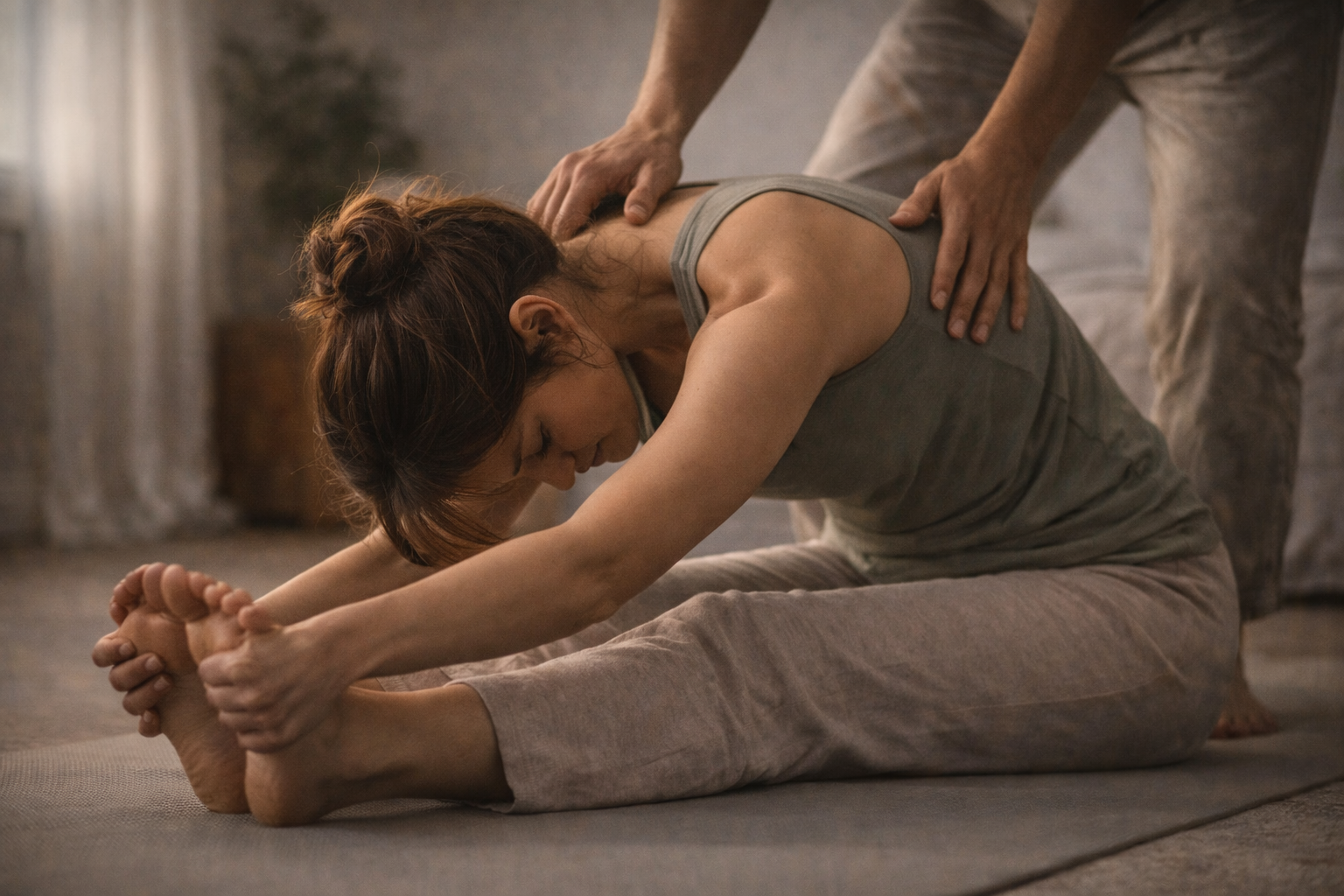
Forward Fold Myths for People Who Struggle With Hamstrings
In almost every yoga class, there is a moment when the room quietly divides. Some people fold forward as if gravity has been waiting all day to receive them. Others stop almost immediately, their hamstrings pulling hard, their lower back rounding, their torso hovering far above their legs as though an invisible line has been drawn. For the second group, the conclusion tends to arrive quickly. My hamstrings are too tight. That is the problem. I just need to stretch them harder. It is an understandable conclusion. It is also, in many cases, incomplete. People who struggle with forward folds are not always being limited by their hamstrings alone. Often the deeper issue is that the pelvis cannot move well, the breath disappears, and the body does not feel safe enough to travel farther. This matters because once the problem is defined too narrowly, the solution becomes narrow as well. And a narrow solution — stretch harder, push deeper, endure more — can keep the body trapped in the very pattern it is trying to escape. Modern adults are especially vulnerable to this misunderstanding. We sit for long hours. We work in chairs, cars, trains, planes. We move our hands constantly and our hips very little. The pelvis learns to stay tucked or fixed. The spine learns to round. The breath becomes smaller and higher in the chest. Then, at yoga, we suddenly ask the body to hinge forward as if it has been preparing all day for precisely that task. It has not. So what happens? The pelvis does not roll forward easily. The fold has nowhere to begin from below. The spine starts compensating by rounding. The breath tightens. The nervous system interprets the position as increasingly risky. And the hamstrings become even more defensive. This is how the “hamstring myth” gets reinforced. A person feels strong tension in the backs of the thighs and assumes the thighs are the whole story. But the sensation may be only the loudest voice in a much larger conversation. A forward fold is not merely a test of muscle length. It is a coordination between pelvis, spine, breath, and nervous system. The pelvis is central. It acts like the hinge of the movement. When it can tip forward, the torso can travel with more ease. When it cannot, the spine often takes over, and the movement becomes compressed rather than integrated. Breath is just as important. A fold in which breathing disappears is often a fold in which the body has already entered a more guarded state. This is why a shallower forward fold with steady breath may be more productive than a deeper one held with strain. The body learns through repeated experience. If it repeatedly learns that folding forward feels threatening, it protects itself. If it repeatedly learns that folding forward can happen with breath, support, and manageable sensation, it slowly allows more range. So flexibility is not only a mechanical issue. It is also a negotiation of trust. This changes the practical approach completely. The first step for many people is to bend the knees a little . This is not cheating. It is often the smartest way to reduce excessive tension in the hamstrings and give the pelvis room to move. That room matters more than people think. A slight bend in the knees can transform a forward fold from a back-strain exercise into an actual hip hinge. The second step is to preserve length rather than chase depth . Instead of trying to crash downward, imagine the spine extending forward as the pelvis tips. The goal is not to touch the floor at all costs. The goal is to let the fold happen from a better relationship between base and breath. And then comes the exhale. A longer, quieter exhale helps reduce defensive tone in the system. It signals that the body is not under attack. It gives the fold time to unfold, rather than forcing it into place. This is a much more sophisticated way of working than simply staying in pain longer. It asks not, “How far can I go?” But, “Can I still breathe here? Can my pelvis still move? Does this feel like learning, or like threat?” Those questions matter. Because the nervous system responds not to ambition, but to evidence. Preparation matters too. People often isolate the forward fold as if it exists by itself. But many bodies need context before they can fold well. Cat-cow. Low lunges. Supine hip movements. Gentle rocking at the pelvis. These are not distractions from the goal. They are what remind the body how to organize toward the goal. The fold improves not because the hamstrings are bullied into length, but because the whole system becomes more ready for the action. This is one of yoga’s quiet gifts: it teaches that function emerges from relationship. The hamstrings are part of the story. But only part. When the pelvis regains motion, the spine regains space, and the breath regains continuity, the hamstrings often stop having to shout so loudly. There is also a deeper human pattern hidden here. People often want one villain. One tight muscle. One bad habit. One explanation. It is comforting to think problems are simple. But most limitations in the body, as in life, are relational. A forward fold is not blocked by one tissue alone. It is shaped by history, posture, breath, stress, repetition, fear, and movement options. To see that is not to complicate things unnecessarily. It is to become more accurate. And accuracy, in the long run, is more merciful than blame. If forward folds have always felt like punishment, perhaps the answer is not to become tougher. Perhaps the answer is to become more skillful. Bend the knees. Let the pelvis move first. Let the breath stay. Stop measuring honesty by intensity. A forward fold does not deepen because the body has been overruled. It deepens because the body gradually learns that moving forward can happen without collapse, panic, or force. That is a different kind of flexibility. A wiser one. And perhaps the real lesson is not about hamstrings at all. It is about what happens when we stop accusing one part of the body and begin listening to the whole system instead.
Reset Yoga Editorial Team →
 Premium Shoulder tension Posture Eye fatigue
Poor Posture Is Not Weak Willpower — It Is a Design Problem
Poor posture is usually not a discipline problem. It is often a design problem created by your chair, desk, screen height, breathing pattern, and work habits. Three essentials: Rounded posture is often a rational adaptation to a poorly designed environment Fixing posture starts with setup, not with “trying harder” to sit straight Yoga helps by restoring breath, alignment, and movement options — not by forcing the chest up In short: Stop blaming yourself for slouching. Start redesigning the conditions that make good posture easier. By late afternoon, many people discover that their body has quietly collapsed. The head has drifted toward the screen. The shoulders have rolled inward. The upper back has rounded into a shape that was never part of the morning’s intention. This is usually the moment self-judgment begins. Sit up straight. Why am I doing this again? I need better posture. I need more discipline. But perhaps the first assumption is the wrong one. Poor posture is often not a failure of will. It is a reasonable adaptation to an unreasonable environment. If the chair does not support the body, if the screen is too low, if the desk height forces the shoulders upward, if the workday asks the body to remain still for hours while staring forward, then slouching is not surprising. It is strategic. The body is trying to find the most sustainable way to survive the conditions it has been given. That does not make the posture ideal. But it does mean the solution begins somewhere other than shame. For a long time, posture has been treated almost like a moral issue. Good posture is associated with discipline, confidence, energy, self-respect. Poor posture is framed as laziness, carelessness, lack of effort. This is especially absurd in modern work culture. People now spend large portions of their lives seated in front of glowing rectangles, with arms extended forward, heads subtly projected, eyes fixed, breath diminished, and movement reduced to finger-level tasks. In that context, telling someone to “just sit properly” is like asking a plant to grow straight in poor light and a cracked pot. The body is always responding to design. And design includes more than furniture. It includes visual demands, task structure, time pressure, breathing habits, and the number of hours the body is expected to remain in one narrow arrangement. Seen from this angle, slouching is not a personality flaw. It is information. Consider the chair. If it is too high, the feet lose stable contact with the floor, and the pelvis loses its foundation. If it is too low, the hips and lower back become compressed. If the seat is too deep, the body slides back and rounds. If the backrest shape does not match the actual body, “support” can create collapse instead of ease. Then consider the desk. If it is too high, the shoulders lift. If it is too low, the chest narrows. If the keyboard and monitor are arranged without thought, one part of the body is always compensating for another. And then there is the screen — perhaps the most underestimated force of all. Vision organizes posture more powerfully than most people realize. If the screen is low, the head will go forward. If the head goes forward, the neck and upper back will adapt. If that adaptation is maintained for hours, slouching becomes less of a mistake and more of a survival pattern. This is why poor posture often persists despite awareness. Awareness alone cannot defeat bad geometry. This is where yoga offers a more useful perspective than simple correction. Yoga does not define posture merely as a “right shape.” It asks a more intelligent question: Can this shape be supported with breath? That changes everything. Because many people try to improve posture by lifting the chest and pulling the shoulders back. But if doing so makes breathing harder, tightens the lower back, or turns sitting into a continuous muscular performance, then the posture is not functional. It is staged. A yoga-informed approach begins differently. It begins with foundation. Feet on the floor matter more than many people think. When the feet have stable contact, the pelvis can organize more naturally. When the pelvis is organized, the spine does not have to compensate so dramatically from above. So the first intervention may be simple: adjust chair height or use a footrest. The second is to stop confusing “good posture” with overextension. Many adults trying to sit tall end up thrusting the ribs forward and arching the lower back. This is not truly upright. It is just an opposite distortion. What works better is a gentler stacking: pelvis under ribs, ribs over pelvis, with enough softness that breath can move in the front, sides, and back body. When that happens, posture becomes less of a held shape and more of a supported one. Screen height deserves special seriousness. Many people work on a laptop placed directly on a desk for hours every day. That setup almost guarantees a forward head position. Raising the screen, using a stand, separating the keyboard, or adding an external monitor is not luxury. It is a structural intervention in how the body spends its life. And even with an improved setup, one truth remains: No posture stays healthy if it becomes frozen. This is why movement matters. Not an hour-long class in the middle of the workday. Just brief, repeatable changes of state. A few breaths into the side ribs and back body. A shoulder-blade glide. A gentle spinal extension and flexion. Standing up and reaching the arms overhead. A brief fold. A soft twist. These are not trivial gestures. They remind the body that the current posture is not its only option. And that may be the most realistic posture strategy of all. The goal is not to maintain perfection. It is to increase the number of times the body can return. This is one of the most important distinctions. Most people think posture improvement means holding one correct shape for longer. But the body does not thrive through static obedience. It thrives through adaptable organization. Good posture is not a pose you perform against gravity. It is the body’s ability to stay supported, breathing, and responsive inside changing conditions. That is why blame is so unhelpful here. A person who slouches is not necessarily failing. They may simply be living inside a setup that repeatedly teaches the body to collapse forward because collapse is the most efficient response available. If that is true, the solution is not more self-criticism. It is redesign. A better chair height. A better screen position. A more grounded foot contact. A more breathable rib cage. More frequent interruptions of static work posture. Less fantasy about “perfect sitting.” Yoga’s gift is not that it forces the body into ideal alignment. Its gift is that it teaches what alignment feels like when it is alive. Breathing. Grounded. Stacked. Moveable. If you want to improve posture, start by asking different questions. Does my setup make it easier or harder to stay upright? Can my feet ground? Is my screen pulling my head forward? Can I breathe where I am sitting? Do I move often enough to keep posture from becoming a prison? These questions are more generous than self-blame, but they are also more effective. Because posture is not merely personal. It is ecological. It emerges from the relationship between body and environment. And that means it can be changed not only through discipline, but through design. In the end, poor posture may not be evidence that you lack strength. It may be evidence that your environment has been quietly teaching your body to organize around strain. If so, the task is not to become a better scolder of yourself. It is to become a better architect of your conditions. Change the chair. Raise the screen. Support the feet. Restore the breath. Move more often. Let posture arise from an environment that finally makes it possible. Because real posture improvement is not the triumph of willpower. It is the moment the body no longer has to fight the room in order to sit well.
Reset Yoga Editorial Team →
 Premium Eye fatigue Focus & clarity Recovery
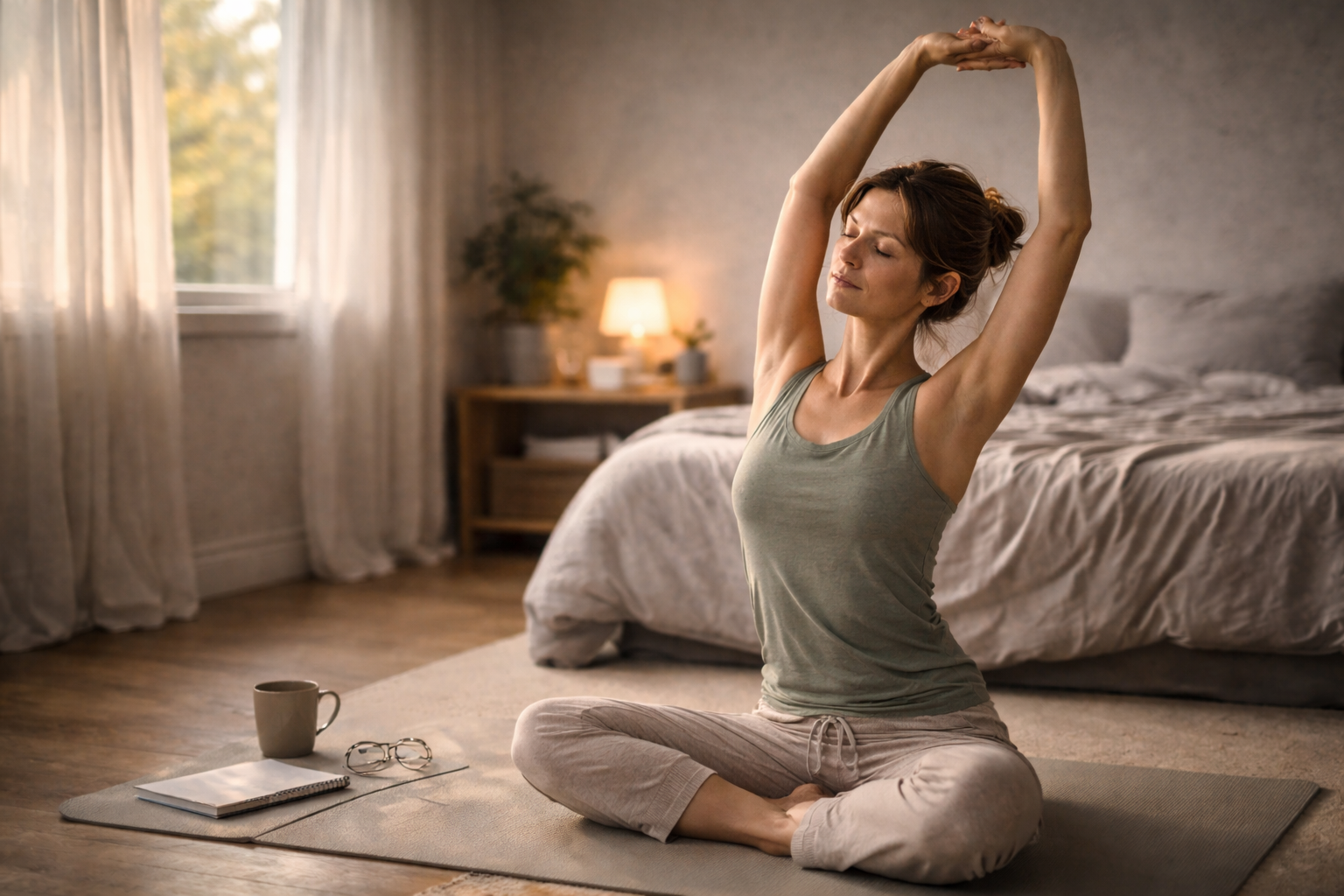
Morning Yoga to Reset a Distracted Brain
If you cannot focus in the morning, it is often not a motivation problem. More often, your brain and nervous system are simply not ready for work mode yet . Three essentials: Morning focus depends less on willpower and more on nervous-system activation Short morning yoga helps switch on attention by organizing breath, spine, posture, and gaze The most effective sequence is: open the breath → move the spine → steady the axis and eyes In other words: Before blaming yourself for poor focus, spend 5–10 minutes helping your system become focus-ready. English Title Morning Yoga to Reset a Distracted Brain English Subtitle Why poor focus is often a nervous-system issue, not a motivation problem — and how to enter work mode in minutes English Column Morning Yoga to Reset a Distracted Brain — Why lack of focus is often a nervous-system issue, not a motivation problem There are mornings when the mind feels scattered before the work has even begun. The laptop is open. The to-do list is visible. You know what matters. You know what should come first. And yet attention slips. You open an email and forget why. You move from one tab to another. You begin something, then drift. The minutes pass, not in effort, but in fragmentation. On mornings like these, many professionals make the same mistake. They turn the problem into a moral one. I am not disciplined enough. I have lost my edge. I need more drive. I need to try harder. But often the issue is simpler, and kinder, than that. A distracted brain in the morning is not always unmotivated. It is often just not yet properly organized for work. That distinction matters. Because if the problem is character, the only response is self-criticism. If the problem is readiness, the response becomes preparation. And this is where morning yoga becomes far more practical than many people assume. Not as exercise. Not as self-improvement theatre. But as a way of telling the nervous system: you may now enter focused work. Most people have rituals for turning on their machines. They open the laptop. Check the calendar. Read messages. Make coffee. What they often lack is a ritual for turning on themselves. Modern mornings begin with immediate input. Notifications. News. Schedules. Children. Requests. The small administrative noise of being alive. Attention is pulled outward almost instantly. Meanwhile, the body is often still carrying the inertia of sleep: shallow breath, stiff spine, collapsed chest, eyes that are awake but not yet settled. In that condition, the brain can be technically alert and still not be ready for deep work. That is because concentration is not just a mental event. It is a whole-body state. Breath influences it. Posture influences it. The position of the head influences it. The steadiness of the gaze influences it. The nervous system must sense coherence before the mind can sustain it. This is why mornings can feel mentally messy even when motivation is present. The system has input, but not yet enough organization. The real value of morning yoga lies here. Its purpose is not merely to “wake up the body.” Its deeper purpose is to create the physical conditions under which the brain can focus. Start with breath. People who cannot concentrate in the morning are often already breathing in a narrow, upper-chest pattern. The inhale is short. The exhale unfinished. The system remains somewhere between sleep and stress. A few moments of conscious breath can change that. Standing or sitting, inhale through the nose and let the breath widen into the side ribs and back body. Exhale slowly and feel the shoulders descend without force. This is not dramatic. But it begins to reduce internal static. Then move the spine. Concentration suffers when the body remains in the collapsed geometry of sleep or screen posture. A rounded upper back, a forward head, a stiff rib cage — all of these make attention more reactive and less stable. A few rounds of cat-cow, a gentle forward fold, a mild twist: these movements are not just stretches. They are signals. They tell the body that the day is beginning not only cognitively, but structurally. The ribs begin to move. The spine wakes up. Breath gains room. And the brain receives a very old message: we are readying ourselves now. Finally, restore axis and gaze. Focus is not the same as stimulation. A person can be highly stimulated and still completely uncentered. What work requires is a quieter kind of alertness — one in which attention can gather rather than scatter. This is why even simple standing postures matter. Mountain pose. Standing balance on one foot. A calm, grounded stance with the eyes resting on one point. The point is not to eliminate all wobbling. The point is to remember how to return. That, in many ways, is the essence of concentration itself. A morning practice does not need to be long to be effective. For busy professionals, shorter is often better because shorter becomes repeatable. Five minutes can be enough. One minute of fuller breathing into the ribs and back body. Two minutes of spinal movement — cat-cow, fold, twist. Two minutes of standing, grounding, and finding a stable gaze. The sequence matters. Open the breath. Mobilize the spine. Organize the axis. Steady the eyes. This is not random. It is a progression from internal chaos toward usable orientation. And that is what focus really is. Not a heroic mental effort. A state of organized readiness. This is also why morning yoga should not become another performance metric. The goal is not to prove discipline before breakfast. The goal is to create the conditions under which discipline becomes less necessary because the system is already cooperating. Modern culture talks about focus as though it were mostly a psychological virtue. Be stronger. Be more disciplined. Resist distraction. Push through. But actual concentration is far less abstract than that. It depends on whether the nervous system feels coherent enough to sustain a direction. After a poor night of sleep, after emotional strain, after too much screen time, after carrying family and work into the same mind at once, the answer is often no — at least not immediately. This is not weakness. It is physiology. And physiology can be influenced. Not always with force. Often with sequence. A deeper breath. A moving spine. A steadier head. A quieter gaze. A body that no longer feels half asleep and half under attack. This is what morning yoga can offer. Not motivation on command. Something more useful. A bridge from scattered wakefulness to functional presence. If your mind feels fragmented in the morning, resist the urge to treat yourself like a failing machine. Try another question instead: Am I truly unable to focus? Or have I simply not yet entered the state from which focus becomes possible? If it is the second — and often it is — then there is good news. That state can be helped. And it does not always take much. A few breaths. A few spinal waves. A few moments of standing in your own center before giving yourself to the day. Morning yoga is not magic. But it can be a remarkably intelligent way of preparing the body for thought. And in a world where attention is constantly being fragmented, that may be one of the most practical forms of self-respect available.
Reset Yoga Editorial Team →
 Premium Restless nights Stress relief
The Answer to Sleepless Nights Is to Stop Trying So Hard to Sleep
If you cannot sleep, trying harder usually makes it worse. Why? Because sleep is not something you can force. It arrives only when the nervous system feels safe enough to stop guarding. Key points: The more you try to control sleep, the more alert your brain becomes Nighttime yoga should not energize or “improve” you — it should help you land The goal is not to “make yourself sleep,” but to create the conditions in which sleep can return In short: Stop trying to win against sleeplessness. Start helping your body feel safe enough to let go. English Title The Answer to Sleepless Nights Is to Stop Trying So Hard to Sleep English Subtitle Why sleep worsens when you try to control it — and how yoga can help calm the nervous system instead English Column The Answer to Sleepless Nights Is to Stop Trying So Hard to Sleep — Why sleep gets worse when you try to control it, and how yoga can help the nervous system settle Sometimes the night becomes louder because of how quiet it is. You wake, perhaps without knowing why. The room is dark. The house is still. For one suspended moment, there is only the fact of being awake. Then comes the clock. 2:17 a.m. And with that number, something shifts. The mind moves faster than the body. There are calculations now. How many hours remain. What tomorrow will feel like. Whether this will happen again. Whether something is wrong. At that point, sleeplessness is no longer the only problem. The effort to fix sleeplessness has begun. This is the hidden escalation of many difficult nights: a person is not only awake, but also trying urgently not to be. And that urgency is often what keeps the system alert. Sleep does not arrive because it has been forced. It arrives when the body no longer feels the need to remain on guard. This is why the answer to a sleepless night is so unintuitive. It is not to try harder. It is to stop trying so hard to sleep. Modern life trains people to manage almost everything. Time. Productivity. Health. Food. Money. Responses. Schedules. So naturally, people try to manage sleep as well. How quickly can I fall asleep? What is the most effective routine? What should I take? What should I avoid? How do I make this work tonight? Some of these questions are useful. Routine matters. Environment matters. Light and caffeine and screens matter. But sleep has a quality that resists the logic of control. Sleep is not a task completed by willpower. It is not a performance metric. It is not an achievement unlocked by sufficient discipline. Sleep is closer to surrender than success. And the nervous system does not interpret pressure as safety. So when a person lies in bed thinking, I must sleep now, the body often hears something else: Stay alert. Something important is at stake. This is why the harder people try, the more awake they can become. It is not failure. It is physiology. For many adults, especially busy professionals, parents, and people living under chronic responsibility, the real issue on sleepless nights is not lack of fatigue. It is unfinished activation. The workday ends, but the body does not fully clock out. Messages stop, but the mind continues drafting responses. The meeting is over, but the nervous system is still holding its posture. A person can be deeply tired and still not be ready for sleep. This is one of the great confusions of modern exhaustion. People assume that being tired should automatically lead to sleeping. But fatigue and safety are not identical. Sleep requires more than depletion. It requires permission. That permission comes when the system no longer believes it must keep watch. This is why simply collapsing into bed often does not work. The body may be horizontal. The nervous system is still vertical. This is where yoga becomes useful — but only if it is understood correctly. Night yoga is not about improving flexibility. It is not about burning off energy through intensity. It is not about accomplishing something healthy before bed. Its purpose is gentler and more profound. Night yoga can help create a sequence through which the nervous system gradually stops bracing. That sequence matters. Many people try to go directly from high alert to complete stillness. But a body that has been “on” all day rarely shifts that quickly. It needs a descent. This is why the most effective nighttime yoga often begins not with deep stretching, but with soft unwinding. A gentle neck release. Slow shoulder rolls. A rounded spine that carefully opens again. A few quiet waves through the back. The goal is not fitness. The goal is to tell the body: the shape of the day is over now. From there, lower and more supported postures tend to help. Child’s pose. Knees-to-chest on the back. Legs up the wall. Simple, grounded shapes that reduce effort and invite the body downward. These positions do something psychologically important as well. They reduce the sense of having to hold oneself together. Then comes the breath. At night, the most helpful breath is usually not the deepest inhale. It is the longest, easiest exhale. Inhale for four. Exhale for six. Or simply let the exhale become slower than the inhale. The message of the long exhale is ancient and clear: you do not need to prepare for the next thing right now. It is not a command to sleep. It is an invitation to stop defending. There is a larger truth inside this. Many people do not only try too hard to sleep. They try too hard to recover in general. They bring the same mentality to rest that they bring to work. Optimize. Improve. Solve. Perform. Get results. Even rest becomes another arena of achievement. But the deepest forms of restoration do not respond well to aggression. They emerge under conditions of trust. Sleep belongs to that category. It asks for less force, not more. Less command, not more. Less negotiation with the clock, not more. This does not mean helplessness. It does not mean giving up on sleep hygiene or healthy habits. It means understanding the nature of what sleep actually is. Sleep is not conquered. It is received. And on the nights when it does not come easily, the most intelligent response is not self-criticism. It is softer cooperation with the body. Dim the lights. Step away from input. Let the shoulders drop. Use the breath to lengthen time from the inside. Let the body lie in shapes that feel held rather than productive. And perhaps most importantly, loosen the demand. The moment a person stops treating wakefulness as an emergency, the nervous system often begins to soften. Not always instantly. Not magically. But honestly. A sleepless night is not necessarily a sign of failure. Sometimes it is just evidence that the system has not yet felt safe enough to release the day. Seen this way, the problem changes shape. It is no longer: Why can’t I sleep? It becomes: What in me is still on duty? That question invites compassion instead of panic. And compassion, unlike panic, is compatible with rest. The next time you find yourself awake in the dark, do not immediately turn the moment into a contest. Do not grade yourself. Do not weaponize the clock. Instead, remember this: Your body may still be working. Your nervous system may still be guarding. And what it needs is not more pressure, but a pathway downward. That is what gentle yoga can offer. Not sleep on command. Something wiser. A way of helping the body remember that the day is finished. In the end, the answer to sleepless nights is not heroic effort. It is the quiet releasing of the hand that keeps trying to control what only safety can invite.
Reset Yoga Editorial Team →
 Premium Stress relief Restless nights Focus & clarity
Three Breathing Pathways for Restless Days
When your mind feels unsettled, “just take a deep breath” is often too vague. What works is choosing the right breathing route for your actual state . If your mind is racing with anxiety → Use a long exhale to slow the nervous system. If you feel irritated or overheated → Use a cooling breath to lower emotional intensity. If you are exhausted but cannot switch off → Use back-body breathing to help the system land. Breathwork is not about erasing emotion. It is about creating a body state in which emotion no longer controls you. English Column Three Breathing Pathways for Restless Days — How to calm emotional waves by choosing the right breath for the state you are actually in Some days feel unsettled before anything has even happened. The inbox is not yet overwhelming. The meeting has not yet gone badly. No crisis has formally announced itself. And still, something inside feels unquiet. The chest is a little tight. The mind is slightly ahead of the moment. A minor comment lingers too long. A future scenario begins playing before the present one has even finished. Busy professionals know this feeling well. It is not dramatic enough to be called collapse. It is not simple enough to be dismissed as mood. It is a kind of inner weather — a low, persistent agitation that moves through the day while you continue functioning. In those moments, many people give themselves familiar advice. Calm down. Don’t overthink. Take a deep breath. Well meant, certainly. But often too general to help. Because not all emotional unrest is the same . And not every breath meets every state. There is the restlessness of anxiety. The restlessness of irritation. The restlessness of exhaustion that still cannot downshift. These may all look like “stress” from the outside. Inside, they are different climates. And different climates require different routes home. That is the real usefulness of breathwork. Not that it removes emotion. But that it gives the nervous system a more intelligent response than force of will. 1. When anxiety makes the mind run ahead Take the long-exhale route This is the kind of unrest that thinks in loops. You replay a message you sent. You anticipate the next meeting. You imagine consequences before there are facts. Your body is seated, but your mind is already in tomorrow. The defining feature here is speed. Thought moves quickly. Breath becomes short and high. The body remains subtly prepared for something it cannot yet name. What helps is not a pep talk. What helps is deceleration. A simple and effective practice is this: inhale through the nose for four counts, then exhale for six to eight. That longer exhale matters. The body reads a full exhale as a signal of reduced threat. It interrupts momentum. It tells the nervous system that urgency may loosen its grip. On anxious days, inhaling is often not the problem. Exhaling completely is. Which is precisely why this route works. It does not argue with the anxious mind. It changes the speed at which the body is living. 2. When irritation or emotional heat is rising Take the cooling route There are days when the problem is not fear, but heat. You are quicker to react. A colleague’s tone feels sharper than it probably is. A minor delay feels like an insult. The jaw tightens. The shoulders lift. The chest carries a small internal fire. This state does not need more reasoning at first. It needs cooling. One useful approach is to purse the lips and exhale slowly and steadily, as if releasing heat from the chest. Another is a gentle cooling-style breath: a light inhale through the mouth and a slow exhale through the nose. The point is not technical perfection. The point is to lower the temperature of the system. Irritation is often tied to a sense of rightness. That is why thinking your way out of it can be difficult. The body is already energized around its position. Breath offers a quieter solution. It does not invalidate the feeling. It simply stops feeding the heat. And very often, once the heat lowers, clarity returns without force. 3. When you are tired but still cannot switch off Take the back-body route This may be the most contemporary form of restlessness. The body is fatigued. The day has already taken too much. And yet, when evening comes, the system does not know how to land. You are not energized. You are merely still activated. This state benefits from a different kind of breath — one that expands not only the front of the chest, but the sides and back of the ribs. Sit deeply in a chair or lie down. Place one hand on the chest and the other on the side ribs or back body. As you inhale, feel for expansion not only forward but outward and behind. As you exhale, let the throat and shoulders soften. This works because many exhausted people try to “relax” by taking effortful deep breaths into the upper chest, which only creates more work. Back-body breathing feels different. It is less performative. More supportive. It gives the nervous system somewhere to settle. On tired nights, what the body often needs is not stimulation, not distraction, not even motivation. It needs a broader internal surface of safety. The deeper lesson is not that one breathing method is superior. It is that discernment matters. What exactly are you feeling? Anxiety? Heat? Wired exhaustion? That question alone changes the relationship. Many adults treat all internal discomfort as one category: stress. But stress has textures. Temperatures. Directions. When you begin to distinguish them, you stop treating yourself so bluntly. That is no small thing. In modern professional life, people are often harsh with themselves by habit. I should be calmer. I should be stronger. I should not be affected by this. But the nervous system does not respond well to criticism. It responds to signal. Breath is one of the clearest signals we have. It reaches the body before language does. It adjusts state before thought catches up. It gives a person a way to intervene not only psychologically, but physiologically. That is why breathwork belongs not only in yoga studios, but in boardrooms, between meetings, in parked cars, outside homes, before difficult conversations, and at the edge of sleep. The next time your mind feels noisy and your body feels slightly displaced from itself, do not rush to fix the feeling with philosophy. Pause. Ask a more practical question: What kind of wave is this? The wave of anxiety? The wave of heat? The wave of depletion that no longer knows how to rest? Then choose accordingly. Lengthen the exhale. Cool the system. Breathe into the back body. This is not about becoming emotionless. It is about becoming less capturable by emotional weather. And that may be one of the most useful leadership skills in modern life — not the ability to never feel turbulence, but the ability to return from it without losing yourself. Calm is not the absence of challenge. It is the capacity to come back to center while challenge is still present. Breath knows that route. Often more quickly than thought. Often more honestly than self-talk. And the remarkable thing is how near that route usually is. Sometimes it begins with a long exhale at your desk. Sometimes with a cooling breath before a hard conversation. Sometimes with one quiet expansion into the back ribs before bed. The path back is rarely dramatic. But it is real. And very often, it is only one conscious breath away.
Reset Yoga Editorial Team →
 Premium Shoulder tension Neck tension Focus & clarity
Desk Workers Are Moving Their Shoulder Blades the Wrong Way
By mid-afternoon, the upper back starts to feel like a wall. The neck narrows. The shoulders harden. Something between the shoulder blades begins to ache with a dull, familiar persistence. At that point, many desk workers do exactly what they have been taught. They sit up taller. They pull the shoulders back. They try to squeeze the shoulder blades together. The intention is understandable. Improve posture. Open the chest. Undo the damage of sitting. And for a moment, it may even feel effective. But often, something else happens. The neck gets tighter. The shoulders climb upward. The lower back overarches. Within minutes, the body slips back into the same uncomfortable shape. This is not because the body is stubborn. It is because the strategy is incomplete. The problem is not that desk workers fail to move their shoulder blades. The problem is that they often try to move them before restoring the conditions that make healthy movement possible. Shoulder blades do not respond well to command alone. They need context. They need space. They need a body that is prepared for movement, not merely instructed to perform it. Modern work is not kind to the shoulder blades. Human arms were designed to reach in many directions. The shoulder blades were designed to glide over the rib cage in response — widening, narrowing, rotating, settling, lifting, returning. That is their job. But desk work puts the arms in one dominant relationship: forward. Hands on keyboard. Hands on mouse. Hands on phone. Eyes fixed ahead. Head slightly drifting forward. Chest narrowing. Upper back rounding. Over time, the shoulder blades adapt to this environment. They settle into a pattern of quiet forward drift and relative immobility. Then, once discomfort arrives, many people try to solve it with the cue they know best: Pull them back. But the shoulder blades are not simply two flat pieces on a wall waiting to be pinched together. They are living structures that glide over a curved, breathing rib cage. That matters. Because if the rib cage is stiff, if the breath is shallow, if the head has moved forward, then “pulling the shoulder blades back” often becomes a superficial correction. The deeper system remains unchanged. And so the neck compensates. The upper traps overwork. The lower back flares. The pose of “good posture” appears, but the body itself feels worse. This is why the sequence matters. Before the shoulder blades can move well, the body must become more moveable beneath them. The first thing most desk workers need is not retraction. It is breath into the rib cage . Shoulder blades glide on ribs. If the ribs have stopped moving, the shoulder blades have lost their terrain. Many people who sit for long hours breathe only into the upper front chest. The side ribs and back ribs become quiet. The thorax becomes less responsive. The shoulder blades lose space. So the first mini-yoga intervention is remarkably simple. Sit with both feet on the floor. Let the chin soften slightly back. As you inhale, do not try to lift the chest dramatically. Instead, feel for breath widening into the side ribs and back body. As you exhale, allow the tops of the shoulders to soften. This is not dramatic. But it changes the environment. The second step is repositioning the head . A slightly forward head places continuous demand on the muscles around the neck and upper shoulders. Then, when a person tries to “move the shoulder blades,” the neck often takes over the task. So before asking the shoulder blades to organize, bring the ears a little more over the shoulders. Lengthen the back of the neck. Let the crown rise. This adjustment does not make the body rigid. It gives the shoulder blades a chance to stop negotiating with a neck that is overworking. Only then does movement become useful. Now the shoulder blades can begin to slide , not just squeeze. That distinction matters. A practical mini-yoga drill at a desk might look like this: Reach both arms forward. As you exhale, let the upper back round slightly and feel the shoulder blades widen. Then inhale and gently open the chest just enough for the shoulder blades to move a little closer together behind you. Do not exaggerate. Do not force a military posture. Do not let the neck harden. The point is to rediscover glide. Not a static ideal. A living motion. Another valuable movement is a one-arm reach overhead. Raise one arm slowly from the front. Do not suppress all upward movement in the shoulder. Allow the shoulder blade to rotate naturally on the rib cage. This is especially important because many adults think the shoulder should never rise. But healthy shoulder blades do rise when needed. They rotate. They respond. The problem is not movement. The problem is dysfunctional movement emerging from a poorly prepared base. So the mini-yoga sequence becomes clear: First restore breath. Then restore head-neck organization. Then teach the shoulder blade to move on a rib cage that is alive again. This reveals a broader misconception about posture. Many people believe good posture means lifting the chest, pulling the shoulders back, and holding the shoulder blades close together. But functional posture is not a fixed performance. It is the capacity to remain organized while breathing and moving. The shoulder blades are not meant to stay pinched together all day. They are meant to be responsive — able to widen, narrow, lift, rotate, and settle according to what the arms and breath require. So the true goal is not permanent retraction. It is adaptability. This is where yoga offers something wiser than many posture hacks. Yoga is not only interested in shape. It is interested in whether breath moves through the shape, whether effort is distributed wisely, whether the system is organized without unnecessary strain. Applied to shoulder blades, this means the key question is not: Can I squeeze them back? But rather: Have I restored the conditions that allow them to move without compensation? For busy professionals, the good news is that this does not require a long class. It requires moments. One minute to breathe into the side ribs and back body. A few seconds to let the head return from its forward drift. A few gentle glides of the shoulder blades. A slow arm raise that invites movement without neck tension. These are small acts. But small acts matter because they interrupt the body’s autopilot. They remind the system that movement is not something to be forced after stiffness appears. It is something to be prepared for. And perhaps there is a lesson here beyond the body. Modern life often encourages people to solve problems by demanding the correct output immediately. Better performance. Better posture. Better focus. Better resilience. But very often, the more intelligent question is not what action to perform. It is what condition needs to be restored first. The shoulder blades are no exception. Do not begin with squeezing. Begin with breath. Begin with space. Begin with enough inner support that movement does not become another form of strain. Once that foundation is there, the shoulder blades stop feeling like stubborn structures that must be fixed. They become what they were meant to be all along: responsive, gliding participants in a body that knows how to breathe and move again. If your upper back feels like stone by the end of the workday, resist the urge to correct it aggressively. Instead, restore the sequence. Breathe into the ribs. Reorganize the head. Let the shoulder blades slide. Real relief rarely begins with force. It begins when the body remembers the conditions under which movement can happen naturally.
Reset Yoga Editorial Team →
 Premium Stress relief Core strength Focus & clarity
For Those Whose Poses Improve, but Whose Yoga Does Not Feel Deeper
At some point, many practitioners notice a quiet success. The forward fold is deeper now. Balance is steadier. A posture that once felt impossible has become recognizable, even competent. The body obeys more easily. The shape, from the outside, has improved. And yet something unexpected can happen alongside that progress. A strange flatness enters the practice. The poses are better, but the yoga does not necessarily feel deeper. The movements are more polished, but the inner experience feels thinner than it once did. There is skill, but less surprise. There is achievement, but less intimacy. This is a subtle turning point, and an important one. Because when visible progress stops bringing a sense of inward growth, many people respond in the same way: they look for a harder pose. A deeper bend. A stronger arm balance. A more impressive challenge. But often the next stage of yoga is not found in a more advanced shape. It is found in a more refined way of paying attention. Yoga may begin with form. But it does not mature there. Modern culture loves visible excellence. We admire what can be seen, measured, compared, displayed. Yoga is not immune to this. A powerful backbend, a stable inversion, an elegant standing pose — these carry immediate meaning in a visual world. They signal progress in a way that is socially legible. They look like mastery. And there is nothing inherently wrong with that. Physical development matters. The body is part of the path. But when external shape becomes the primary marker of growth, yoga can quietly shift from inquiry into performance. The attention begins moving outward. How do I look? Am I deeper than before? Is this correct? Am I improving fast enough? How does this compare with others? And the more polished the pose becomes, the easier it can be to miss what is happening inside it. That is the paradox. A person may become more skillful in form while becoming less sensitive in awareness. So what does deepening actually mean? Not necessarily more complexity. Not necessarily more years. Not necessarily more knowledge. A deepening practice is one in which the practitioner begins to perceive what was previously too subtle to notice. The slight holding of the jaw. The breath that shortens at the edge of difficulty. The way weight escapes into one side. The reflex to rush when discomfort appears. The moment ego quietly enters and says, now prove something. From the outside, the pose may look identical to yesterday. Inside, it is a different world. Take a simple balance posture. At first, the task may be obvious: do not fall. Later, the inquiry changes. Where is the foot actually meeting the floor? What happens to the breath when instability arises? Can I remain present in the wobble, or do I become urgent? What is the quality of my attention here? This is where yoga stops being a sequence of shapes and becomes a relationship with consciousness. What many people discover, if they stay long enough, is that yoga reveals not only the body, but the patterning of the self. How do I respond when I struggle? Do I force? Do I withdraw? Do I become self-critical? Do I perform confidence while internally bracing? These are not merely questions about movement. They are questions about character. The reason yoga can become profound is that the mat often amplifies the same reactions that appear in the rest of life. How you meet resistance in a posture may resemble how you meet uncertainty in work, disappointment in relationships, or pressure at home. That is why the breath matters so much. Breath is not just technique. It is feedback. It reveals when effort becomes aggression. When ambition outruns sensitivity. When “doing well” begins to cost too much. A beautiful pose with broken breath may still contain violence. An imperfect pose with steady breath may contain real practice. This is a difficult truth for achievement-oriented people, which is to say, for many adults. We are used to believing that better visible outcomes mean deeper value. Yoga gently interrupts that assumption. To say that practice should be measured by sensation, breath, and awareness is not to speak vaguely. It is, in fact, extremely practical. It means asking different questions. Am I actually breathing here? Where is unnecessary effort hiding? Am I so focused on correct form that I have left my own body behind? Can I remain in this moment without mentally rushing ahead to the next one? These questions do not weaken the pose. They animate it. They turn posture from a photograph into an experience. And then something remarkable begins to happen. A practice can feel rich without being spectacular. A simpler class can feel more transformative than a difficult one. A day of “less successful” movement can become more revealing than a day of visible accomplishment. Because the center of gravity has shifted. The practice is no longer primarily about doing more. It becomes about relating more honestly. To the body. To the breath. To the mind. To the self that appears when things are not going perfectly. This matters even more as life grows fuller. When people are younger, physical progress alone may feel sufficient. The pleasure of movement is often enough. The body opens, strength increases, and improvement is gratifying in itself. But over time, life becomes more layered. Fatigue accumulates. Responsibilities deepen. The nervous system carries more. The body stores more history. At that point, what many people need from yoga is not proof that they can still achieve. They need a place where they can actually meet themselves. Not the ideal self. Not the photographed self. Not the high-performing self. The actual self. A yoga practice built only around outward refinement may not be able to offer that. But a yoga practice attentive to sensation, breath, and awareness can. And when that happens, yoga begins to extend beyond the mat. A person who can detect unnecessary tension in a posture may begin to notice it in a conversation. A person who learns not to panic in a wobble may become less reactive in uncertainty. A person who can stay with a breath inside difficulty may become more available to life without always needing to control it. That is what true deepening looks like. Not just more advanced shapes. A more conscious way of inhabiting experience. If your poses have improved but your practice feels strangely shallow, do not assume something is wrong. You may simply be arriving at the next layer. And the next layer is quieter. It will not necessarily impress anyone. It may not look like progress at all. It might be the choice to come out of a pose sooner because the breath disappeared. It might be the willingness to notice comparison without feeding it. It might be the discipline to value steadiness over ambition. It might be the humility to realize that the deepest part of practice is not always the most visible part. Yoga is not only a way of becoming capable. It is a way of becoming perceptive. And perhaps that is what mature practice finally asks of us: not just to shape the body beautifully, but to refine our sensitivity to what cannot be seen. Because in the end, the question is not how finished the pose looks. It is how fully you are there inside it. And that may be the real sign that yoga is deepening: not that the form becomes perfect, but that your relationship to breath, sensation, and awareness becomes honest enough to transform the rest of your life.
Reset Yoga Editorial Team →
 Premium Stress relief Restless nights Focus & clarity
Change the Breath, and the Tempo of Life Changes
Busy people rarely forget to breathe. They simply forget that breathing has a quality. The day begins before the body has truly arrived. A phone glows. A schedule reappears. Messages wait. Children need breakfast. A meeting is already forming in the mind before the first cup of coffee has finished. Air moves in and out, certainly. But for many people, breathing is no longer something they do with awareness. It is something that happens while they hurry. Shallowly. Quickly. Incompletely. As if the body has accepted urgency as its native rhythm. Over time, this begins to feel normal. That is one of the great quiet distortions of modern life: a dysregulated pace can become so familiar that people stop recognizing it as a pace at all. It simply becomes “how life is.” And yet, hidden inside that ordinary habit is a profound possibility. When breath changes, what changes is not merely stress level. What changes is the tempo through which a person experiences life. This is why breathwork deserves to be understood as more than a relaxation trick. It is a method for changing the quality of daily existence from the inside out. Most people try to improve life externally. They optimize schedules. They adjust diets. They seek better productivity systems, better sleep, better routines, better boundaries. These things matter. But beneath all of them lies an internal pace — a bodily speed at which life is processed. And that pace is often overlooked. The same conversation feels different depending on the breath. The same problem lands differently depending on the breath. The same family dinner, work meeting, or commute can feel manageable or overwhelming not only because of what is happening, but because of the speed at which the nervous system is receiving it. In this sense, many people are not simply tired because life is demanding. They are tired because their internal tempo is too fast for sustained aliveness. Breathwork addresses that tempo directly. It does not merely calm a person after the damage is done. It helps determine the state in which life is lived. Breathwork is often reduced to a wellness accessory. Something to do at the end of yoga. Something to try when anxious. Something soft, optional, secondary. But this understates its importance. Breath is one of the few physiological processes that is both automatic and influenceable. It stands at the border between body and will. That is why it is so powerful. By changing the breath, a person can send a message to the nervous system that thought alone often cannot deliver. Slow down. You are not under immediate threat. You do not need to react this quickly. You may remain here without bracing. This has consequences far beyond feeling calm for five minutes. When the breath is rushed, life is interpreted through haste. Words become sharper. Attention narrows. Decisions become more reactive. Patience thins. The world begins to feel more hostile than it may actually be. When the breath lengthens, even slightly, another possibility emerges. There is a pause before reaction. A little more room in a conversation. A little less urgency in the body. A little more choice in how to meet what is difficult. These shifts seem small. But life is made of small shifts repeated. And repeated enough times, they become character, climate, and destiny. The yogic traditions understood something here that modern life often forgets. Breath is not merely support for life. It is one of the primary ways life is shaped. That idea may sound poetic, but it is also practical. A person who lives in a hurried breath often lives in a hurried nervous system. A person who never fully exhales often never fully arrives in rest. A person whose breathing remains high in the chest through most of the day may begin to experience even ordinary responsibilities as low-level threat. Seen this way, breathwork is not about escaping reality. It is about changing the physiological lens through which reality is met. The same workload may remain. The same children. The same inbox. The same unfinished tasks. But with a different inner rhythm, the day stops feeling like a series of collisions. It becomes something more inhabitable. What makes breathwork transformative is not complexity. It is portability. You do not need a studio. You do not need perfect silence. You do not need a long spiritual ritual. You need moments. Before opening the laptop: exhale longer. Before walking into a meeting: take three conscious breaths. Before answering a child impatiently: soften the shoulders and let the breath finish. Before sleep: inhale gently, exhale a little longer than the inhale. This is where breathwork stops being an isolated practice and becomes a life technology. A simple pattern such as inhaling for four counts and exhaling for six can be enough. Not because the numbers are magical, but because the longer exhale interrupts the body’s momentum toward speed and defense. The point is not to achieve an altered state. The point is to recover a usable one. To remind the body, again and again, that life does not need to be lived at the pace of panic in order to be effective. Modern adults are extraordinarily trained in acceleration. Reply faster. Decide faster. Travel faster. Produce faster. Move on faster. This has made many outer systems more efficient. But it has also made many inner systems more brittle. Recovery becomes harder. Attention becomes more fragmented. Stillness begins to feel unfamiliar, even threatening. Breathwork is a quiet refusal of that pattern. It says that speed is not the only measure of usefulness. It says that efficiency purchased with chronic internal strain is too expensive. It says that a good life is not only one that gets many things done, but one in which the self is not continually abandoned in the process. This may be especially important for those in the middle years of adult life — professionals, parents, caregivers, managers, builders of families and futures. These are often the years when outer responsibility expands while inner rhythm quietly deteriorates. And because the deterioration is gradual, it can go unnoticed. Until irritability increases. Until fatigue lingers. Until joy begins to feel delayed. Until even success feels strangely breathless. This is where breathwork becomes more than wellness. It becomes reclamation. To change the breath is, in a real sense, to reclaim authorship over tempo. Not the tempo of the calendar. Not the tempo of notifications. Not the tempo of other people’s demands. But the tempo of your own organism. And when that tempo shifts, the day changes with it. Problems may still exist. Pressure may still exist. Grief, deadlines, parenting, uncertainty — none of these disappear. But they are no longer met by a body that is constantly one beat away from alarm. That alone can change the quality of a life. If your days have begun to feel as though they are passing in fast-forward, do not assume the only solution is to redesign your entire life immediately. Perhaps begin somewhere smaller. Perhaps begin where you still have access. With the next exhale. Lengthen it. Let it finish. Allow the body to feel one moment of not rushing. Life’s tempo does not always change through dramatic decisions. Sometimes it changes through the quiet repetition of a new internal rhythm. And sometimes that rhythm begins with something as ordinary, and as powerful, as the way you breathe.
Reset Yoga Editorial Team →
 Premium Restless nights Stress relief Recovery
If Fatigue Never Really Leaves, Your Recovery Switch May Not Be Turning On
You rested. At least, technically, you did. You slept a little longer over the weekend. You spent time on the sofa. You stepped away from work, or tried to. And yet by Monday morning, something still feels unfinished. The shoulders remain slightly raised. The mind is dull but not calm. The body feels heavy in a way that sleep alone did not touch. This is one of the quiet confusions of modern adulthood: many people confuse stopping with recovering. They cancel plans. They sit down. They lie in bed. They do less. But less activity is not always the same as restoration. Because recovery is not merely the absence of movement. Recovery begins when the body understands that it no longer needs to remain on guard. Without that shift, a person can spend hours “resting” while the system remains subtly at work. The body may be still. The nervous system is not. Most people think about fatigue in terms of quantity. How much did I do? How many hours did I sleep? How busy was the week? These questions matter. But fatigue also has another dimension: state. Two people can work the same number of hours and end the day in very different conditions. One feels used but intact. The other feels scraped thin, as though even stillness cannot quite restore them. Part of that difference lies in the nervous system. Human beings are designed to shift between activation and recovery. Sympathetic arousal helps us respond, perform, protect, decide. Parasympathetic activity supports digestion, repair, rest, and restoration. In theory, this rhythm is natural. In modern life, it often becomes impaired. The email is done, but the body is still waiting. The conversation is over, but the chest is still braced. The workday has ended, but some part of the self remains internally on call. This is what many exhausted people are really experiencing. Not too little rest. But too little successful downshifting. Breath is often the clearest place to see this. A body that is entering recovery tends to breathe differently. The exhale lengthens. The ribs move more freely. The breath spreads beyond the upper chest into the sides and back body. There is less urgency in the respiratory rhythm. But in people whose fatigue never seems to clear, breathing is often remarkably shallow. Not dramatic. Just persistently incomplete. The breath stays high. The exhale never fully finishes. The body inhales again before it has truly let go. This matters because shallow breathing is not just a symptom of stress. It is one of the ways stress stays physically organized. When the breath remains small, the diaphragm moves less. The rib cage stiffens. The deep structures that normally help support posture and internal regulation become less available. And then the body compensates. The neck helps. The shoulders help. The jaw helps. The lower back helps. Which brings us to muscle tension. Many tired people are carrying muscles that never really clock out. The shoulders hover slightly upward. The jaw stays faintly clenched. The belly is held, not strongly, but constantly. The thighs and hips remain subtly prepared. This is not the dramatic tension of lifting something heavy. It is quieter than that. More continuous. Harder to notice. But for the nervous system, it is meaningful. A body with ongoing low-grade muscular tension keeps receiving the same message: Stay ready. Hold yourself together. Do not fully release. And if the body does not feel safe enough to release, the recovery switch does not fully engage. This is why many people feel confused by their own exhaustion. They think, “I am resting, so why am I not restoring?” Because restoration requires a specific internal environment. The nervous system must shift. The breath must deepen. The muscular system must stop signaling background alarm. These are not separate problems. They reinforce one another. When the system stays guarded, the breath becomes shallow. When the breath is shallow, the body relies on surface muscles. When those muscles stay tense, the system continues to read the world as requiring vigilance. Fatigue then accumulates not only from effort, but from interrupted recovery . So what helps turn the switch? Not force. Not optimization in the aggressive sense. What helps is creating conditions the body recognizes as safe enough for repair. A useful beginning is the exhale. Inhale softly for four counts. Exhale for six. Repeat this five or ten times. It sounds almost too simple. But a longer exhale is one of the clearest physiological cues of reduced threat. It gently shifts the body away from readiness and toward release. Then come small unwinding movements. Not an intense workout. Not a performance of self-care. Just enough motion to interrupt holding patterns. A soft shoulder roll. A gentle neck release. A rounded spine that slowly opens again. A child’s pose. A forward fold with no ambition attached. These movements matter because they do something larger than stretching muscles. They help the body verify that it can stop bracing. And then there is perhaps the hardest intervention of all in modern life: less input. Many people believe they are resting while continuing to feed the brain a constant stream of stimulation — news, messages, videos, updates, scrolling. The body is motionless, but the mind is still consuming. The visual system is still processing. The nervous system remains partially engaged. Recovery needs a little emptiness. A little boredom. A little quiet. A little time in which nothing new is being asked of the system. This is not wasted time. It is where the return begins. The deeper truth in all of this is that rest is not merely a scheduling issue. It is a relational one. How does the body relate to stillness? Can it trust it? Can it enter it without continuing to defend, brace, or anticipate? For many adults — especially those in the crowded middle years of life, when work and family often overlap in relentless ways — chronic fatigue is not always about weakness or age or poor discipline. Sometimes it is the body saying: I do not need more collapse. I need a successful shift. That shift is subtle, but it changes everything. When the nervous system softens, breath changes. When breath changes, muscles stop volunteering for permanent duty. When muscles release, the body begins to believe that repair is possible. Only then does rest become recovery. If fatigue has been lingering in your life longer than it should, perhaps the question is not simply whether you are taking enough breaks. Perhaps the more revealing question is this: Am I truly resting, or am I merely stopping while my body remains prepared for the next demand? Recovery is not just time away from effort. It is a state. And that state sometimes begins not with a weekend, but with a single deeper exhale — the kind that tells the body, at last, that it no longer has to keep watch. What the chronically tired often need is not just permission to rest. They need the inner conditions under which rest can finally become repair.
Reset Yoga Editorial Team →
 Premium
Core in Yoga Is Not About Bracing the Abs
“Use your core.” It is one of the most repeated phrases in modern movement culture. In yoga, in Pilates, in fitness classes, in rehabilitation rooms — it appears everywhere, usually carrying an air of obvious authority. And most people respond in the same way: they tighten the stomach. They pull the navel in. They brace the abdominal wall. They try to make the body feel firm, contained, controlled. At first, this can feel convincing. The torso seems more stable. The posture seems more organized. There is even a sense of effort that resembles strength. And yet, something often goes wrong. The breath shortens. The shoulders creep upward. The neck begins to work too hard. The lower back quietly takes over. And when the pose is over, the body does not feel integrated. It feels held together. This is the moment when an important distinction appears. In yoga, core is not merely the ability to stiffen the front of the body. It is the ability to remain organized, responsive, and stable without losing breath. That difference is subtle enough to be missed. It is also large enough to change the entire way a person moves. Modern people are used to equating stability with tension. We do it physically, emotionally, professionally. If something must be carried, we brace. If something must be managed, we harden. If something must not fall apart, we hold it tighter. So it makes sense that many people bring the same strategy into movement. Need balance? Grip. Need strength? Tighten. Need control? Freeze what can be frozen. But the human body does not function best as a locked structure. It functions best as a coordinated one. And coordination depends on something that rigid bracing often interrupts: breath. This is where yogic understanding becomes both more nuanced and more useful than the popular image of “core training.” The core is not just the abs. It includes the diaphragm, the pelvic floor, the deep abdominal wall, the muscles around the spine, and the entire canister-like relationship between ribs, pelvis, and breath. These structures do not operate like a single clenched fist. They operate more like an intelligent system — expanding, responding, stabilizing, releasing. When they work well, the body feels supported from within rather than held in place from the surface. Breath sits at the center of this. Each inhalation changes pressure through the torso. The diaphragm descends. The ribs widen. The pelvic floor responds. Each exhalation re-organizes the body from the inside. So if the moment you “engage your core” is the same moment your breathing becomes shallow, that is useful information. It may mean you are not finding support. You may be replacing it with tension. A strong tree in the wind does not survive because it is rigid. It survives because it can distribute force without losing integrity. The human core is similar. Its purpose is not to make the body immovable. Its purpose is to create a center from which movement can happen without collapse. That means true core strength is not anti-movement. It is what allows movement to remain organized. This is especially relevant in yoga, where balance, transition, and breath are all part of the practice. If stability costs you your breath, it is usually too expensive. Seen this way, many everyday complaints begin to look different. A person feels lower-back fatigue after standing. Their shoulders tense while carrying a child. Their neck works too hard at a desk. A balance pose feels impossible unless everything tightens. These are often framed as signs of “weak abs.” But the issue may be broader — a breakdown in the relationship between breath, rib cage, pelvis, and axis. When those relationships are unclear, the body improvises. The neck helps. The jaw helps. The lower back helps. The outer muscles begin compensating for missing inner organization. This is why many people try to strengthen the core and still feel more strained than supported. They are training effort, but not necessarily integration. And yoga, at its best, is a study in integration. Not just strength. Not just form. But the conversation between support and softness. So how does a person build a usable core? The answer begins not with squeezing harder, but with sensing better. Start with breathing into the whole torso. Not just the front of the chest. Let the inhalation widen the side ribs, the back body, the lower ribs. Then allow the exhale to gather the body gently back toward center without forcing the belly inward. This matters. Because what many people call “core engagement” is actually an imposed shape on the front body. What yoga asks for is deeper: a felt sense that support arises naturally when the breath and structure are in relationship. Then consider stacking. Many adults live either in an overarched lower back or a collapsed chest. In both cases, the system loses efficiency. When the ribs are more softly organized over the pelvis, breath can move more freely and the deeper stabilizing layers can participate without drama. Only then do poses begin to teach the right lesson. A tabletop position. A gentle lunge. Standing on one leg. A short plank done with clear breath. These may look simple. But simple is often where real learning happens. The question is not: How hard is the pose? The question is: Can you stay present without gripping? Can you breathe without collapsing? Can the neck remain soft? Can the support feel internal rather than forced? When the answer becomes yes, even in modest shapes, the body begins to understand what usable core strength actually is. There is also a philosophical lesson hidden here. Many people think strength must feel hard to be real. That if they are not straining, they are not working. That if they are not holding everything together by force, they are not truly strong. But some of the most durable forms of strength do not announce themselves that way. They feel quiet. Available. Unpanicked. The strongest center is not always the one that clenches the most. It is the one that can remain steady while change happens around it. This is why yoga’s version of the core matters beyond movement. It suggests a different model of strength. Not domination. Not compression. Not constant readiness. But a kind of inner coordination that allows life to move through you without everything else becoming rigid. That may be one of the most needed lessons of adult life. Especially for people in the busy middle years — those raising children, building careers, holding families together, answering too many demands — the habit of bracing can begin to feel like identity. Yoga quietly offers another possibility. You do not need to harden to be stable. You do not need to lose your breath to find your center. You do not need to grip to be strong. If you have spent years interpreting core as “tighten the abs,” there is nothing foolish in that. It is how the language is often taught. But the next time you step onto the mat, try something different. Before bracing, breathe. Feel the ribs widen. Feel the spine lengthen. Feel the exhale organize the body from within rather than flatten it from the front. Then move from there. Over time, something subtle but important changes. The shoulders do less. The neck stops volunteering for every task. The lower back becomes less defensive. The body begins to trust its own center. And that is when core stops being a command and becomes a resource. A real core is not a locked wall of muscle. It is a living axis — one that breathes, adapts, and holds you from the inside without making you hard.
Reset Yoga Editorial Team →
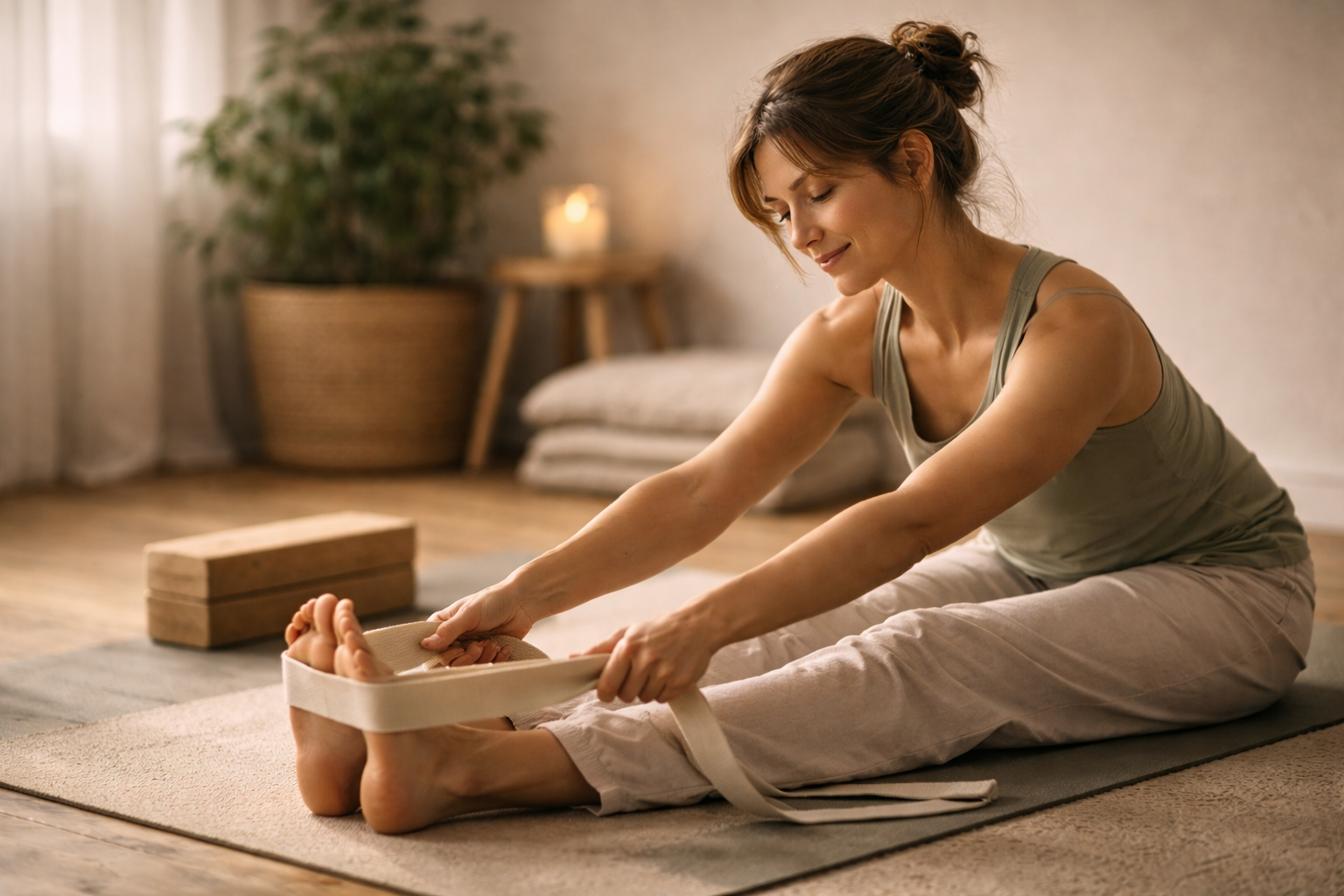 Premium Recovery Flexibility
The Stiffer Your Body Is, the Less You Should Force It in Yoga
In almost every yoga class, there comes a moment of quiet comparison. It usually arrives in a forward fold. Some bodies seem to pour downward without resistance. Others stop almost immediately, as though the back of the legs has drawn a hard line in the sand. For the person who cannot reach very far, the conclusion often comes quickly and painfully: I am stiff. I need to push more. If I want to become flexible, I have to endure this. It is such a familiar belief that it feels almost like common sense. And yet, it is often the very belief that keeps flexibility out of reach. The stiffer the body, the less helpful it may be to force the stretch. Because flexibility is not simply a matter of muscle length. It is also a matter of whether the nervous system believes that more range is safe. Modern culture treats stiffness almost like a personal failure. A flexible body is associated with youth, grace, athleticism, vitality. A stiff body is often interpreted as neglect, aging, or lack of discipline. So people with tight bodies tend to enter stretching with a subtle emotional burden. They are not just trying to move. They are trying to prove something. That they are improving. That they are trying hard enough. That they can endure discomfort in the name of progress. But the body does not always respond to effort in the way ambition would like. In fact, the body often responds to force with defense. This is the part many people never learn. When a muscle feels tight, the resistance is not always just the tissue itself. Very often, the nervous system is involved — monitoring position, tension, threat, and stability. It is constantly asking a quiet question: Can I let you go there safely? If the answer feels uncertain, the body tightens. Not because it is broken. Not because it is stubborn. But because protecting range is one of its oldest forms of intelligence. For people who sit for long hours, live under chronic stress, have a history of pain, or feel disconnected from movement, this protective response often arrives early. What they experience as stiffness is sometimes not a lack of potential. It is a surplus of caution. This changes everything. Because if stiffness is partly a protective strategy, then aggressive stretching can become a kind of argument with the body. You may win briefly. You may force another inch. You may produce the appearance of flexibility for a moment. But the cost is often visible. The breath stops. The jaw tightens. The face hardens. The next day, the body feels irritated, guarded, or even more resistant than before. And the nervous system learns something important: Stretching is dangerous. Yoga is something I survive. Depth equals threat. This is why some people practice for months or years and still feel trapped in the same range. They are training length, perhaps, but also training alarm. Flexibility does not thrive in alarm. It grows best in an environment of trust. What the stiff body needs is not domination. It needs evidence. Evidence that it can move without being overwhelmed. Evidence that it can soften without collapsing. Evidence that a new range does not have to feel like an emergency. This is why one of the most powerful questions in yoga is not: How deep can I go? It is: Can I still breathe here? Breath is a remarkably honest measurement. If the breath becomes strained, shallow, or held, the body is often telling the truth before the mind does: this may be too much. To stop before that point is not quitting. It is skill. To stay where the stretch is real but not alarming, where sensation exists but threat does not dominate, is how the nervous system begins to revise its map. Over time, that map changes. The range increases not because it was forced open, but because it was gradually permitted. That distinction is subtle. It is also profound. Yoga, at its best, is not about conquering the body. It is about negotiating with it. What helps the body trust? A slower entrance into the pose. A longer exhale. A block under the hand. A wall behind the back. A smaller range held with steadier breath. These supports are sometimes dismissed as modifications, as if they were lesser versions of the “real” pose. In truth, they are often what make real change possible. Support is not a shortcut. It is information. It tells the nervous system: you do not have to grip so hard. You do not have to brace against the unknown. You can stay. And once the body learns it can stay, it begins to release. This is why people with the least flexibility often need the greatest gentleness — not less seriousness, but more precision. The goal is not to prove tolerance for discomfort. The goal is to create conditions in which the body no longer needs to defend so aggressively against movement. There is also a deeper emotional layer to all this. People with stiff bodies are often especially hard on themselves. They compare. They apologize for their own range. They explain their limitations before anyone asks. But stiffness is not shameful. In many cases, it is the physical record of adaptation. A body shaped by desk work. By stress. By little sleep. By old injuries. By years of carrying responsibility without enough recovery. In that sense, stiffness may not be failure at all. It may be the body’s way of saying: this is how I learned to keep you together. If so, the task is not to attack that strategy. It is to offer the body a new one. Move a little. Breathe a little. Wait a little. Choose dialogue over force. The body often resists orders. But it responds, sometimes beautifully, to understanding. Flexibility is too often mistaken for a contest of depth. But perhaps real flexibility is not measured only by how far a body can go. Perhaps it is also measured by how safely a body can change. If you want to become more flexible, the way forward may not be to stretch harder. It may be to stretch with less threat. Less ambition. Less comparison. Less willingness to override the body’s signals in the name of progress. There is no failure in using props. No failure in bending the knees. No failure in remaining above the place where others seem to go. The real failure would be to teach the body that every attempt at change must feel like a fight. Sustainable flexibility comes from a different lesson: Here, you are safe enough to soften. And when that lesson is repeated often enough, something remarkable begins to happen. The breath deepens. The grip lessens. The range expands. Not dramatically, perhaps. Not all at once. But honestly. And in that honesty lies the greater gift of yoga. Because what yoga ultimately teaches is not only how to touch your toes. It teaches that transformation does not have to come through punishment. It can come through patience. Through trust. Through a nervous system that no longer mistakes change for danger. For the stiffest bodies, this may be the most liberating truth of all: A truly flexible body is not one that has been forced open. It is one that has learned, gradually, that it is safe to let go.
Reset Yoga Editorial Team →
 Premium Neck tension Eye fatigue Focus & clarity
Eye Strain Does Not Go Away by Resting the Eyes Alone
By late afternoon, the words begin to blur. You look away from the laptop and down at your phone, and there it is again — the dull heaviness behind the eyes. You close them for a moment. You blink. Perhaps you use eye drops. Perhaps you stare out the window. It helps, a little. But not enough. This is one of the quiet frustrations of modern life: eye strain rarely stays in the eyes. It spreads. Into the temples. Into the back of the neck. Into the breath, which grows shallower without permission. Into the mind, which begins to feel not only tired, but crowded. What many people call tired eyes is often not a local problem at all. It is a whole-system fatigue wearing the mask of vision. And that is why simply resting the eyes is often not enough. We are living through a period of human history in which vision is under near-constant demand. From the first glance at a phone in the morning to the last lighted screen at night, the eyes are rarely asked to soften. They are asked to focus, process, compare, interpret, scan, decide. Even leisure has become visual labor. Streaming, scrolling, reading, replying, watching, checking. The eyes may appear passive, but they are participating in a relentless economy of attention. And the eyes do not work alone. Whenever we stare, the neck organizes around that stare. The head subtly moves forward. Blinking often decreases. The jaw may tighten. Breathing shifts upward into the chest. Concentration, especially digital concentration, has a way of making the whole body quieter on the outside and more strained on the inside. This is why eye fatigue so often arrives with a sore neck and a foggy mind. The system has been bracing around the act of seeing. To understand this more clearly, it helps to stop thinking of vision as merely optical. Seeing is neurological. The eyes gather information, but the brain does the interpreting. Words, notifications, faces, icons, charts, messages, color, movement — all of it requires processing. So when the eyes feel exhausted, the brain is often exhausted too. That is why eye strain can feel strangely emotional. Not sad, exactly. Not anxious in a dramatic way. Just full. A person may close their eyes and still feel no relief because the visual world is still active inside them. The unfinished email remains. The flashing notification is remembered. The meeting is replayed. Tomorrow’s tasks continue to hover behind the forehead. The eyes are closed. But the mind is still staring. This is the deeper reason recovery often fails when it is aimed only at the eyeballs. Because what needs rest is not just the visual organ. It is the entire chain of effort surrounding it: the gaze, the neck, the breath, the cognition, the vigilance. This is where yoga becomes unexpectedly relevant. Yoga does not merely ask where the discomfort is. It asks what patterns are organizing the discomfort. If the eyes are tired, yoga does not respond only by saying, “close them.” It also asks: What is the neck doing? What has happened to the breath? How much effort is being held in the forehead, jaw, and shoulders? Has attention become trapped in a mode of endless outward seeking? Recovery begins when these relationships are addressed together. A useful first step is simple: stop asking the eyes to keep searching. Look far away. Or better yet, look at nothing. Close the eyes not as a gesture of escape, but as a way of reducing demand. Then bring attention to the back of the neck. Many people who are visually fatigued carry the head slightly forward. A small adjustment — softening the chin back, lengthening the back of the neck — can reduce a surprising amount of strain. Next comes the breath. Not a dramatic inhale. Not a performance of wellness. Just a longer, quieter exhale. When the exhale lengthens, the whole body begins to shift away from the effort of processing and toward the possibility of release. This matters because visual strain is often accompanied by subtle physiological urgency. The system remains in a state of low-level pursuit: read one more thing, answer one more message, resolve one more input. A slower exhale interrupts that pursuit. Certain yoga shapes are especially helpful because they reduce visual stimulation and redistribute effort away from the head. A gentle child’s pose. A soft forward fold. Legs up the wall. A supported reclining shape where the face can soften and the eyes are no longer tasked with orienting outward. These poses do not fix the eyes directly. They do something more intelligent. They remove the conditions under which the eyes must remain vigilant. That distinction matters. Modern people are often taught to solve fatigue by isolating the tired part. Dry eyes? Use drops. Stiff neck? Get a massage. Brain fog? Take a break. Sometimes those help. But often what is needed is not a fragmented solution. It is a systemic one. Because eye strain is not just an eye problem. It is a postural problem. A breathing problem. An attention problem. A nervous-system problem. And therefore recovery must also be systemic. There is something revealing about how many adults feel at the end of a screen-heavy day. It is not only that their eyes hurt. It is that they feel unable to take in any more of the world. That feeling deserves more respect than it usually receives. It may be the body’s way of saying: Enough input. Enough brightness. Enough vigilance. Enough interpretation. In that sense, eye strain can be understood not merely as overuse, but as a boundary signal. The body is asking not just for less seeing, but for a different way of being. Less pursuit. Less reaching outward. More return inward. This is why recovery is not ultimately about closing the eyes for a minute and then resuming the same intensity. It is about changing modes. From scanning to sensing. From processing to breathing. From outward fixation to inward contact. If your eyes have been tired for too long, do not blame the eyes alone. Rest them, yes. But also release the neck. Soften the jaw. Lengthen the exhale. Step away from the demand to keep focusing. Choose shapes that narrow the visual field and widen inner awareness. Because true relief begins not when the eyelids close, but when the whole system understands that it no longer needs to keep searching. And perhaps that is one of the quiet lessons of modern fatigue: Sometimes what hurts is not the organ. It is the way an entire life has been asked to remain alert. The eyes are simply where that truth becomes visible. And healing begins when we stop treating vision as an isolated task and remember that to see well, a human being must also know how to soften, breathe, and return.
Reset Yoga Editorial Team →
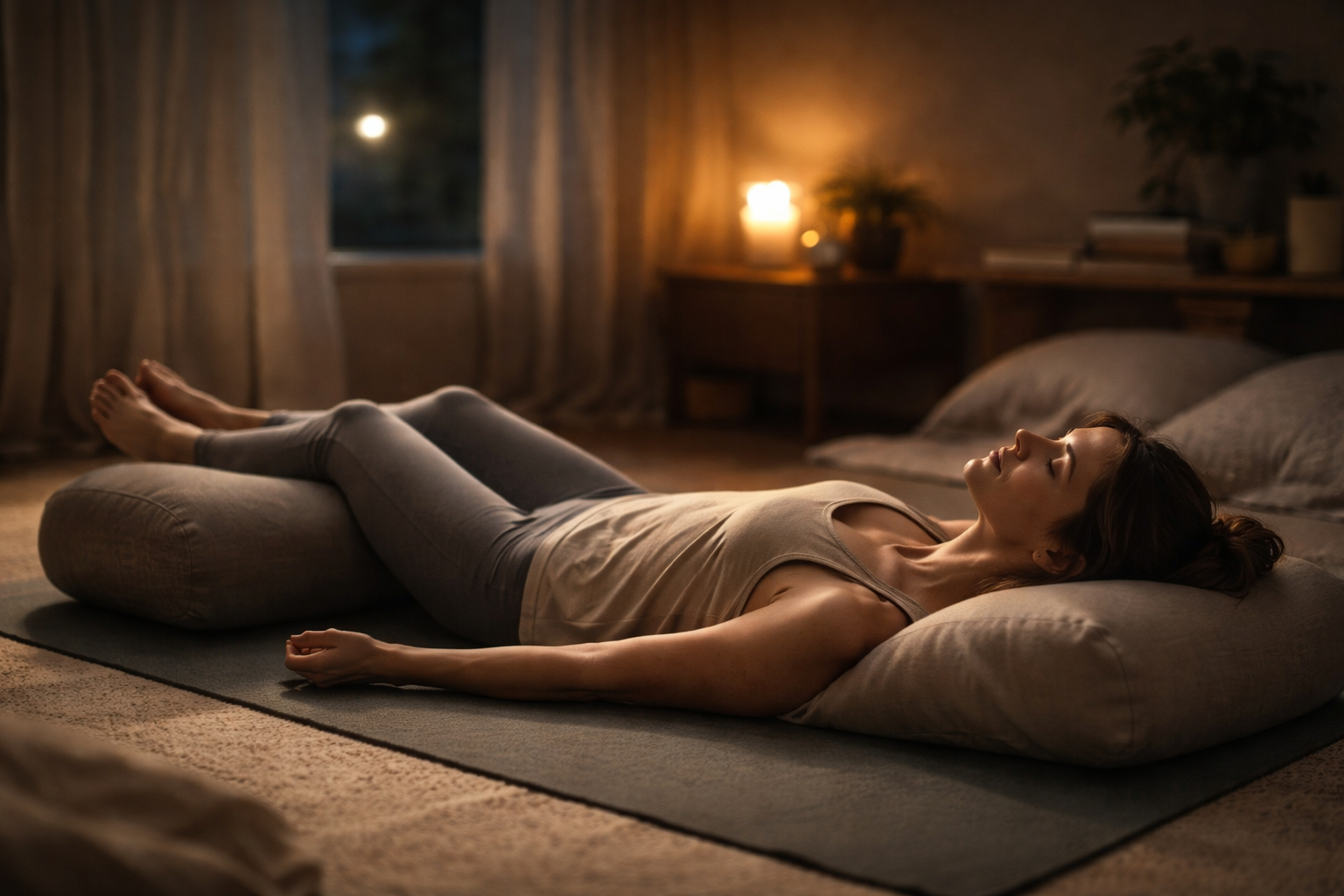 Premium Stress relief Restless nights
For Those Who Do Yoga Before Bed and Still Cannot Sleep
Night is supposed to be the softest part of the day. The lights dim. The noise thins out. The obligations, at least in theory, begin to loosen their grip. And yet for many people, this is precisely when sleep becomes elusive. They try to do everything right. A little yoga before bed. Some stretching. A few mindful breaths. A sincere effort to “wind down.” But once they get into bed, something feels strangely awake. The mind is clearer than it should be. The heart feels slightly elevated. The body is tired, but not surrendered. This is one of the subtle paradoxes of modern wellness: something can be healthy in general and still be unhelpful at a particular hour. Yoga is a good example. It is widely, and correctly, associated with relaxation. But not all yoga leads the body toward sleep. At night, the question is not whether you moved. The question is whether your practice guided the nervous system in the direction of rest. That direction matters more than people think. Sleep is not something the body does on command. The harder we try to force it, the more it recedes. The same principle applies to evening movement. During the day, the nervous system is oriented toward action. Attention is sharper. The body is prepared to respond, decide, produce, and protect. To fall asleep, that state must gradually shift. The system has to move from alertness toward safety, from effort toward release. The mistake many people make is assuming that any kind of yoga counts as winding down. But some forms of practice do the opposite. They stimulate. They sharpen. They heat the body. They raise heart rate. They quietly tell the nervous system: stay online. A strong flow at 10 p.m. may feel satisfying in the moment. A deep backbend may create a temporary emotional lift. A determined stretching session may produce the pleasing sense of having “done something good.” But satisfaction is not the same as sedation. And exertion is not the same as recovery. For many people who struggle with sleep, the issue is not lack of fatigue. It is that they are tired while still internally activated. That is why the body can ache for rest while the mind remains brightly lit. So what tends to work against sleep? First, anything that pushes the body toward higher arousal . Fast-paced vinyasa. Sweat-producing sequences. Long, effortful strength holds. Practices that noticeably raise body temperature or breathing rate. These are not bad practices. In the morning or midday, they can be excellent. But at night they may reinforce wakefulness. Second, strong backbends deserve caution. Backbends often create openness, energy, and emotional brightness. They can feel invigorating, even liberating. That is precisely why they are not always ideal before bed. A practice centered around deep chest opening may encourage the body to feel more alert rather than more settled. Third, there is the subtler problem of achievement-oriented stretching . Many people approach evening yoga as another task of self-improvement. Open the hips. Fix the back. Go deeper than yesterday. Once effort and measurement enter the room, the nervous system often follows. The body remains in performance mode, even while technically lying on a mat. In that sense, the issue is not that certain poses are universally wrong. It is that some ways of practicing continue the logic of the day: do more, fix more, get somewhere. Sleep does not respond well to that logic. What helps instead is sequence. The body rarely drops from daytime vigilance into deep rest in one sudden step. It needs a descent. A good evening practice begins not with intensity, but with transition. Start with small, loosening movements that help the body leave the shape of the day. Gentle neck release, without pulling. Slow shoulder rolls. A soft cat-cow through the spine. Subtle side bending. Nothing dramatic. The point is not to stretch deeply. It is to signal that the body no longer needs to hold its daytime posture. Then move toward quieter, floor-based shapes. Child’s pose. A seated forward fold without force. Supine knees-to-chest. Legs up the wall. A gentle twist close to the floor. These positions reduce sensory demand and bring attention inward. They ask for less output from the body and offer more support in return. Only then does breathwork become especially powerful. The most sleep-friendly breathing patterns are usually those with a slightly longer exhale than inhale. Inhale softly for four. Exhale for six. Or simply breathe through the nose and let the exhale become unhurried, unforced, complete. At night, the goal is not to take the biggest possible breath. It is to let the breath stop acting like a signal of urgency. Finally, there should be a period of stillness. Not the kind accompanied by a phone screen. Not a pause filled with scrolling. But an intentional stillness in which the body lies down and experiences gravity without demand. This is where something essential happens: rest stops being an idea and becomes a physical event. Seen this way, the sequence makes a kind of physiological sense. First, release the obvious tension. Then reduce stimulation. Then lengthen the exhale. Then surrender into support. Each step lowers the body one level closer to sleep. Modern people often treat sleep as a problem to be solved through strategy. Which supplement? Which app? Which stretch? Which exact routine? But sleep is not conquered. It is allowed. And what allows it is not optimization alone, but safety. The body sleeps when it no longer feels the need to keep watch. That is why evening yoga can be so powerful when it is done well. Not because it exhausts the body, but because it reorganizes the conditions of rest. It says: the day is over now. The effort may stop. You do not need to remain prepared. For many adults — especially those carrying work stress, family responsibility, or the lingering mental noise of contemporary life — this message is not a luxury. It is medicine. If yoga before bed has ever left you feeling more awake instead of less, it does not mean your body is failing or that yoga is not for you. It may simply mean that your evening practice has been asking the body for the wrong kind of participation. Try a gentler order. First unwind. Then settle. Then exhale. Then let go. Sleep is not something to chase. It returns quietly when the body finally believes the day is finished.
Reset Yoga Editorial Team →
 Premium Stress relief Restless nights Focus & clarity
If Stress Never Really Leaves You, You May Be Resting the Wrong Way
At the end of the day, everything is finally quiet. The children are asleep. The last email has been answered. The kitchen has been restored to a version of order. You sink into the sofa, pick up your phone, and tell yourself the sentence so many modern adults whisper at night: Now I can rest. And yet, half an hour later, something still feels unsettled. The body is technically still, but the mind is not. The chest remains slightly tight. Thoughts continue to flicker like lights in windows that never quite go dark. This is one of the quiet frustrations of modern life: many people are stopping, but very few are truly recovering. We often imagine rest as the absence of activity. No work. No chores. No obligations. No movement. But for a nervous system that has spent all day bracing, performing, deciding, and absorbing, the absence of action is not always the same as the presence of restoration. A body can be motionless and still not feel safe enough to let go. That is why so many people wake after a weekend, or rise from an evening on the couch, and still feel oddly unrefreshed. They rested in the ordinary sense. They paused. But they did not truly come down. The modern problem is not merely that people are tired. It is that many no longer know how to cross the inner distance between alertness and recovery. We live in an age that trains the nervous system to remain partially activated at all times. Notifications arrive before breakfast. Messages interrupt conversations. Work seeps into evenings. Parenting, commuting, planning, responding, remembering — all of it creates a low, constant hum of vigilance. Even leisure has become strangely stimulating. We scroll to relax. We stream to unwind. We consume in order to recover. But the nervous system does not always interpret this as rest. It often experiences it as more input. And so a curious thing happens: people spend hours “off,” yet remain internally on. This is where the popular idea of rest begins to fail. Because rest is not simply the opposite of work. Rest is a physiological shift. It is the body’s ability to move from guarding to softening, from scanning to settling, from effort to repair. In other words, real rest requires a change of state , not just a change of schedule. This is why yoga matters in a way that goes beyond flexibility, posture, or fitness. At its deepest level, yoga is not merely movement. It is a method of communication with the nervous system. It says, in effect: You are allowed to stop preparing for the next thing. You are allowed to release what you have been unconsciously holding. You are allowed to return. For many people, especially those in their thirties and forties, this message is not easy to receive. These are often the years of layered responsibility — career, children, family, finances, invisible emotional labor. A person can become so practiced at functioning that they lose contact with the internal sensation of ease. They may know how to endure. They may know how to perform. They may even know how to “take a break.” But they no longer know how to feel safe enough to exhale fully. That is why doing nothing is sometimes not enough. Because when the body has forgotten how to downshift, rest must become intentional. Not dramatic. Not complicated. But intentional. A restorative yoga habit begins with a simple recognition: The nervous system changes through cues, not commands. You cannot order yourself to calm down in the same way you answer an email or finish a task. But you can create conditions in which calm becomes more likely. Breath is one of those conditions. Under stress, most people breathe too high in the chest and too fast to register. The inhale becomes urgent. The exhale becomes incomplete. The body remains subtly prepared for action. But when the exhale lengthens, the entire internal climate begins to shift. Heart rate softens. Jaw and shoulders loosen. Attention widens. A longer exhale is one of the body’s oldest signals of safety. This is why even a few minutes of conscious breathing can feel more restorative than a distracted hour of passive downtime. The body is not asking for more entertainment. It is asking for permission to come out of defense. A useful evening yoga ritual does not need to be impressive. In fact, the more exhausted a person is, the more simplicity matters. Dim the lights. Sit on the floor or on a chair. Begin with breath: inhale gently for four counts, exhale for six. Repeat this slowly, without strain. Already, something begins to change. Then soften the body not by forcing it, but by unhooking it from the day. A small forward fold. A gentle twist. A supported child’s pose. A posture where the body can feel held rather than asked to perform. The purpose is not to stretch deeply. The purpose is to change the message the body has been receiving all day. Not: do more. Not: improve. Not: achieve. But: enough now. Finally, lie down for a minute or two without reaching for the phone. Let gravity do what effort no longer should. This kind of practice may look too small to matter. But that is one of the great misunderstandings of healing. What the nervous system trusts is not intensity. It is consistency. A five-minute ritual repeated gently each night can teach the body more about safety than a single perfect class taken once a month. Many ambitious people measure rest the same way they measure work. How long did I sleep? How much time did I take off? Did I optimize recovery? But perhaps the better question is quieter: Did my system actually shift? Did my breathing slow? Did my mind stop bracing for what comes next? Did my body receive the message that, for this moment, it does not need to defend, decide, or deliver? If the answer is no, then even hours of inactivity may not restore very much. If the answer is yes, then even ten careful minutes can feel like rescue. This is not laziness. It is literacy. It is learning to read the language of the nervous system in a culture that rarely teaches it. And that may be one of the most necessary forms of wisdom in modern adulthood. For too long, many people have treated rest as empty space — the blank margin around the serious business of life. But real recovery is not empty. It is active in a quieter way. It is the deliberate rebuilding of inner conditions. It is the shift from being managed by stress to being met by care. Yoga offers this not because it is ancient, though it is. Not because it is fashionable, though sometimes it is. But because it understands something modern life often forgets: A human being does not recover merely by stopping movement. A human being recovers by re-entering safety. If stress never seems to leave you, it may not be because you are weak, undisciplined, or doing life badly. It may simply be that your way of resting has never truly reached the place where stress is held. The good news is that the doorway is often smaller than people imagine. A longer exhale. A darkened room. A posture of surrender rather than performance. A few minutes without demand. Sometimes recovery does not begin with a vacation or a breakthrough. Sometimes it begins with the body hearing, perhaps for the first time all day: You do not have to stay ready anymore. And in that moment, rest stops being the absence of work. It becomes the return of self.
Reset Yoga Editorial Team →
 Premium Shoulder tension Neck tension Posture
For People With Neck Pain, “Drop Your Shoulders” May Be Making Things Worse
“Relax your shoulders.” “Pull them down.” It is the kind of instruction that has floated through yoga studios, fitness classes, and ordinary life for years. And sometimes, for some people, it helps. But for those who live with chronic neck tension — the kind that blooms by late afternoon, settles at the base of the skull, and turns the upper shoulders into a band of stone — this advice can quietly make things worse. You feel the ache rising after a long day at a computer. So you do what you have been taught. You drag the shoulders down. You try to make the neck look longer. For a moment, it seems disciplined, even correct. Then, strangely, the neck feels tighter. The discomfort deepens, not because your body is failing, but because it is telling the truth. For many people with neck pain, the answer is not to force the shoulders downward, but to rebuild the support system that allows the neck to stop working so hard. That support system involves two structures that are widely misunderstood: the trapezius and the rib cage . Modern life pulls the body forward. Toward screens. Toward deadlines. Toward children, steering wheels, laptops, and endless small responsibilities. The head drifts slightly forward. The chest narrows. The breath becomes shallow. And gradually, the neck begins doing more than its share. The human head is heavy. In a well-coordinated body, that weight is distributed across the spine, rib cage, shoulder girdle, and breath itself. But in many adults, especially busy professionals and parents, that coordination breaks down. This is where the trapezius often gets blamed. People speak of it as if it were merely a problem area — the bulky muscle of tension, the enemy to be flattened, massaged, or silenced. But the trapezius is not a mistake. It is a sophisticated network that helps organize the relationship between the head, shoulder blades, spine, and arms. It contributes to stability. It helps support movement. It participates in breathing. The issue is not that the trapezius exists. The issue is that it is often doing too much, too alone. So when people with neck pain are told simply to “drop the shoulders,” they may not be creating support at all. They may be collapsing the very structures that the trapezius is trying, however imperfectly, to hold together. This is the hidden problem with the cue. When many people try to lower the shoulders, they do not create spaciousness. They create compression. They pin the shoulder girdle down. They tense the sides of the neck. They flatten the upper chest. They reduce the mobility of the ribs. And they interfere with the natural movement of the shoulder blades. A healthy shoulder blade is not meant to remain fixed and depressed at all times. When the arm lifts, the shoulder blade should rotate and glide on the rib cage. That is not dysfunction. That is intelligent design. But if a person is constantly trying to prevent any upward motion in the shoulders, the body must compensate elsewhere. And very often, the neck pays the price. This is why neck pain is so often misunderstood. It is rarely just a matter of “tight muscles.” More often, it is the consequence of a system that has lost cooperation. The neck becomes painful not because it is weak, but because it is covering for structures that are no longer communicating well. At the center of that communication is the rib cage. The rib cage is more than a protective shell around the lungs. It is a dynamic, breathing architecture — a moving foundation for the shoulder blades, spine, and breath. When the rib cage moves well, the shoulder blades can rest and glide on it. The arms can move with less strain. The neck no longer has to stabilize everything by itself. But stress, fatigue, and long hours of sitting make the rib cage rigid. Breath becomes shallow. The chest collapses inward. The upper back stiffens. The back ribs stop expanding. When that happens, the shoulder blades lose their platform. And when the shoulder blades lose their platform, the trapezius tries to compensate. Then the neck tightens to keep the head organized over the body. What appears to be “neck pain” is often a problem of missing support. This is where yoga offers an unusually valuable lens. Yoga does not merely ask where it hurts. It asks what relationships have been lost. Between breath and ribs. Between ribs and shoulder blades. Between shoulder blades and neck. Between posture and effort. It reminds us that the body is not a collection of isolated parts, but a conversation. So what helps? Not more gripping. Not more instructions to “pull down.” A better starting point is this: instead of trying to lower the shoulders, try to lengthen the neck without suppressing the shoulders . That distinction matters. When people think of lowering the shoulders, they often push down. When they think of lengthening the neck, they often allow the crown of the head to rise, the collarbones to widen, and the base of the neck to soften. The result is not collapse, but space. The next piece is breathing into the back and sides of the ribs. Sit comfortably. Allow the shoulders to be where they are. As you inhale, feel the ribs expand not only in the front, but into the sides and back body. This restores motion to the chest and gives the shoulder blades something alive to move on. Another shift is to stop treating all shoulder elevation as wrong. Healthy shoulders move. Sometimes they rise. Sometimes they rotate. Sometimes they settle again. The real problem is not that the shoulders ever go up. It is that they become stuck in tension and cannot organize their movement well. So the goal is not suppression. It is flow. Upward when needed. Stable when needed. Released when possible. That is what support looks like in a living system. Many of the habits that produce pain begin as attempts to be correct. Sit up straight. Pull the shoulders back. Drop the shoulders down. Hold yourself properly. These instructions are not malicious. But they can become crude when applied to a body that needs nuance. The body is not restored by slogans. It is restored by relationships. For those with neck pain, the path forward is rarely about forcing better form. It is about rebuilding the environment in which the neck no longer has to overperform. Do not turn the trapezius into a villain. Do not ignore the rib cage. Do not forget the breath. The next time your neck begins to ache, pause before trying to press your shoulders down into obedience. Ask instead: Am I compressing the base of my neck? Are my ribs actually breathing? Do my shoulder blades have room to move? These questions change the meaning of pain. And sometimes, they change more than the body. Because true stability is not created by pressing things down. It is created by giving the body enough support to move freely without fear.
Reset Yoga Editorial Team →
 Premium Shoulder tension Posture Recovery
Why Your Tight Shoulders Keep Coming Back
By late afternoon, the shoulders begin to harden. It happens quietly. After hours at a laptop. After meetings that stack on top of one another. After carrying a child, a tote bag, or the invisible weight of a day spent holding everything together. Many people reach up instinctively and press their fingers into the tops of their shoulders. There it is again. The familiar ache. The heaviness. The feeling that the neck and shoulders have somehow turned to stone. So we do what most modern people do. We rub the area. We stretch the neck. We book a massage. We buy the heat patch. We try to “loosen” what feels tight. Sometimes it helps. For a few hours. Sometimes for a day or two. And then it comes back. This is the frustrating logic of chronic shoulder tension: it behaves like a problem that lives in the shoulders, even when the shoulders are only where the problem becomes visible. That is why so many people keep treating the symptom and missing the system. The real cause, in many cases, lies elsewhere — in the relationship between breathing, the rib cage, and posture . Modern life has a way of shrinking the body. We spend our days leaning slightly forward — toward screens, toward tasks, toward responsibilities, toward worry itself. And as life narrows, so does breath. Most people under stress do not breathe deeply into the body. They breathe high in the chest. Quickly. Lightly. Incomplete. This often happens without awareness. During emails. During meetings. While scrolling a phone. While rushing through dinner cleanup. While trying to answer one more message before bed. But breathing is not supposed to be a small activity that occurs only at the top of the lungs. Healthy breathing is expansive. The diaphragm descends. The rib cage widens and rotates subtly. The torso moves in all directions. When that natural movement becomes restricted, the body begins improvising. And this is where the shoulders enter the story. Muscles around the neck and upper shoulders — which were never meant to be the main workers of breathing — start helping lift the chest to pull in air. They do this once, then hundreds of times, then thousands of times a day. What we call shoulder tension is often, in part, overworked breathing muscles trying to compensate for a system that has lost its natural rhythm. In other words, your shoulders may not just be carrying your stress. They may be breathing for you. No wonder they are tired. Then posture intensifies the problem. A head that drifts forward even slightly becomes heavier for the neck and shoulders to support. A collapsed chest reduces the mobility of the ribs. Rounded upper back posture narrows the front body and limits the capacity of a full breath. And so a cycle begins. Poor posture restricts breathing. Restricted breathing recruits the shoulders. Overworked shoulders stiffen further. Stiff shoulders reinforce poor posture. Massage can soften the surface of this pattern. But if the pattern itself remains unchanged, the body simply recreates the tension. That is why so many people feel temporarily better and then mysteriously worse again. The body is not broken. It is repeating what it has been trained to do. This is the deeper insight: Shoulder tension is often less a local problem than a whole-body conversation. The shoulders are where the bill arrives. But the spending may have started elsewhere. At the rib cage. At the diaphragm. At the position of the head. At the nervous system, always slightly braced for what comes next. This is especially true for people in their thirties and forties — professionals, parents, caregivers, managers, those who spend their days both achieving and absorbing. Chronic tension is often the physical expression of a life lived a little too forward. Forward into deadlines. Forward into duty. Forward into tomorrow. The body follows where attention goes. And for many people, attention has not rested fully in the body for a very long time. So what helps? Not force. Not more aggressive rubbing. What helps is restoring the conditions under which the shoulders no longer need to do everyone else’s job. A useful place to begin is with the exhale . Sit comfortably. Let the chin soften slightly back. Inhale gently through the nose. Then exhale a little longer than you inhale. For example: inhale for four counts, exhale for six. Repeat that five to ten times. A longer exhale tells the nervous system that danger is receding. It reduces the urgency that often drives upper-chest breathing. And when the breath drops lower, the shoulders begin to loosen their grip. The second step is to reintroduce movement to the rib cage . Place your hands on the sides of your ribs. As you inhale, feel for expansion not only in the front of the chest, but sideways into the hands and even into the back body. At first, this movement may feel faint. That is common. For many people with chronic shoulder tension, the ribs have become quiet, almost forgotten territory. Waking them up changes the distribution of effort in the body. The third step is to reposition the head . Stand against a wall with the back of the pelvis, upper back, and back of the head lightly touching it. Do not force the lower back flat. Instead, imagine the back of the neck lengthening. Then breathe. Not dramatically. Just steadily. This simple position reminds the body of a more efficient relationship between head, spine, and breath. It is less about “perfect posture” than about reclaiming a posture in which the body can breathe without strain. There is something quietly moving about realizing that pain is not always where the story begins. A sore shoulder can be a messenger. A tightened neck can be a clue. An aching upper back can be the body’s way of saying: You are bracing too much. You are breathing too little. You are carrying more than your structure was meant to carry alone. Seen this way, shoulder tension becomes more than a nuisance. It becomes information. It asks a different question from the one most people ask. Not: “How do I make this tightness disappear?” But rather: “What is my body trying to compensate for?” That question changes everything. Because once we stop blaming the shoulders, we can begin supporting the system. The goal is not merely to rub away discomfort. It is to create a body in which the shoulders are no longer drafted into constant emergency service. The next time tightness rises at the base of your neck or across the tops of your shoulders, pause before reaching for the quick fix. Ask instead: Am I really breathing? Are my ribs moving? Has my head drifted forward into the day? Sometimes the path out of pain begins not with force, but with attention. And sometimes shoulder tension is not a sign that the body is weak. It is a sign that it has been strong for too long.
Reset Yoga Editorial Team →
 Premium Stress relief Restless nights Focus & clarity
The Simplest Wellness Practice in the World
Morning commute. The train is quiet except for the soft rhythm of movement. Passengers stare into their phones. Later, before a meeting, shoulders tighten over keyboards as emails are sent in haste. At night, after children finally fall asleep, the mind begins planning tomorrow. Modern life moves quickly. Yet in the middle of this constant motion, something subtle often disappears. Our breath. Most people rarely notice it. But stress changes it instantly. Breathing becomes shallow. Faster. Tighter. In yoga philosophy, breath is not merely air entering the lungs. It is life energy. The ancient yogic science of breathing is called Pranayama . The word combines two Sanskrit ideas: Prana — life force Ayama — expansion or control In simple terms, pranayama is the art of working with breath to influence body and mind. And its central insight is remarkably powerful. Change the breath, and you change the state of your entire system. The Breath We Forget The average person takes more than twenty thousand breaths every day. Yet we rarely notice a single one. Breath changes automatically with emotion. Anxiety speeds it up. Stress makes it shallow. In that sense, breath acts like a mirror of the mind. But pranayama introduces a reversal of this relationship. Instead of the mind controlling breath, breath can guide the mind. Slow the breath, and the nervous system begins to calm. Lengthen the exhale, and the body relaxes. Modern neuroscience increasingly confirms what yogis discovered centuries ago. Breath is one of the most direct pathways to regulating the nervous system. Three Simple Practices for Beginners Pranayama may sound ancient and mysterious, but its entry point is surprisingly accessible. Here are three gentle practices. 1. Deep Diaphragmatic Breathing Inhale slowly through the nose, allowing the belly to expand. Exhale gently. This simple breathing pattern activates the body’s relaxation response and releases tension. Even one minute can make a difference. 2. Alternate Nostril Breathing (Nadi Shodhana) Using the fingers, close one nostril and inhale through the other. Then switch sides. This technique is believed to balance the two hemispheres of the brain and create mental clarity. Many practitioners use it before focused work or meditation. 3. 4-4-6 Breathing Inhale for four seconds. Hold the breath for four seconds. Exhale slowly for six seconds. The longer exhale signals safety to the nervous system and encourages deep relaxation. It can be particularly helpful before sleep. Why Busy People Need Breath the Most Modern wellness culture often focuses on complexity. New technologies. New supplements. New training routines. Breathing asks for something simpler. Attention. No equipment is required. No membership is needed. Just awareness. Especially for people in their thirties and forties — often the busiest years of life — a few minutes of conscious breathing can change the tone of an entire day. Breath as a Doorway to the Present Our minds often live in two places. The past. Or the future. Regret. Worry. Breath, however, exists only in the present moment. This is why focusing on breath can feel grounding. It quietly pulls attention back to the now. In that sense, pranayama becomes a form of moving meditation. In the End Yoga contains many postures. Some elegant, some physically demanding. But at its center lies something far simpler. Breath. If today feels overwhelming, there is no need for an elaborate practice. Sit down. Close your eyes. Take a slow inhale. And an even slower exhale. The body will begin to remember something it has always known. Its natural rhythm. And in that quiet rhythm, you may discover that calm was never far away. It was there all along, waiting in the next breath.
Reset Yoga Editorial Team →
 Premium Stress relief Shoulder tension Recovery
The Quiet Secret to Better Yoga
Early morning. The world is still quiet. Before the children wake up, before the inbox fills with messages. You roll out your yoga mat. A deep breath. Arms reach toward the ceiling. For many people in their 30s and 40s, yoga has become a small ritual of recovery — a way to reconnect with the body after long hours of work, parenting, and digital noise. And yet, there are days when something feels different. On some mornings, the body feels light and responsive. On others, every movement feels heavy, slow, resistant. The poses are the same. So what changed? Often, the answer is surprisingly simple. What — and when — you ate. Most of us pay attention to what we eat. But very few of us consider how food interacts with movement. Yoga traditions have long understood that the relationship between food and practice is essential. Because yoga is not simply exercise. It is an activity that works with the body’s internal energy and breath. And digestion is part of that energy. Eating Before Yoga Lightness Creates Freedom Imagine trying to fold forward with a full stomach. The abdomen feels compressed. Breathing becomes shallow. The body instinctively resists movement. For this reason, many yoga teachers recommend finishing a meal two to three hours before practice. If hunger is unavoidable, a very light snack can help. Examples include: a banana yogurt a handful of nuts a smoothie These foods digest relatively quickly and provide gentle energy without burdening the body. The guiding principle is simple: Before yoga, keep the body light. When the body feels light, breathing deepens. And when breathing deepens, the mind begins to settle. Eating After Yoga The Body Becomes Receptive After yoga practice, something subtle happens. Circulation improves. The nervous system relaxes. Digestion becomes more active. In other words, the body is ready to receive nourishment. This makes the post-yoga meal especially meaningful. The most supportive foods are simple and natural. For example: vegetable-based meals warm soups whole grains such as brown rice fresh fruits In Ayurveda, these foods are known as sattvic foods — foods that promote clarity and balance. They nourish not only the body, but also the mind. Heavy meals, excessive oils, or too much sugar can disrupt the calm state that yoga has created. Food Is Not Just Fuel Modern life often treats food as a quick transaction. We eat between meetings. We scroll through phones while chewing. Yoga quietly challenges that habit. It reminds us that eating is not only about calories. It is a conversation with the body. Does this food create lightness? Or heaviness? Energy, or fatigue? Simply asking that question begins to transform the relationship we have with food. Why Busy People Need This the Most People in their thirties and forties often carry the greatest load. Career pressure. Children. Responsibility. Time becomes scarce. That is why yoga matters so much. But the benefits of yoga multiply when the surrounding habits support it. A small change in meal timing can dramatically affect flexibility breath depth mental focus It is one of the simplest improvements anyone can make. In the End Yoga is not about mastering poses. It is about rebuilding a relationship with the body. And that relationship continues beyond the yoga mat. It continues at the table. The next time you practice yoga, pay attention to when you last ate. Notice how your body responds. You may discover something subtle but powerful. The body is always communicating. And sometimes, the smallest habits quietly reshape the quality of an entire day.
Reset Yoga Editorial Team →
 Stress relief Neck tension Shoulder tension
The Yoga That Actually Works
Early morning. Before the children wake up, before the first meeting begins, before the phone fills with notifications. For a brief moment, the house is quiet. You roll your shoulders. They are tight again. The tension didn’t appear overnight. It built slowly — through emails, deadlines, school runs, and the invisible mental load of modern life. For many people in their 30s and 40s, yoga becomes a refuge. A place to breathe. A place to stretch. A place to recover. And yet, many people quietly feel something puzzling. “I’m doing yoga… but it doesn’t always feel right.” The answer may be simpler than we think. Not all yoga is meant for every body. And this is where an ancient wisdom begins to make sense. More than 5,000 years ago, the traditional Indian science of Ayurveda described human constitution through three energetic patterns: Vata Pitta Kapha These are known as doshas . Each person carries a unique combination of them, and understanding your dominant dosha can help you choose the yoga style that supports your body instead of fighting against it. Because yoga, at its core, is not about flexibility. It is about balance . Vata The restless energy of modern life Vata represents the energy of air and movement. People with strong Vata energy tend to be creative, fast-thinking, and constantly multitasking. Many busy professionals and parents fall into this category. But this movement often comes with tight shoulders shallow breathing anxiety restless sleep For Vata types, the most effective yoga is slow, grounding, and calming . Recommended practices include: gentle Hatha yoga restorative yoga long, slow stretching Breathing practices such as deep diaphragmatic breathing or alternate nostril breathing (Nadi Shodhana) can help calm the nervous system. The goal is simple: to bring the wind back to the ground. Pitta The driven achiever Pitta represents the energy of fire. These are the leaders, decision-makers, and high performers. They are focused, productive, and often highly successful. But the same fire can create tension in the neck and shoulders irritability burnout difficulty relaxing For Pitta types, the most beneficial yoga is not intense. It is cooling and softening . Practices such as Yin yoga restorative yoga slow flow yoga allow the nervous system to reset. Cooling breathing techniques such as Sitali breathing can also help balance excess heat in the body. For Pitta personalities, yoga is not about pushing harder. It is about learning to let go. Kapha The steady foundation Kapha represents earth and water. People with strong Kapha energy tend to be calm, patient, and deeply supportive of others. They often become the emotional anchors of families and teams. However, they may also experience heaviness in the body stiffness in the back and shoulders low motivation to move For Kapha types, yoga should be energizing and stimulating . More dynamic styles such as Vinyasa yoga Power yoga Sun salutations can awaken the body’s energy. Breathing techniques like Kapalabhati breathing can help activate vitality and circulation. For Kapha types, movement is medicine. The deeper purpose of yoga But perhaps the most important insight is this: Yoga is not about mastering poses. It is about understanding your own body. Most of us move through life without listening to the signals our bodies send. We push through fatigue. We ignore tension. We forget to breathe. Yoga creates a rare moment where something shifts. A realization appears. “I have been holding tension for hours… maybe years.” That moment of awareness is where real healing begins. Why busy people need yoga the most Especially in the modern world. People in their 30s and 40s carry an extraordinary amount of responsibility. Career. Children. Relationships. Endless digital noise. That is why even ten minutes of mindful movement can change the entire rhythm of a day. A slow stretch. A quiet breath. A gentle twist. These small practices become powerful anchors. In the end Ayurveda offers a simple idea. Health is not about perfection. It is about living in harmony with your natural rhythm. You do not need the perfect yoga practice. You only need a moment of awareness. And when that awareness appears, yoga becomes something deeper than exercise. It becomes a way of coming back to yourself. And sometimes, in that quiet moment, a surprising thought appears. Maybe life does not have to be pushed so hard. Maybe it can also be lived gently.
Reset Yoga Editorial Team →
This content is for educational purposes only and is not medical advice. If you have pain, injury, pregnancy-related concerns, or a medical condition, consult a qualified healthcare professional before practicing.